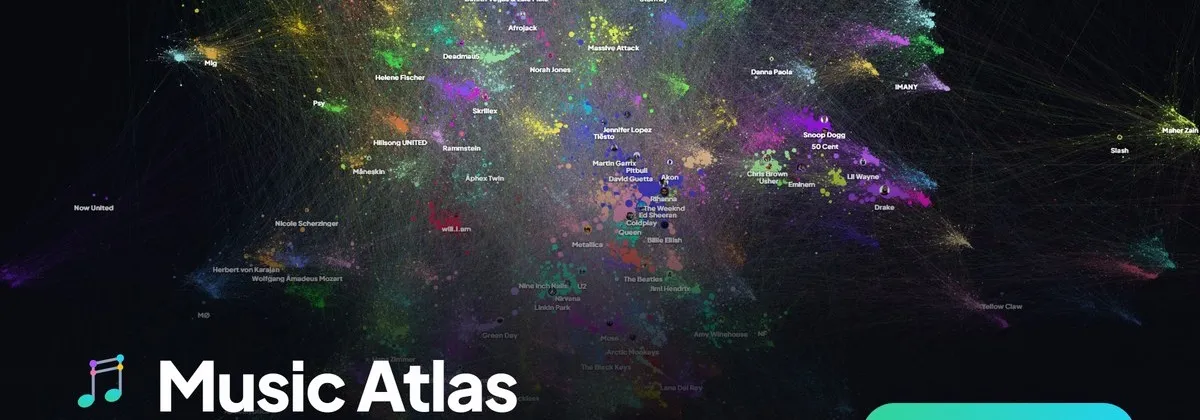
The Music Atlas map, cropped from the site’s own preview image. Image: Leon.
Two artists sit near each other when strangers keep putting them on the same playlist. The map is what that looks like for 74,407 artists.
Music Atlas is a one-person project by Leon, a software engineer and motion designer, who published the code in September 2026. The map’s dots are artists, sized by popularity. Lines join artists who turn up together in many playlists, and colors mark groups of related genres. The About panel says it was inspired by the Twitch Atlas.
The data is the interesting part, and the maker documents it in the open. Genre names come from EveryNoise at Once, which lists 6,291 of them. For each genre, a crawler searches YouTube Music for public playlists that people made, skipping the platform’s own mixes, playlists that are mostly one artist, near-copies of other playlists, and more than two from any one curator. An artist makes the map only by appearing in at least four of these. Artist photos, fan counts and previews come from Deezer. The published graph holds 74,407 artists and 308,738 links in 256 groups.
The map is computed, not drawn. Per the README, playlist overlap is turned into a cosine similarity between artists, each artist keeps between 6 and 20 links, a modularity method (Louvain) finds the groups, and a ForceAtlas2 layout pulls linked artists together. That description comes from the README; the graph counts were checked against the shipped data.
What you can do with it: pan and zoom the galaxy, press / or Ctrl+K to search artists and genres, and click an artist to light up their neighbors. A side panel lists the playlists they share with those neighbors and plays a 30-second Deezer preview. Genre panels show a genre’s artists and related genres, with a Wikidata description where one matches by name. A trace-path tool finds the shortest chain of shared playlists between two artists and gives you a link to it. There is also a plain A to Z artist index at /artists/.
Limits, stated plainly. The playlists come from YouTube Music, not Spotify, so the map shows what that audience curates. The graph is a snapshot, generated on October 15. Previews need sound and Deezer’s availability for that artist. The first load downloads a graph file of about 10 MB. Code is MIT-licensed and the derived graph data is CC BY 4.0, but Deezer’s images and audio stay under Deezer’s terms.