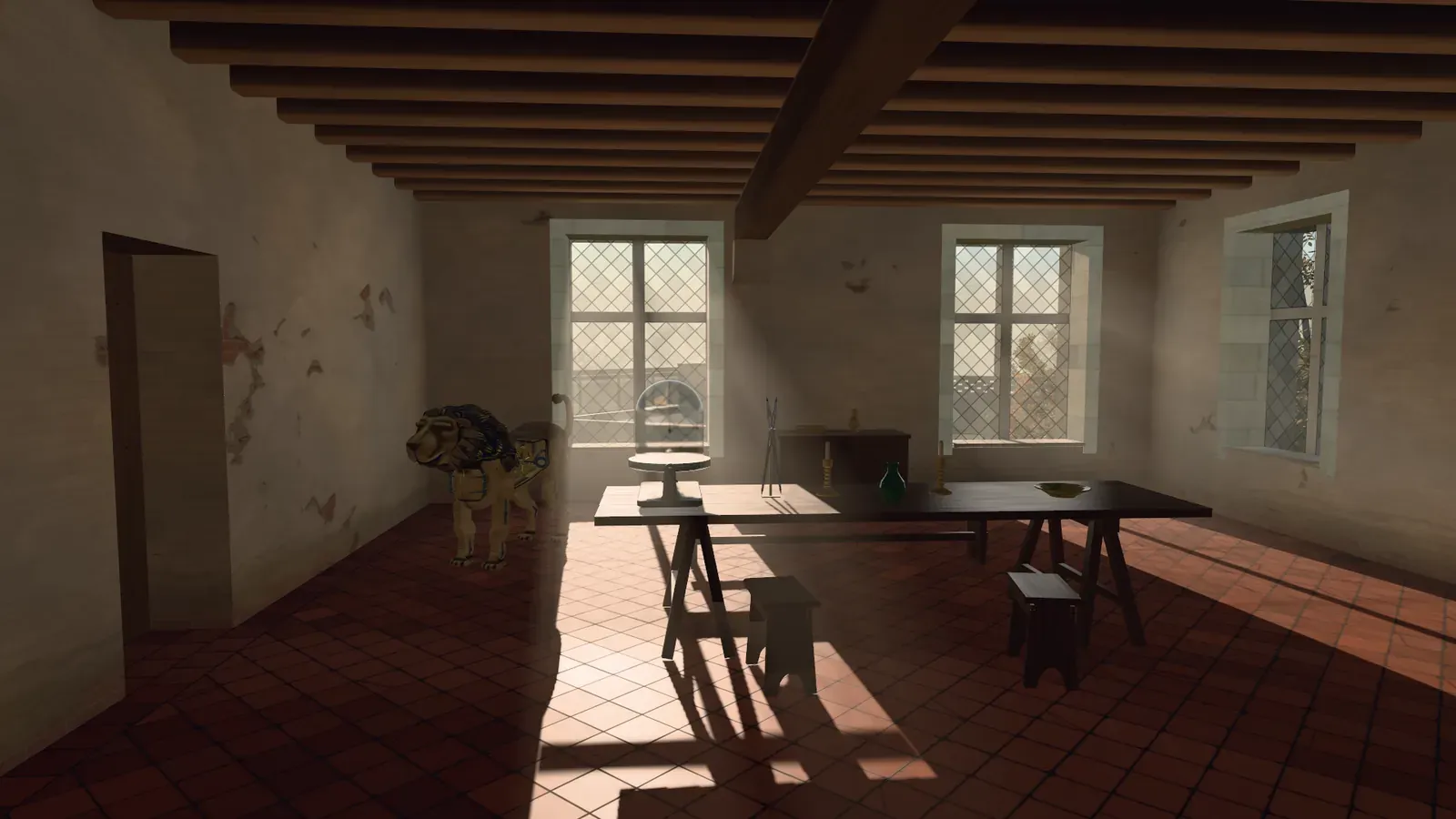
The great hall of Clos Lucé, a still from the museum. Rendered by Museum of Ages, CC BY-SA 4.0.
A free, guided 3D museum that labels every stop as documented, reconstructed, conjectural or not known, so you can see where Leonardo ends and the guesswork begins.
Museum of Ages is a nonprofit’s first wing: seventeen stops built around Clos Lucé, the manor in Amboise where Leonardo lived his last years and died on 2 May 1519. The museum fixes the walk on a single day, 10 October 1517, when Cardinal Luigi d’Aragon visited and his secretary, Antonio de Beatis, recorded the paintings Leonardo showed them. The light is computed for that date and place, and the last stop is a court under that evening’s stars, placed one by one from a star catalogue.
Most of the walk is not the house. Before it come rooms the museum designed for the work: a picture room with 24 works hung close to real size, the Mona Lisa among them, a court carrying the Last Supper at its true 8.8 by 4.6 metres, a wall of 29 anatomy sheets, and a reading table of 207 notebook pages. The house itself is one room, the great hall, rebuilt from plans and photographs.
The honest part is the grading. A mark before each stop says how sure the museum is, and a record names the sources. The aerial screw is “reconstructed from Ms B f. 83v”. The mechanical lion by the wall is built from old accounts because no sheet of it is known, and the hall’s furniture is flagged as period-typical, not his. Fifteen machines are rebuilt, nine of them in the mechanism hall, and 14 of the 15 can be set in motion.
You do not steer. The walk is a pre-rendered film, on purpose, so that it runs on an older phone and nobody gets lost. On Hacker News one commenter wanted to roam and another found the controls confusing. The founder promised a way to pause the walk. There is a faster-forward arrow, and a Plan in the Instruments panel jumps straight to the machines, though the founder admits it is a bit hidden. One commenter called the German “quite broken”. The museum says English and German are read and approved by a person, while the other five languages are AI translations and are labelled as such.
The texts and the museum’s own stills are CC BY-SA 4.0 (images showing Leonardo’s works excepted), and the code is AGPL-3.0, on GitHub. It needs WebGPU or WebGL2, has no spoken words yet, and has not been tested with a screen reader.