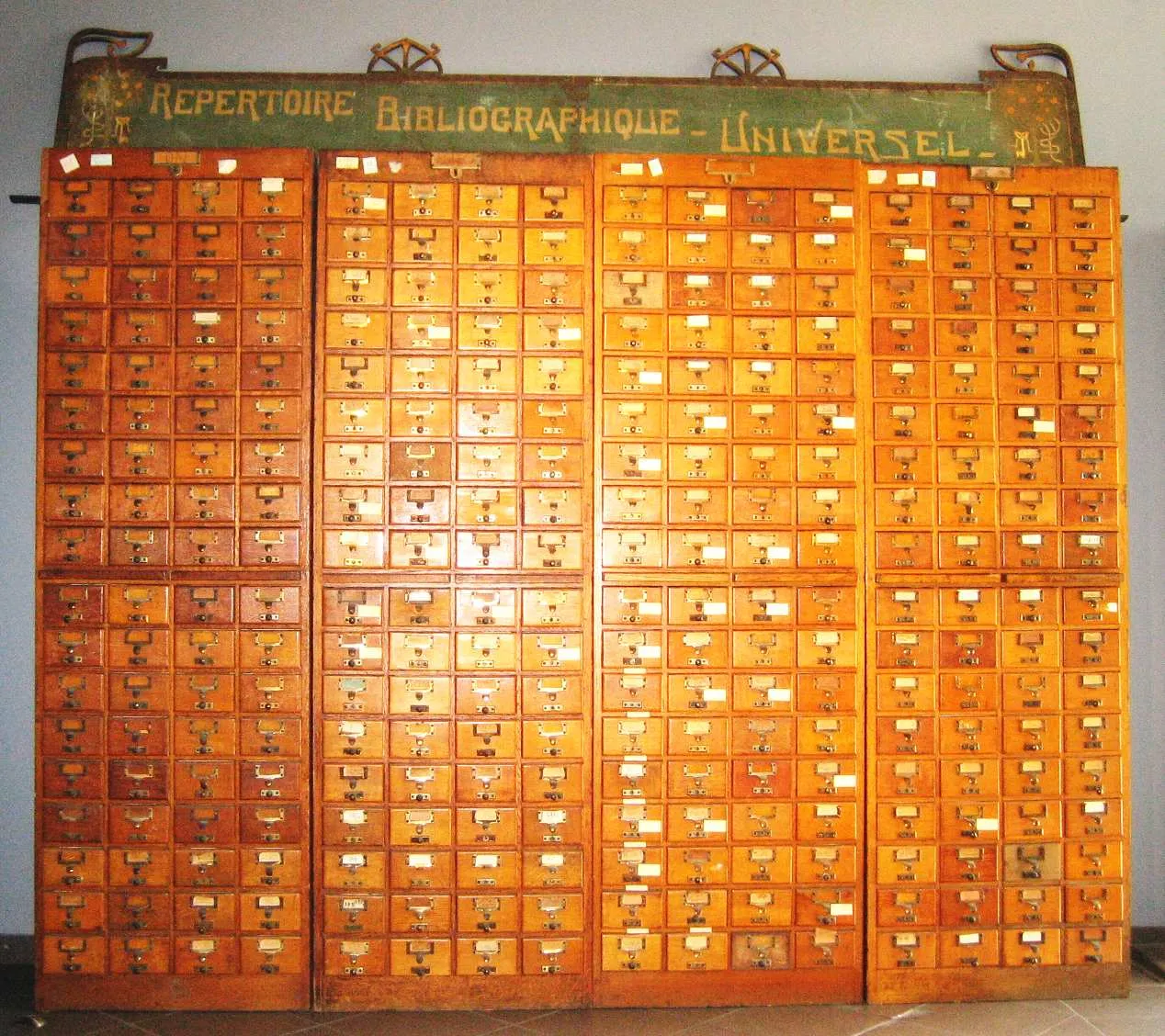
Two Belgian lawyers decided to hold all human knowledge on 3×5 cards, and then to answer any question anyone mailed them out of it. The remarkable part is that it worked.
Paul Otlet and Henri La Fontaine founded the Institut International de Bibliographie in Brussels in 1895. The plan was to record every fact in every book on a standard index card, classify all of it under one scheme, and keep going. By the end of that first year the Répertoire Bibliographique Universel held 400,000 cards. At its peak in 1934 the count is usually given as 15,646,346 — precise enough to have been somebody’s job.
The card count is not the interesting number. This one is: you could write to it. Post a question with a fee, and staff walked the drawers, found the relevant cards, and mailed you facsimiles of them. By 1912 the service was fielding roughly 1,500 queries a year from around the world, by post and telegraph. By 1934 it was handling about 27,000. That is a search engine with a two-week latency and a human in the loop, running four decades before the first computer, and the query volume is the proof it was used rather than merely built.
It did not survive its own government. Funding was withdrawn in 1934 and the doors closed. When Germany occupied Belgium in 1940 the collection was cleared to make room for an exhibition of Third Reich art, and part of it was lost outright. La Fontaine, who had taken the Nobel Peace Prize in 1913, did not see it reopen; Otlet died in 1944 having spent his last years drawing a “réseau” of linked documents on screens, which reads now like a man describing the web from memory.
What is left opened in Mons in 1998, in a converted 1930s department store on Rue de Nimy, with the exhibition designed by the comics artists François Schuiten and Benoît Peeters. It holds over six kilometres of documents and an online catalogue of 88,037 archives, strongest on pacifism, feminism and anarchism — the causes the two founders were actually working for, which the internet-precursor story tends to crop out. The permanent show is called Machine to Think the World.
Be clear about what you are going to see: not fifteen million cards, but the furniture and the fragments, in a room built to argue for them. That turns out to be enough, because the argument is in the object. A wall of oak drawers under a hand-lettered board reading Répertoire Bibliographique Universel is the ambition at full scale, and nothing on a screen has ever looked that certain.