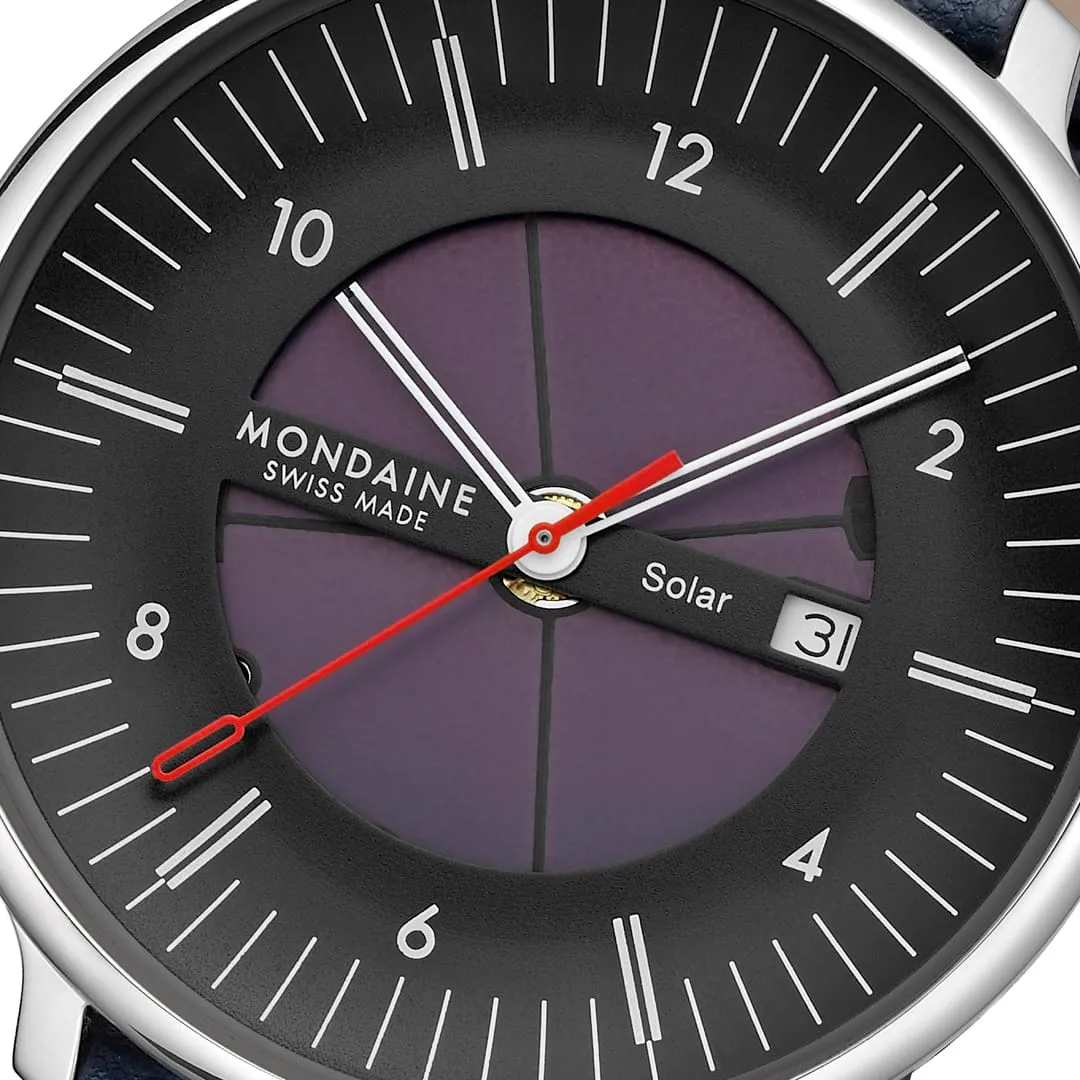
Almost every solar watch hides its cells under the dial and never mentions them again. Mondaine cut a circle out of the middle and made them the view.
The trick of a solar watch is that it is designed to be invisible. Light passes through a dial engineered to look opaque, reaches the cells underneath, and the whole point is that you can’t tell. The Doppio Solar Skeleton inverts that: a precisely cut circular opening at the centre of the dial exposes the cells, and they are a deep violet, seamed into quadrants like a stained-glass rose window that happens to be doing electrical work. A double-domed sapphire crystal sits over a concave dial, so the opening reads as a well rather than a hole.
The legibility survives, which is the part that could easily have gone wrong. Indexes and numerals stay out on the dial’s outer ring where they always were, so nothing you actually need to read has been moved to make room for the view, and the red seconds hand — the Swiss railway signature Mondaine has held a licence to since 1986 — sweeps across the violet without getting lost in it.
Inside is a Ronda 215 quartz solar movement with an MT920 cell. Fully charged, Mondaine rates it at up to eight months running in complete darkness, and there is no scheduled battery change. The case is 41mm polished steel, 5 ATM, 43 grams, with a discreet date window at three. Two references: the polished steel on a vegan grape leather strap at $465, and a polished gun-metal IP case on a matching mesh bracelet at $495. Both went on sale on 17 August 2026.
One claim is worth reading carefully, because Mondaine repeats it everywhere. Their own site says that in 1973 the company “introduced the world’s very first solar-powered watch.” The generally credited first is the Synchronar 2100, an American digital LED watch by the engineer Roger Riehl, which reached buyers in 1972 with its solar cells sitting openly on top of the case — and Citizen’s Crystron Solar Cell of 1976 is usually named as the first commercial analogue solar watch. Mondaine’s 1973 date sits between them, so the superlative is best read as the brand’s own rather than a settled fact. It doesn’t dent the watch; a fifty-three-year-old house speciality is a good enough story without the word first in it.