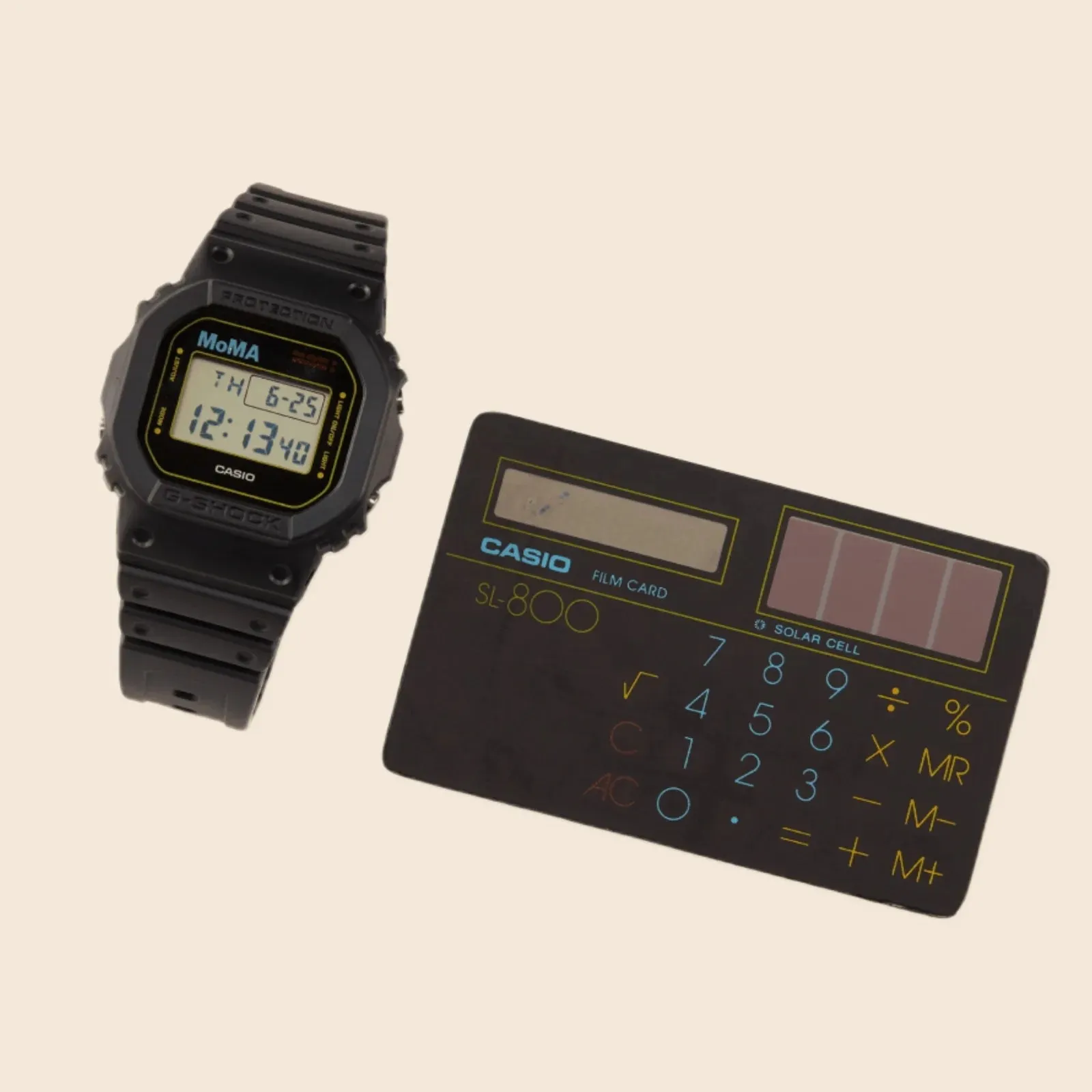
The square G-Shock, repainted in the palette of a calculator as thin as a credit card: cyan, chartreuse and red on black, down to the strap loop.
The calculator is Casio’s SL-800 Film Card, released at the end of 1983 and still the thinnest calculator Casio has made: 0.8 mm and 12 grams, with a solar cell and a keypad pressed flat into the card. MoMA holds one in its collection, and the photograph above shows exactly what the designers borrowed. On the card, the numbers are printed in cyan, the functions and outlines in chartreuse, and C and AC in red. On the watch, the MoMA wordmark is in cyan, a chartreuse line frames the LCD, and the small labels at top right are red.
The details go past the dial. The keeper loop on the strap reproduces the back of the calculator in red and yellow. Press the light button and a red MoMA logo glows across the display. The caseback is engraved, and the watch comes in a box and tin that MoMA says honour the calculator’s original 1984 packaging.
Underneath, it is the ordinary 5600: resin case and strap, shock resistant, water resistant to 200 metres, made in Japan. MoMA lists the case at 48.9 × 42.8 mm and 13.4 mm thick, with a 195 mm strap. The edition is 1,000 pieces worldwide, sold only through the MoMA Design Store for $135, or about $122 with the member discount. It went on sale on 1 September and was still in stock three weeks later.
One small correction to our find, which gave the calculator’s date as 1984. That’s the year MoMA’s store copy uses, and apparently the year of the packaging. Casio released the SL-800 in November 1983, and MoMA’s own collection record dates the design to 1982. And although the calculator is solar, the listing says nothing about solar charging, so the watch takes the colours and leaves the solar cell behind.
That’s the honest summary: $135 buys a standard G-Shock in new colours and a better box. What makes it worth it is how exact the tribute is. Put the two side by side and the watch looks like a museum label for the calculator.