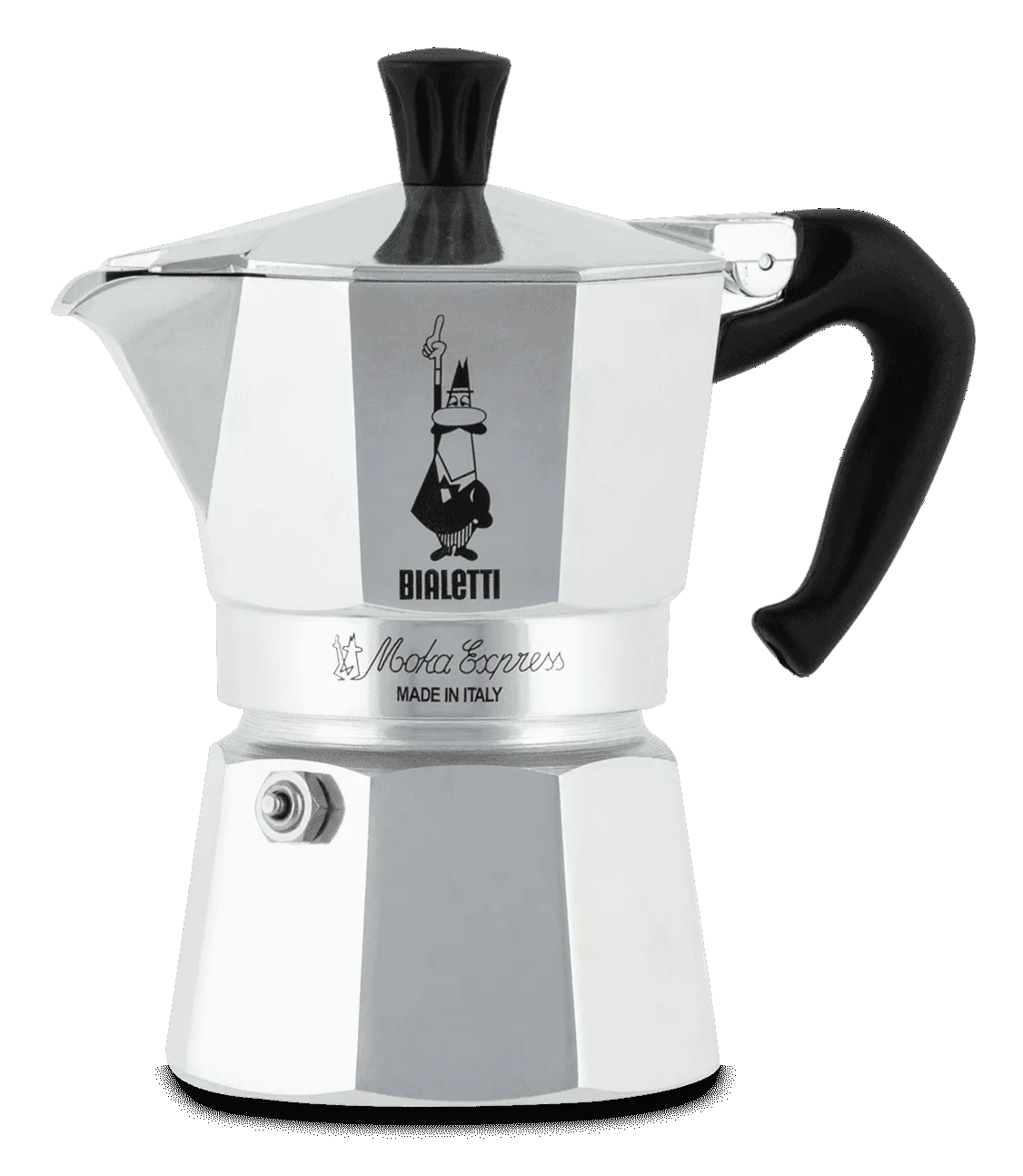
Eight flat sides, a black handle, and a little man with a moustache pointing at the sky. The design has barely changed since 1933, and it still makes coffee with a hob and a bit of attention.
The Moka Express is two chambers and a funnel. Water in the base heats, the pressure pushes it up through the grounds, and the coffee collects in the upper chamber; you listen for the gurgle that says it is done. The pressure is roughly 1 to 2 bar, against the 9 bar of an espresso machine, so what you get is strong, but it sits between espresso and pour-over rather than being either. Aluminium is the classic material, and Bialetti’s care advice is short: rinse with warm water, no soap, no dishwasher.
Who designed it is less settled than the packaging suggests. Bialetti’s own history credits Alfonso Bialetti with it in 1933, the idea coming as he watched his wife wash clothes in a lessiveuse, a French forerunner of the washing machine. Open Culture, via a design textbook, says it was invented around 1933 by Luigi de Ponti, who worked for Bialetti. Wikipedia’s article on Alfonso Bialetti gives yet another account, naming a different designer. We could not settle it, so credit “Bialetti” and leave the name on the patent open.
How it became ubiquitous is clearer. Alfonso’s son Renato took over after the war and put the pot on television, in the Carosello adverts from 1958. They gave it l’omino coi baffi, the “little man with the moustache”, drawn by the cartoonist Paul Campani; Bialetti says the figure was inspired by Renato himself. When Renato died in 2016, his ashes were placed in a large moka pot, a detail reported by AGI and ANSA; AGI says the pot, decorated with the mascot, was buried in the family grave at Omegna.
James Hoffmann’s tips, as Open Culture relays them: start with hot water in the base, do not pack the grounds as you would for espresso, avoid too fine a grind, and cool the base as soon as brewing finishes. On Bialetti’s US site the 3-cup pot is $44.99. It suits gas and electric hobs; on induction, Bialetti says you need its adapter plate.