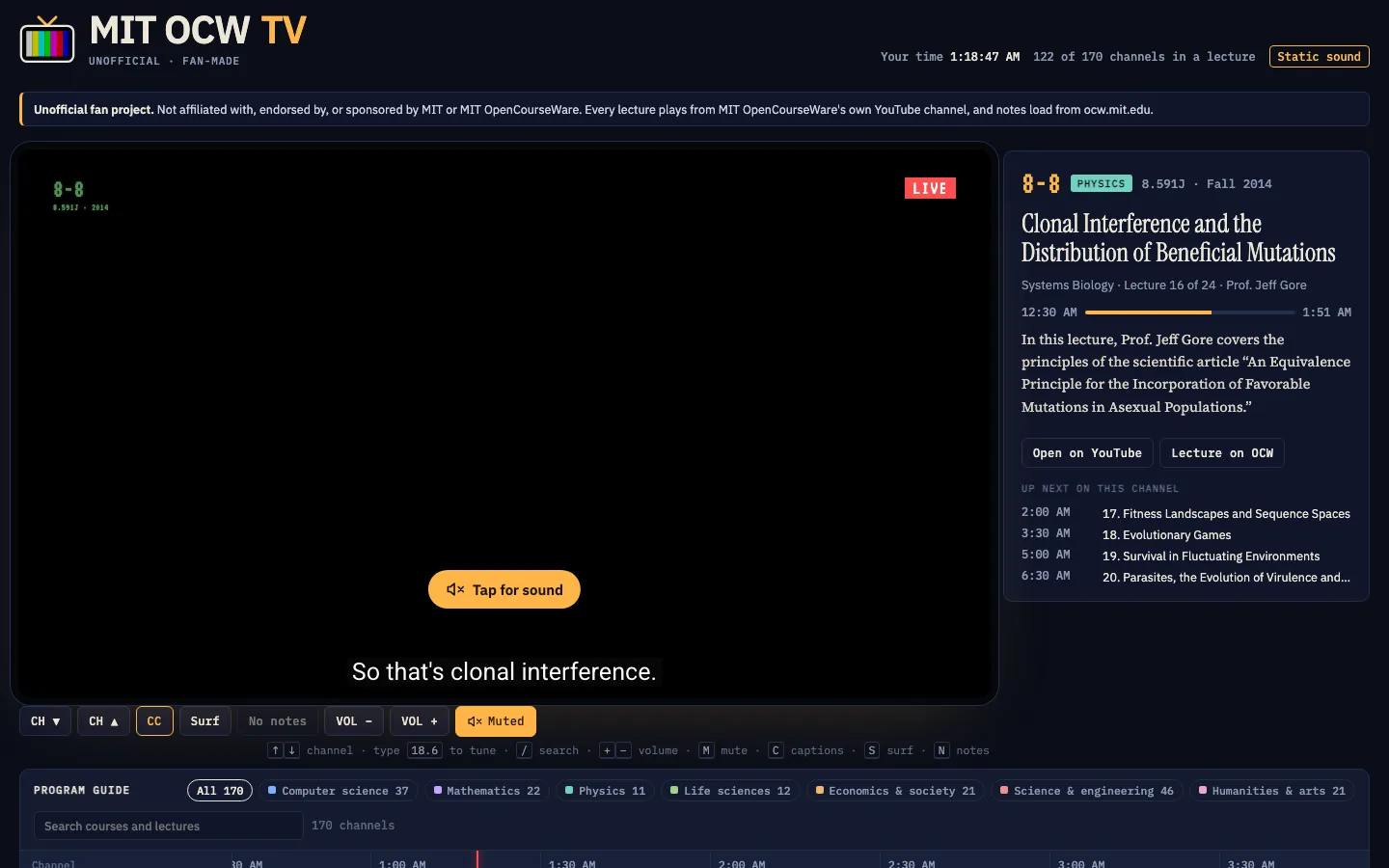
Channel 8-8 at 1 a.m. Image: MIT OCW TV, via rahulch.site.
Open it and you land mid-lecture, as if you had flipped on a cable channel. Each of 170 MIT OpenCourseWare courses is a channel, playing lecture after lecture on a clock everyone shares.
The pleasure is the lack of choosing. You do not browse a catalogue and pick a video; the page tunes you to a live-looking channel, with a red now-line on a program guide, an up-next list and a LIVE badge. Channels are numbered by department and then sequence, so physics sits in the 8s; type 18.6 and you land on channel 18-6. Arrow keys change channel, slash searches, and Surf hops channels every 11 seconds. Genre chips filter the guide into computer science, physics, life sciences and four other groups. Captions are on by default, with a button for the course notes when OCW provides them.
How the shared schedule works is visible in the page’s JavaScript. There is no server tracking viewers. The page loads a small index of every course and lecture length, rounds each lecture up to a 30-minute slot, and starts each channel at an offset derived from a hash of its course name. Then it reads your clock. Anyone whose clock agrees lands on the same lecture at the same second, and the page says the schedule is invented. Nothing is actually broadcast. The index lists about 3,380 lectures, over 3,400 hours, so most channels take about a day to come round again.
The video is MIT’s own: it streams through the OpenCourseWare YouTube player, and the lectures are CC BY-NC-SA 4.0. The site says it hosts nothing and is an unofficial, non-commercial project, not affiliated with or endorsed by MIT.
The limits follow from that. Video starts muted because browsers block autoplay with sound. It depends on YouTube staying up and on those lectures staying public. Each channel carries only the lectures OCW has on video, so some skip lecture numbers. A channel is a loop, not a syllabus: tuning in at 1 a.m. drops you into lecture 16 of 24.
That is the charm and the cost. It is a worse way to study than the course page and a better way to stumble onto clonal interference.