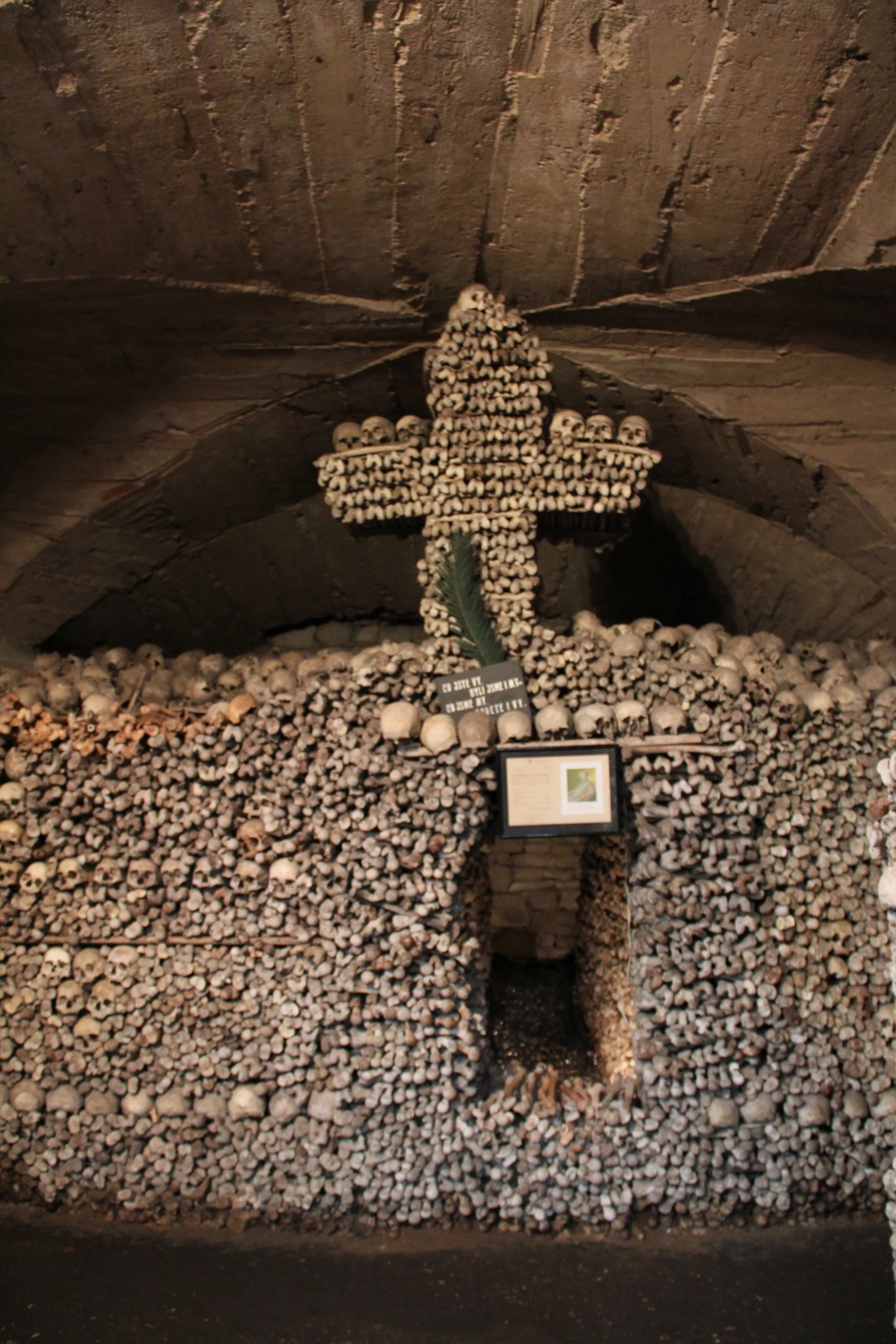
The bone cross and the memento mori plaques, Mělník ossuary. Photo by Kalendarka, via Wikimedia Commons — CC BY-SA 3.0.

Beneath a small church in Bohemia, an anthropology professor spent four years turning several thousand exhumed bones into a pile taller than a person, a cross, a heart, and a tunnel — then signed the whole thing in skulls.
The crypt sits under the Church of St. Peter and Paul in Mělník, at the confluence of the Elbe and Vltava rivers some 30 kilometers north of Prague. It started as an ordinary burial vault tied to the churchyard outside, not as anything designed to hold this many people.
It filled the way most ossuaries did: gradually, for more than one reason. Plague overcrowded the churchyard starting in the 1530s, and the parish began exhuming older graves to make room underground — a process that ran close to two and a half centuries, adding soldiers (Saxon and Swedish dead from the Thirty Years’ War) alongside the plague years, until the cemetery closed for good in 1775. A governor’s decree sealed the vault itself as a health hazard in 1787; repairs reopened it in the 1890s.
Turning it into something else was the work of one man: Jindřich Matiegka, Prague’s first professor of physical anthropology and the founder of the discipline in Czechoslovakia, later elected rector of Charles University. Between 1915 and 1919 he sorted and stacked what was down there himself. This wasn’t a one-time detour for him — two decades later Matiegka published the only full scientific study of the Předmostí skeletons, a set of more than forty Ice Age humans found in Moravia, work that turned out to matter more than anyone expected: the original bones were destroyed in a fire at the end of the Second World War, so his notes and photographs are now most of what survives of them. He spent his career, on and off, doing careful work with other people’s skeletons.
At Mělník, that care produced a pile of roughly 10,000 skulls and long bones stacked over six feet high — sized, independent estimates suggest, to read as a hill of Calvary — topped with a cross built from more bone and skulls, a palm frond laid at its base. Elsewhere, something like another 5,000 bones form a heart and a low tunnel walled in stacked leg bones, standing in for the empty tomb. Across one wall, skulls spell out “Ecce mors” — Behold death. Total remains are usually put at 10,000 to 15,000 people, so both figures are round numbers, not an exact headcount. Near the tunnel he also left a plainer message, painted rather than built: a plaque in Czech that translates to “What you are, we once were. What we are, you will become.” The whole design addresses a specific person — the visitor standing in front of it — which is a strange thing to spend four years building, and exactly the kind of care that makes it worth the walk down.
The crypt is still a working part of the church, not a separate museum, and it’s open to the public now much as it was then: daily through August, roughly 9:30am to 6pm, for around 60 koruna at the door.