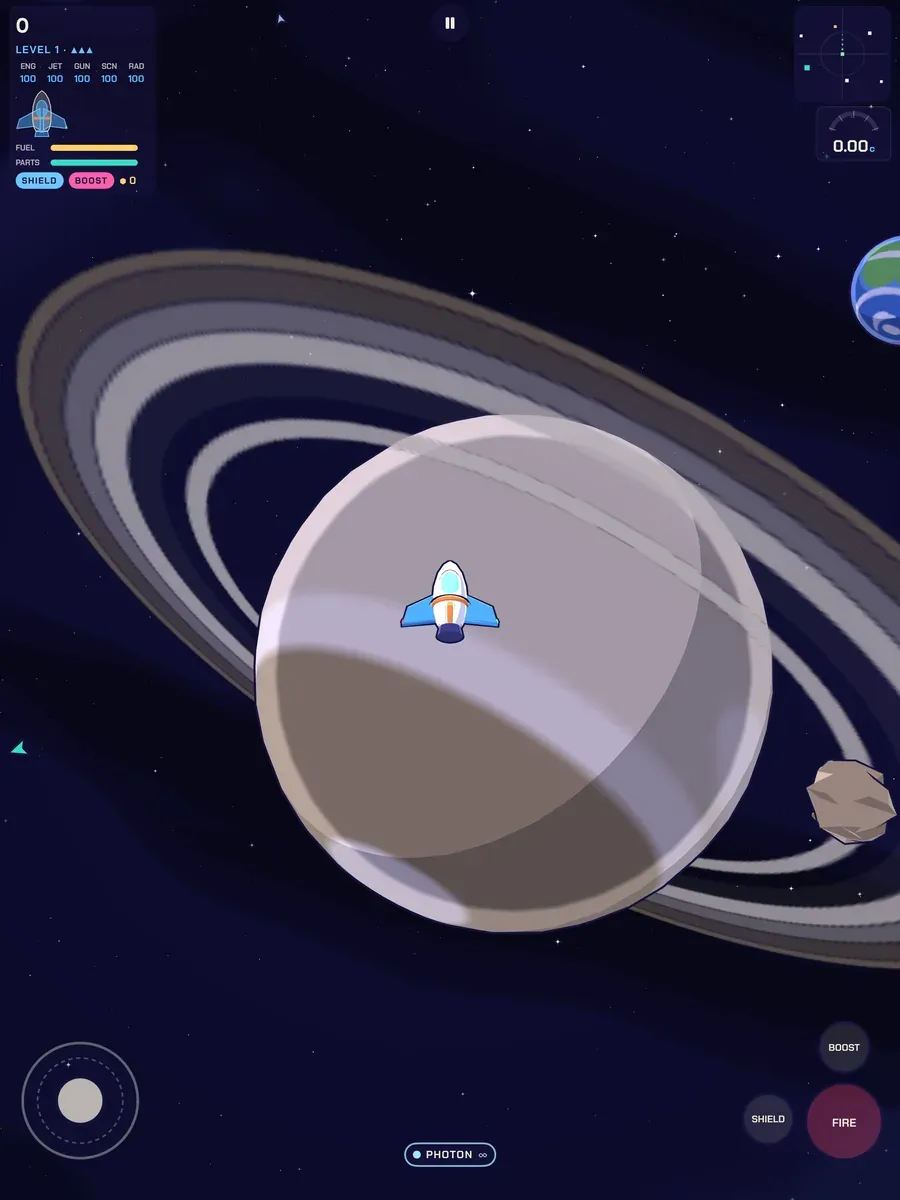
A quiet moment beside a ringed planet. Image: Lunatic Fling, via lunaticfling.com.
Every push lasts until you push back, the speed limit is light, and your ship comes apart one part at a time. Free on iPhone and iPad, and everyone flies the same sky each day.
There is no friction, so thrust is a decision you live with: you keep going in that direction until you thrust the other way. Relativity is enforced, so the closer you get to the speed limit, the less each push adds; the HUD gauge reads your speed as a fraction of c. The sector wraps around, and so does whatever you shot.
The ship is two wings, a tail fin, a nozzle and a canopy, and hits land where they strike. Lose a wing and the engine pushes off-centre, dragging the nose toward the wing you still have. Lose the fin and every turn keeps on turning. Crack the canopy and your scanner flickers. Nothing is gone for good: limp home to the harbor and it bolts the pieces back on. What breaks off keeps flying as wreckage with its own mass and momentum, so knocking a chunk into an enemy starts a chain reaction.
Nearly half of all sectors have a black hole, and its gravity pulls on everything, including your shots. Dive past one to slingshot beyond the speed limit you can’t reach on your own, or settle into an orbit. Get too close and the tides pull your wings and fin off a piece at a time; cross the horizon and the run is over.
At midnight UTC the whole world gets the same sector, with the same suns, planets and waves; you get one scored run, locked in the moment you launch. Share a result line afterwards: score, level, best chain, and one square per level (blue clean, yellow lost a part, red lost a life), so friends see exactly where it went wrong. Play on the title screen gives a random sector, unlimited.
The find called it free, and it is, with one footnote: an optional $4.99 Pilot’s License adds global Game Center leaderboards and seven ship paint schemes. No ads, no subscriptions, and the App Store lists Data Not Collected. It needs iOS or iPadOS 18, weighs about 3.7 MB, and appeared on 8 October 2026 as version 1.0, so it is days old, with no ratings yet.
It is Marc Hoag’s tribute, published by Axiomic, to Ben Haller’s Lunatic Fringe, the space game hidden in Berkeley Systems’ 1991 After Dark. It is not that game: the site says the physics are the homage and nothing from the original is used. If you want the 1991 code itself, that is what Lunacy runs on a Mac.