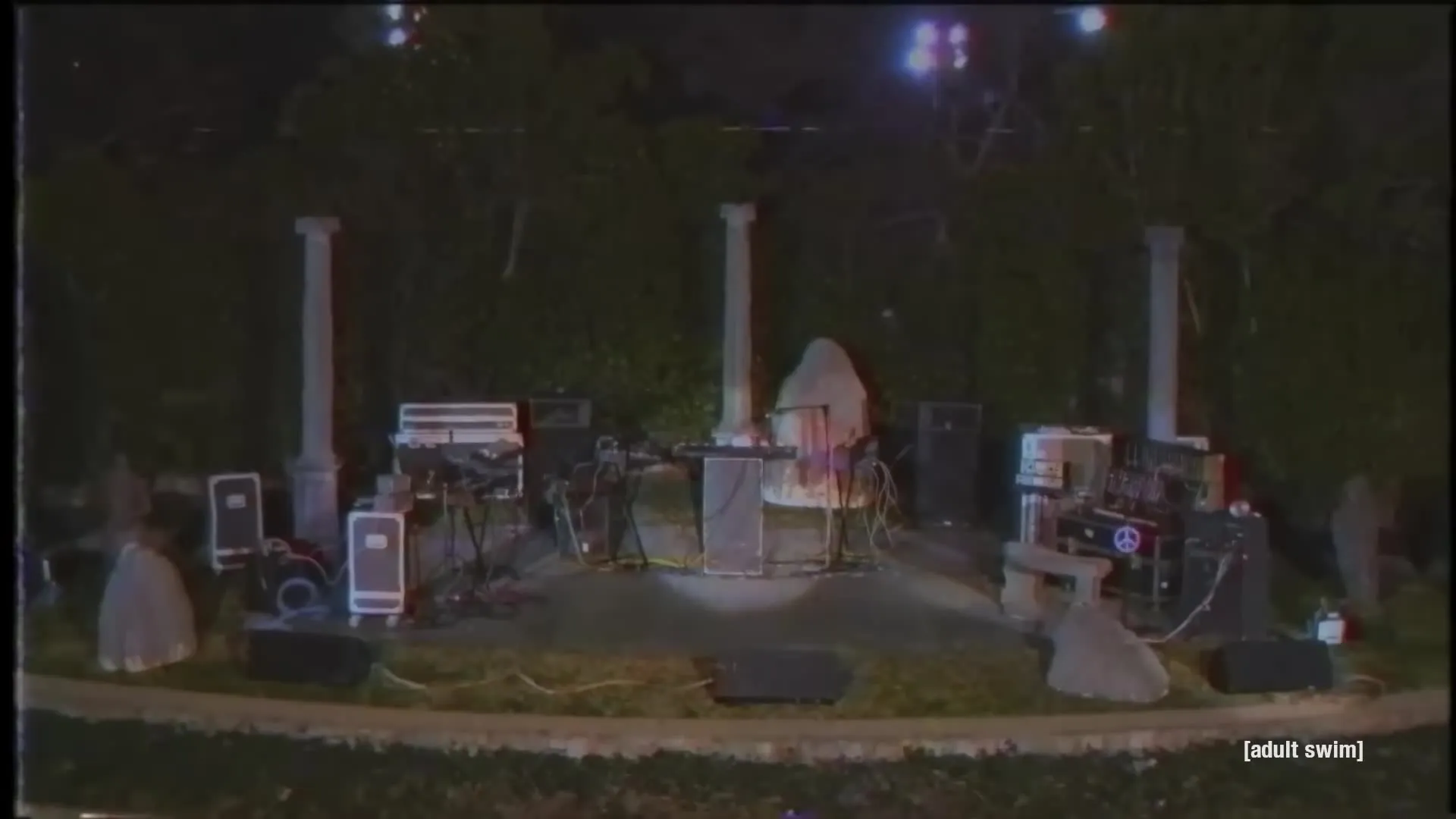
Three has-been synth legends bury a decade of grudges and improvise their way out of a comet strike, judged the whole time by an ESPN-style broadcast crew grading the jam for “sheer coolness” like a batting average.
Adult Swim’s special first aired May 2, 2016 — confirmed by the upload date on Adult Swim’s own YouTube channel, where it still streams free and uncut a decade later — and frames itself as a “recently unearthed” concert film from 1986: Yanni’s 1993 Live at the Acropolis, restaged seven years early and relocated from the Herodes Atticus theatre to an actual graveyard.
The three synth lords are played straight, not as caricature voices: Jerry G. Angelo is Xangelix (Vangelis), Molly Hawkey is Carla Wendos (Wendy Carlos), and Tim Kalpakis is Morgio Zoroger (Giorgio Moroder). Writers Scott Gairdner and Ryan Perez cast themselves as the two color commentators, Ulf Jobim and Edgar Tangram — the latter a nod to Tangerine Dream’s Edgar Froese — delivering synth trivia with the flat gravity of a real sports desk. Nick Corirossi and Charles Ingram direct; Corirossi also plays third announcer Zedd Centauri.
This is where the find undersold it: the gear is real and specific, not generic “synth stuff.” Wendos plays an actual Moog modular system, Zoroger works a Jupiter-8 through guitar pedals alongside an Emulator I and a Prophet-5, and Xangelix’s instrument is a Yamaha CS-80 — literally Vangelis’s own signature machine. The score is the one thing nobody claims credit for: no composer or musician is listed in the special’s own end credits, on Adult Swim’s site, or on IMDb. The two tracks that later circulated, “Zoroger’s Song” and “End Jam,” are as anonymous as the instrument choices are well-researched.
Halley’s Comet is the threat, resolved on pure sports-parody logic: the three rivals trade a burst of synth Morse code, drop the grudges, and merge into an all-white-suited trio whose jam is graded on camera for “sheer coolness” — enough, per the broadcast, to knock the comet off course. Gerald Ford, having evacuated Earth earlier by space pod, returns just long enough to hand out the medals.
One characterization is worth flagging, not celebrating: Zoroger plays a grudge-holding, hard-drinking stereotype of his real counterpart, and Wendos’s backstory turns Wendy Carlos’s own gender history into a punchline. Neither reads as mean-spirited, more affectionate ribbing than mockery, but it isn’t material for a page built on broad delight. What holds up a decade later is the research: three fake legends built out of the real gear, reputations, and habits of the musicians they impersonate.