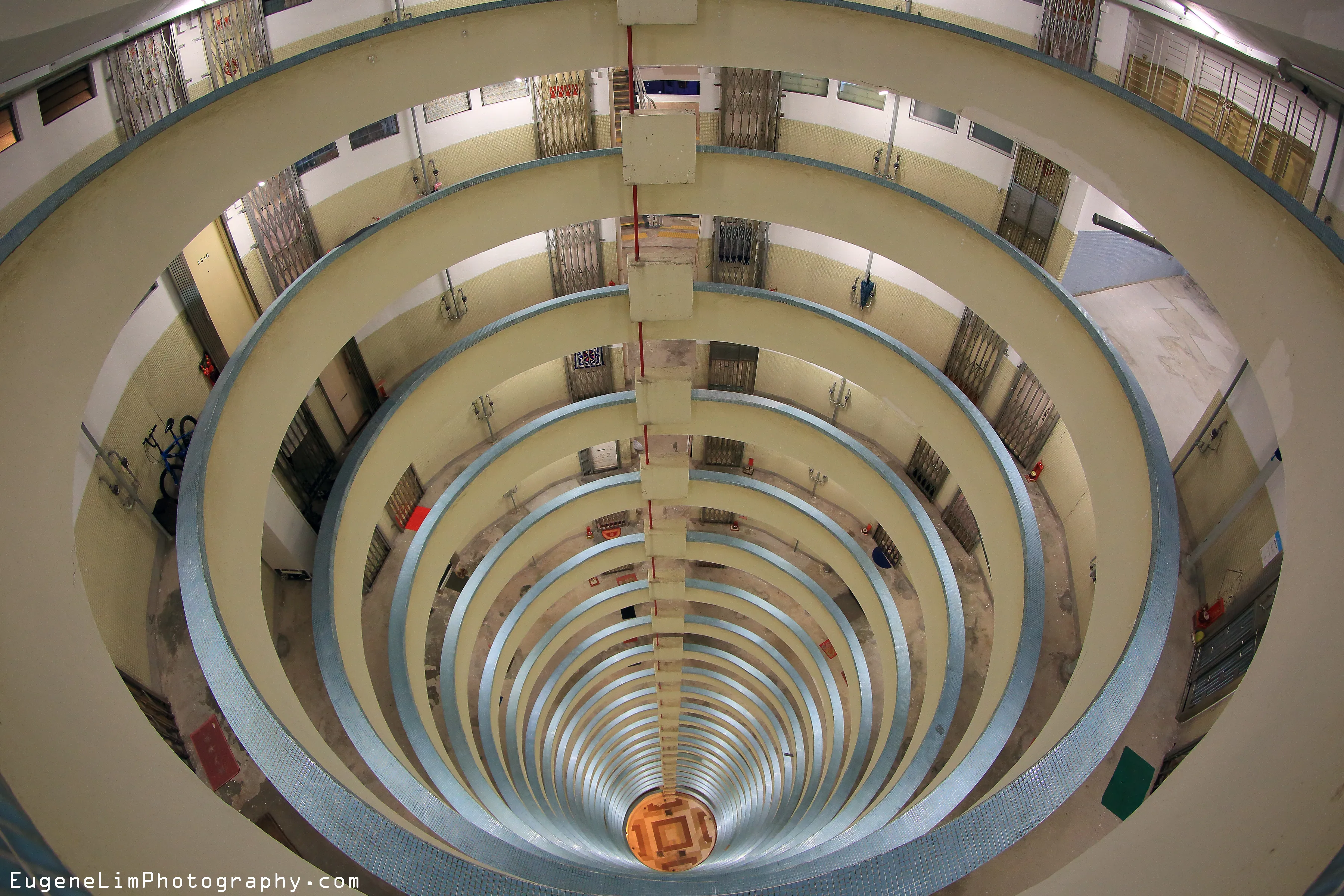
Lai Tak Tsuen, Causeway Bay. Photo by Eugene Lim, via Wikimedia Commons — CC BY 2.0.

Lai Tak Tsuen is the only cylindrical public rental housing ever built in Hong Kong: two twin-drum blocks on a Tai Hang hillside, each cylinder ringed by access balconies around an open-air void that runs the full 27 storeys to the sky. It is also 2,675 flats that people live in, and the estate now posts notices asking visitors not to come in and photograph it.
Start with what it actually is, because the popular description of it is wrong in ways worth fixing. Lai Tak Tsuen is a Hong Kong Housing Society estate — the Housing Society, not the Housing Authority, a separate self-financing non-profit — and it has three named blocks, not two. Tsuen Wing Lau, finished in May 1975, is a conventional 26-storey slab with a central corridor and 66 flats to a floor; nobody photographs it. The famous ones are Lai Kit Lau and Tak Chuen Lau, completed in 1976, and each of them is not one cylinder but two: a twin-drum block, joined at the waist, 27 storeys, 20 flats per floor, 540 flats apiece. So the count is four cylinders and four atria across two blocks — the estate is numbered internally as eight blocks — and the hero image above is one drum, not the whole thing. The architect was Wong Cho Tong Architects & Engineers. Its three blocks were named so that their first characters spell out the estate: Lai–Tak–Tsuen, itself a tribute to Michael Wright (鄔勵德), the Public Works director whose “Wright Principle” — that every public flat gets its own kitchen and toilet, not shared ones — is the reason Hong Kong public housing looks like housing at all.
The reason the atrium reads the way it does is that it is a circulation deck, not an ornament. These are balcony-corridor blocks: to reach your flat you walk an open gallery that rings the void, so the void is lined, floor after floor, with the same continuous band of parapet — pale render, blue-tiled rim, doors and windows behind it. Stack that twenty-seven times in a perfect circle and the eye stops reading it as storeys and starts reading it as a moiré, an optical rather than architectural pattern. The photograph above is a fisheye, which is a confession: the effect depends on seeing the whole cylinder at once, and the human eye standing at the bottom does not have that field of view. What you actually experience is narrower, dimmer and stranger than the picture — a shaft of daylight, a lot of laundry, and the sound of the estate arriving from every direction at once.
The design was not whimsy. The Housing Society announced the estate in January 1969 and expected it in 1972; the hillside site defeated that, with site-formation problems and a landslide during construction pushing completion out by three years. On a steep, cramped Tai Hang slope, the drum does real work: it packs a lot of flats onto a small footprint, it puts a light-and-ventilation well at the centre of a very deep plan, and — the stated intent at the time — it swings far more of those flats around to face Victoria Harbour than a slab could. The trade-offs are equally real, and were noticed immediately: wedge-shaped rooms are miserable to furnish, the light well only meaningfully lights the upper floors, and the stairwells had to be triangles. It was, when it opened, the most expensive low-cost rental estate in the territory, and the flats in the two cylinders came with bathtubs — the top of the Housing Society’s range in 1976. Its afterlife has been cinematic: Fruit Chan’s Dumplings (2004), a Coca-Cola commercial, a TVB drama, and, in 2016, the atrium as the apartment block where the Major visits her mother in the live-action Ghost in the Shell (2017). That claim, at least, holds up.
Which brings up the thing the pretty pictures leave out. Lai Tak Tsuen is not a monument, a museum, or a set — it is 2,675 households, many of them elderly, who have spent the last decade absorbing a steady trickle of people who came to photograph their hallway. The estate has responded the way you’d expect: coded gates on the entrances and posted notices reading, in plain terms, that entering or photographing the buildings without permission is not allowed. Tailgating a resident through the gate to get the shot anyway is a well-documented tourist move, and it is exactly the move not to make. The honest version of “how to visit” is therefore short: the estate is not open to you. The public streets around it are — Lai Tak Tsuen Road climbs right past the blocks and the exteriors are visible and photogenic from outside — and that is the visit. If you are there with a resident, or you are let in, the rules are the ones you already know: ground floor, quiet, no photographing people, nothing pointed into a flat, and don’t linger. A place can be worth knowing about without being yours to walk into.
Honest limitations, then. Access is restricted and getting more so, so the odds are you will look at Lai Tak Tsuen rather than stand in it. The interior is genuinely hard to photograph — the images that made it famous are wide-angle and taken from positions most visitors will never reach — and the reality at ground level is a working residential lobby. And the estate is an ordinary, ageing, well-used piece of 1970s public housing that happens to be round: the architecture press has never been entirely kind to it, the flats are small and awkwardly shaped, and the type went extinct for reasons (Singapore’s semi-cylindrical Pearl Bank Apartments, its closest cousin, was demolished in 2020). What survives is a genuinely singular idea, executed once, at scale, for people who needed somewhere to live — and still doing that job fifty years on, which is more than most photogenic buildings can say. That is the reason to know about it, and the reason to leave it alone.