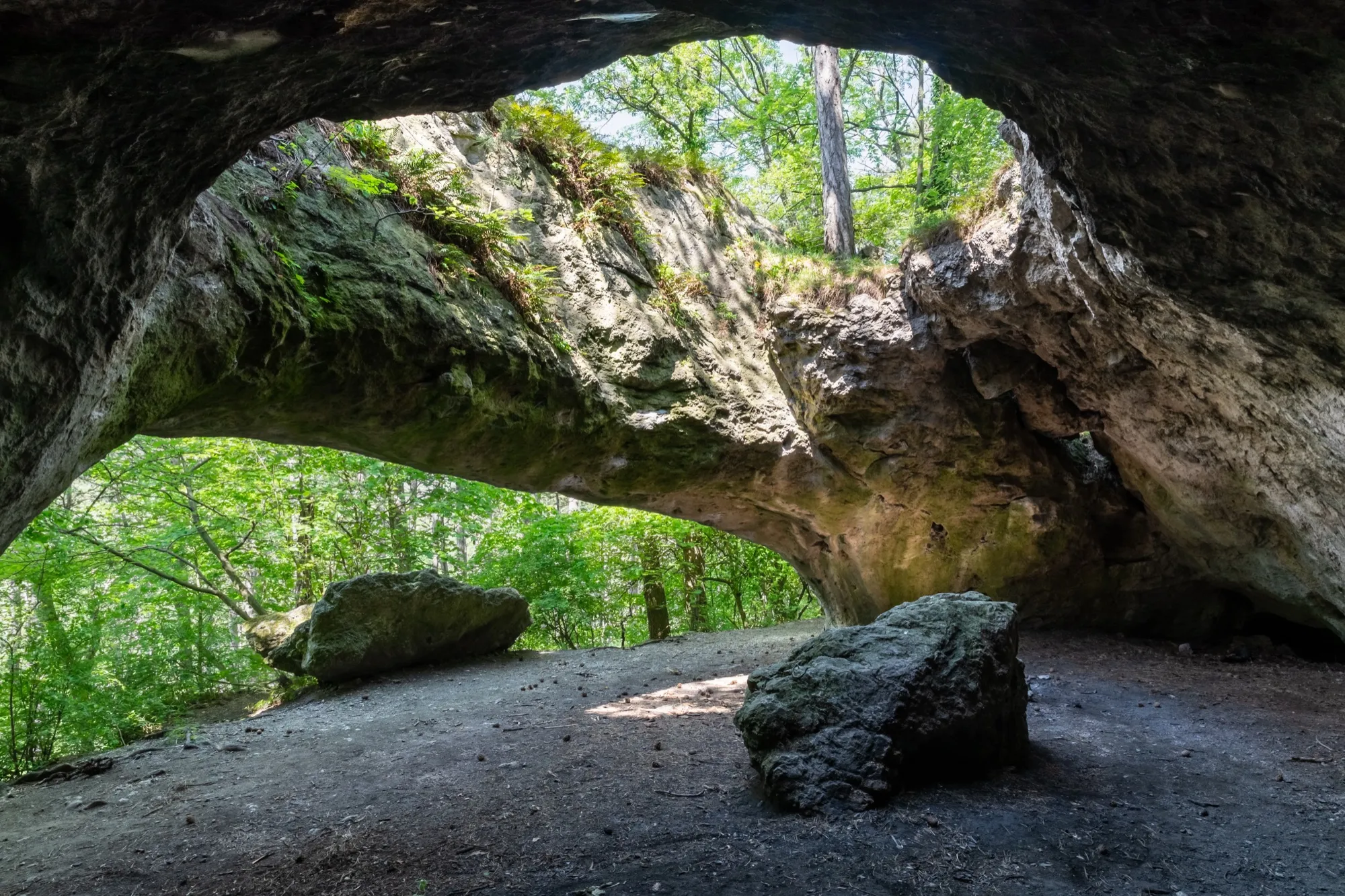
A twenty-five-metre cave in a ravine outside Baden bei Wien, with a four-metre window in its ceiling. An amateur emptied it in 1892 and got it wrong; the finds went on to name an entire Copper Age culture anyway.
The Königshöhle sits at about 350 metres in the Wolfstal, the narrow valley below the ruined castle of Rauheneck, twenty minutes uphill on a marked path. The portal is sixteen metres across and three high, and a few paces in the roof simply stops: a hole four metres wide, open to the sky, with a collapse block sitting under it. You do not have to be told the hole is the point.
The archaeology is a more honest story than the version usually told. In January 1892 Gustav Calliano, a Baden local historian with enthusiasm and no training, dug the cave out almost entirely and interpreted it, in one Austrian survey’s words, with great imagination — he seems to have decided it was a pottery kiln. Everything came out of a single mixed ash layer, which is exactly what an untrained dig produces. Professionals reached the material only in the 1920s, when Oswald Menghin and Josef Bayer catalogued it.
That is where the name comes from. Menghin gave the central-Danube Copper Age — roughly 3600 to 2800 BC — the label Baden culture, after the spa town at the bottom of the hill. It has been called that ever since, across Hungary, Slovakia, Serbia and Croatia, in a scholarly literature whose real evidence comes from stratified sites in the Carpathian Basin rather than from one ransacked Austrian cave. Worth being straight about: the Königshöhle lent the culture its name, it is not the site that defines it.
The material itself is a jumble in the best way. Linear Pottery sherds two thousand years older than the Baden ware they were found beside. Amphorae, flat bowls, one with a face on it. A clay spoon that may be Lengyel. A single copper neck-ring. And, at the top of the sequence, a fragment of a bronze follis of the emperor Gratian, who died in 383 — the last person to leave anything here on purpose for a very long time.
Which leaves the hole, and the explanation Calliano’s own brother Carl printed in his Niederösterreichischer Sagenschatz in 1924. A rock so heavy a hundred horses could not shift it. The Devil put it on his head like a summer hat and went about shouting that nobody could match him. God arrived in a blaze of light, lifted the rock onto his little finger, set it down where it now is, and the Devil — blinded and embarrassed — went home. You can still see, they say, where the head was and where the finger went.
It is a natural monument, protected since October 1973, free to walk into, and about nineteen bouldering problems now run up the rock around it.