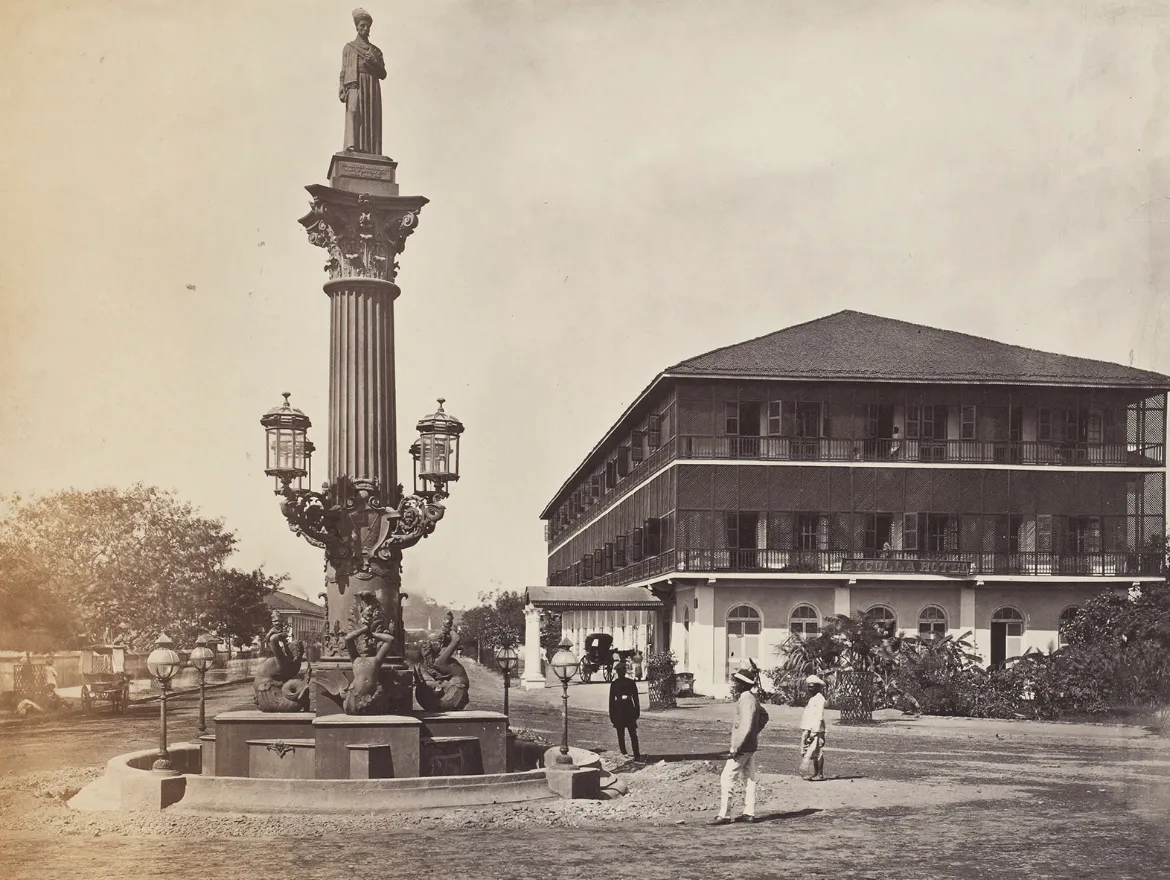
The fountain with the Byculla Hotel behind it, in a print credited to Francis Frith; the listing dates it c. 1850–70, though the monument went up in 1867. Photo: Francis Frith, Wikimedia Commons, public domain.

A son ordered a memorial to his father from London: a 40-foot column, a robed figure on top, four mermaids blowing conches at the foot. It went up in Bombay in 1867 without the city’s blessing, and now holds a Byculla junction between two flyovers.
The figure is Cursetjee Manockjee (1763–1845), a Parsi businessman and philanthropist. His son, the judge Manockjee Cursetjee, saw a Chilean fountain at the 1862 International Exhibition in London: waterspouting mermaids around the goddess Ceres. In 1865 he returned to London and commissioned the fountain maker John Bell. It was installed in 1867, at a cost of about Rs 20,000. (1865, the year it was ordered, sometimes turns up as its date.)
The details reward a long look. The father wears the Parsi jama-pichori with a shawl over one shoulder, two pieces of sandalwood in his left hand and a book in his right, usually read as the Zoroastrian scriptures. Beneath him the mermaids sit in a trough ringed by lamps, with four more lamps higher on the column. The water came from the Vihar Water Works and the gas from the Bombay Gas Company, so the memorial doubled as a showcase of the city’s new infrastructure. Locals treated it almost as an object of worship, leaving coconuts and prayers.
The installation was a quiet act of defiance. Municipal officials objected, so Manockjee reclaimed Byculla land his family had donated and put the monument up without formal approval or an inauguration. By one count it was only the third statue of an Indian in Bombay, after Jamsetjee Jejeebhoy and Jagannath Shankarseth.
The monument has had a hard century and a half. By 1915 the lamps were reported missing and the fountains dry. In 1928 it was moved to the base of the Byculla bridge, and the family eventually handed it to the municipal corporation on condition that it be kept in water and repair. A restoration finished in 2014 sandblasted the iron, restored the stonework, and laid new gas and water lines for the eight lamps. It is now a Grade I heritage monument.
The name is plain: Khada Parsi, or in Marathi Ubha Parsi, means “Standing Parsi”; it is also called the Cursetjee Fountain. The photograph above shows how much open road it once had.