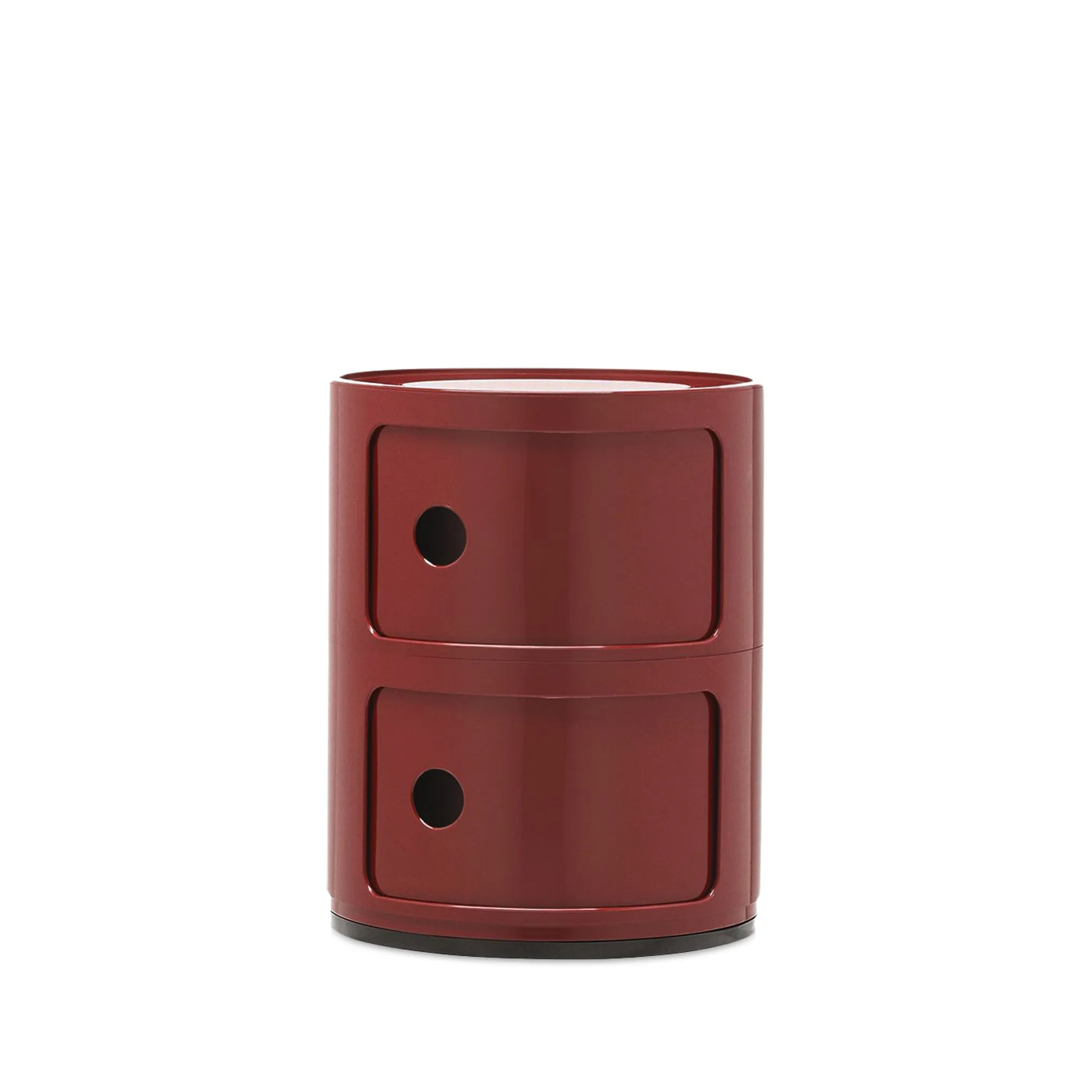
The 2-element round unit — two stacked modules, a recessed lid, a finger-hole where a knob would be.
Anna Castelli Ferrieri’s round modular storage cylinder for Kartell, designed in 1969, held in MoMA’s collection, and in continuous production without a single revision since. The whole argument is that the design was correct the first time.
The Componibili is a stack of injection-molded ABS cylinders that snap together without screws or glue: a base module, a middle, a lidded top, each with a curved sliding door and a punched finger-hole where a lesser design would have bolted a knob. Buy the 2-tier and you get two modules; a 3- or 4-tier is the same part list, taller. It rolls on optional castors, tucks under a nightstand or beside a bathroom sink, and holds whatever a small round drum holds — a difficult brief that the object solves so completely it disappears.
What earns its place is not novelty but the opposite. Anna Castelli Ferrieri co-founded Kartell in 1949 and spent the 1960s proving that plastic could be a serious material rather than a cheap one; the square Componibili element of 1967–68 was among the first furniture ever injection-molded in ABS. The round version arrived in 1969, was shown in MoMA’s 1972 Italy: The New Domestic Landscape, and entered the museum’s permanent collection. That is the interesting fact here: a mass-market object you can still buy off Amazon today is the same tooling, the same geometry, the same idea that a museum enshrined more than fifty years ago. Most “iconic” design gets reissued, softened, or reinterpreted. This one never had to be.
It is also genuinely modular in the way the marketing word usually isn’t. Because every tier is an identical stacking part, a single unit grows into a column without redesign, and the visual language holds at any height. The current catalog runs the round system in a long spread of colors — the archetypal white, plus black, red, orange, sky blue, and newer tones like the burgundy shown here — alongside variants (a bio-plastic edition, a taller “Classic Big,” a smiling-face novelty). The core object is untouched underneath all of it.
The honest limitations are the same ones it has always had. It is glossy ABS plastic, and it reads as glossy ABS plastic — a finish some rooms want and some don’t. At roughly $200–210 for the 2-tier (MoMA sells it around $205; genuine Kartell units on Amazon land near $212), you are paying a design-object premium for what is, mechanically, three molded drums that stack. And it is ubiquitous — it has been photographed in enough bedrooms and design blogs to have shed some of its surprise. None of that is a defect so much as the cost of being right for fifty-seven years: the thing works, everyone figured that out, and now it is simply furniture.
Also on Amazon ↗ Affiliate
Affiliate link — we may earn a commission from qualifying Amazon purchases at no extra cost to you.