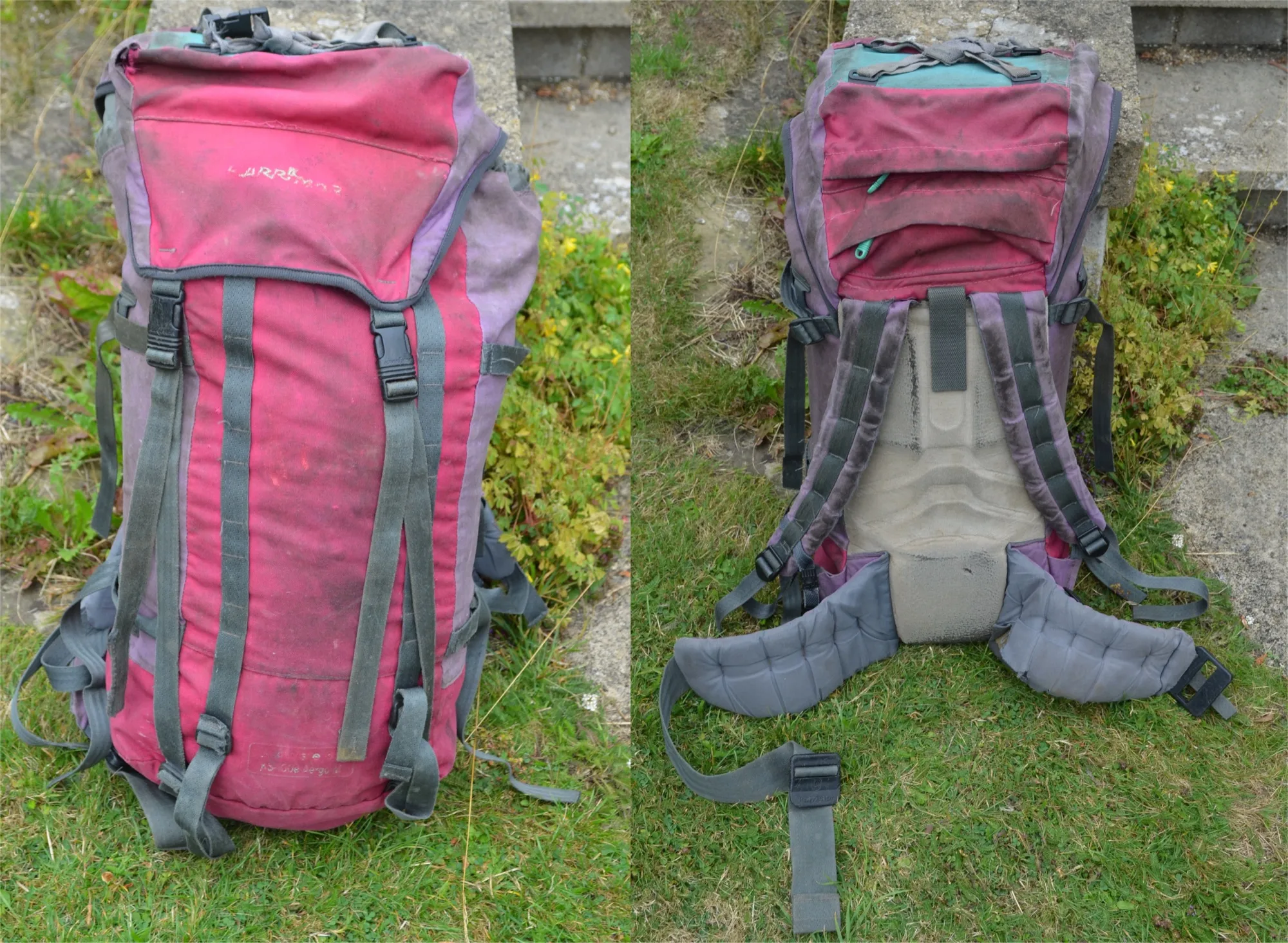
A 65-litre Karrimor Alpiniste from the early 1990s, faded to pink. Photo by Ericoides, via Wikimedia Commons — CC BY-SA 3.0.

Karrimor exists because its founder went blind and couldn’t buy stock, so his wife and her sister sewed it instead. Their son turned the shop into Britain’s biggest rucksack maker and invented a foam mat that is now an ordinary lowercase noun in Polish. The name he built is currently rented back to Japan from Sports Direct.
Charles Parsons had run a bicycle shop in Waterfoot, in Lancashire’s Rossendale valley, since 1931. An accident in 1939 took his sight by 1943, and wartime supply controls took his stock: no saddlebags, no panniers, though he could still buy raw canvas. His wife Mary and her sister Grace Davies were machinists — Rossendale was textile country — so they made the bags themselves, and began selling them on to other shops. The Karrimor Bag Company was registered in 1946. The name is just “carry more”.
The Karrimat was not the founders’ doing. Mike Parsons was their son; he joined a six-person firm in 1960 and by 1975 was running 163 people and roughly 80% of the British rucksack market. The mat came out of the shoulder straps: Karrimor was already padding rucksacks with closed-cell foam, and laid flat, a sheet of it was a bed. It went on sale in 1966. The version everyone pictures — bright yellow — arrived in 1968, blown from Evazote by BXL Plastics (now Zotefoams), in a bespoke colour Karrimor could only have by committing to five tons of foam.
The find reached for Hoover; the evidence is better than that. Karimata is a headword in the Słownik języka polskiego, PWN’s standard dictionary of Polish, glossed as “a thin mattress of light, waterproof, well-insulating foam” — no capital letter, no brand, no Karrimor. Czech Wikipedia’s article on sleeping mats is titled Karimatka, and says outright where the word came from.
Two Everest claims need adjusting. Karrimor did build the Whillans Box, the coffin-shaped shelter Don Whillans sketched from a Patagonian farm shed; Parsons made it from the company’s own pack-frame tubing and rucksack fabric, and it held Annapurna’s South Face in 1970. But the boxes bolted to the Southwest Face in 1975 were Hamish MacInnes’s redesign: strengthened, with roofs of bulletproof mesh on the lower camps to shed avalanche debris, and cut down to two-man “assault boxes” of 1.07 by 1.12 by 1.91 metres for Camp 6. And Junko Tabei’s Karrimor pack frame, on her summit of 16 May 1975, is attested only by Karrimor’s own timeline. Independent accounts of the Japanese women’s expedition run the other way: each member paid ¥1.5 million to be there, and Tabei made her waterproof gloves from her car cover and sewed her trousers from old curtains.
“Forgotten” is earned in the paperwork. Two acquisitions went wrong after Parsons sold 25% to Gartmore in 1993; by 1996, on 320 staff and £20m of turnover, control passed to 21 Invest — the Bonomi and Benetton investment vehicle — for £7 million. They wanted a fashion range. Parsons was forced out in early 1998, not 1996 as the article has it; 1996 is the year he was made president. Karrimor went to a South African leisure group in 1999, into receivership in March 2004, and to Mike Ashley’s Lonsdale Sports for about £5 million. Its own shops had already been renamed Mountain Warehouse.
The tidiest proof of where the name sits now is printed on Karrimor’s Japanese site, which sells trekking packs up to ¥46,200: “KARRIMOR® and the KK device® are trade marks of Lonsdale Sports Limited and used under licence by karrimor International Ltd.” The Japanese licensee trades under the exact name the Lancashire company adopted in 1975, at its peak — and leases it from Sports Direct.
Parsons kept one thing. The mountain marathon he started in 1968 — 78 teams set out, 11 reached day two — left with him, and when the new owners dropped the sponsorship in 2004 it was renamed the Original Mountain Marathon. He sold it in 2010; his sister Jen Longbottom, who joined the family factory in 1972, stayed on to run it. He also wrote the history down: Invisible on Everest: Innovation and the Gear Makers (2003), co-authored with Mary B. Rose, professor of business history at Lancaster. It is the primary account of all of this, by the man who was in the room, with footnotes.