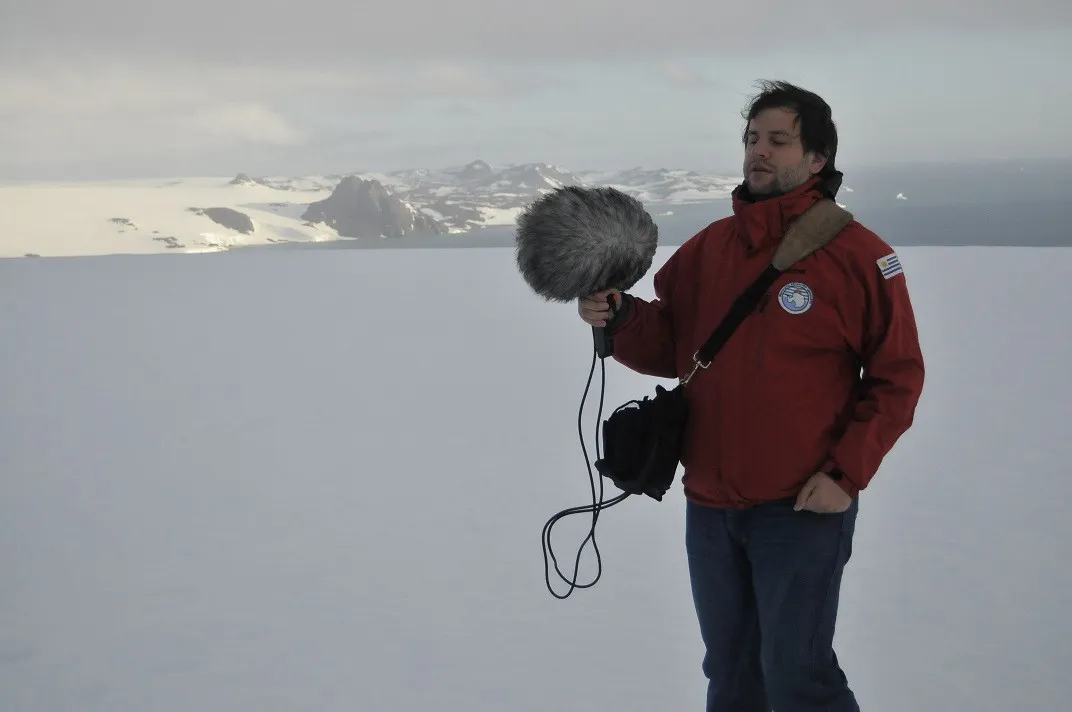
From Culasso’s own site.
Juan Pablo Culasso was born without sight and has spent more than two decades recording the sound of the Americas. The work he leads with is not a recording. It is four hundred metres of path in a Colombian cloud forest.
He trained at the Universidade Estadual de Campinas in Brazil alongside Jacques Vielliard, curator of the great neotropical sound archive, and then as a nature recordist through the Cornell Lab of Ornithology. More than fifteen published works have followed — Voces de las Aves del Pantanal al Bosque Atlántico in 2008, Sonidos Invisibles: Aves de Brasil in 2014, a sound map of Uruguay in 2021, fifty tracks of Iguazú in 2022, Sonidos del Chaco Seco in 2023 — and he contributes to the Macaulay Library, the largest collection of natural sound there is.
National Geographic filmed the first season of Supercerebros in October 2013 with roughly three hundred candidates from across Latin America and the United States. Culasso won it over five days of competition, on nothing but the ability to put a name to a bird from its call.
How many birds he can name is where the public record falls apart, and it is worth walking through. Global News said more than 720 species in 2016. The Associated Press said 3,000 bird sounds. Mongabay said more than 700; a Chilean paper said almost a thousand. A Radio Ambulante episode is titled “240 aves”, which turns out to be the number of candidate songs in his first round of the contest rather than a total of anything. His own site gives no figure at all — which, given how the others agree with each other, is the most trustworthy number on the list.
The work that won him Colombia’s Riqueza Natural prize for transformation in nature tourism, in October 2020, is the first birding route in South America designed for people who cannot see. It runs four hundred metres through the San Antonio cloud forest at Km 18 outside Cali, with six guided stops, and opened to the public in September 2021. What it solves is not access to a path. Birdwatching as a hobby is organised end to end around a pair of binoculars, and this route rebuilds the whole activity around the instrument Culasso has been using all along.
Two honest caveats. The route is documented as running through late 2024, when Universidad Nacional covered it around COP16, and nothing more recent confirms it is still open — check before travelling. And his site itself has not been updated since a blog post in February 2025; its English edition is only half-translated, with whole paragraphs still in Spanish.
He was named to the Explorers Club 50 in 2024. The better use of an evening, though, is not to read about him: put on Birds of Iguazú and listen to what someone who has never seen a bird decided was worth keeping.