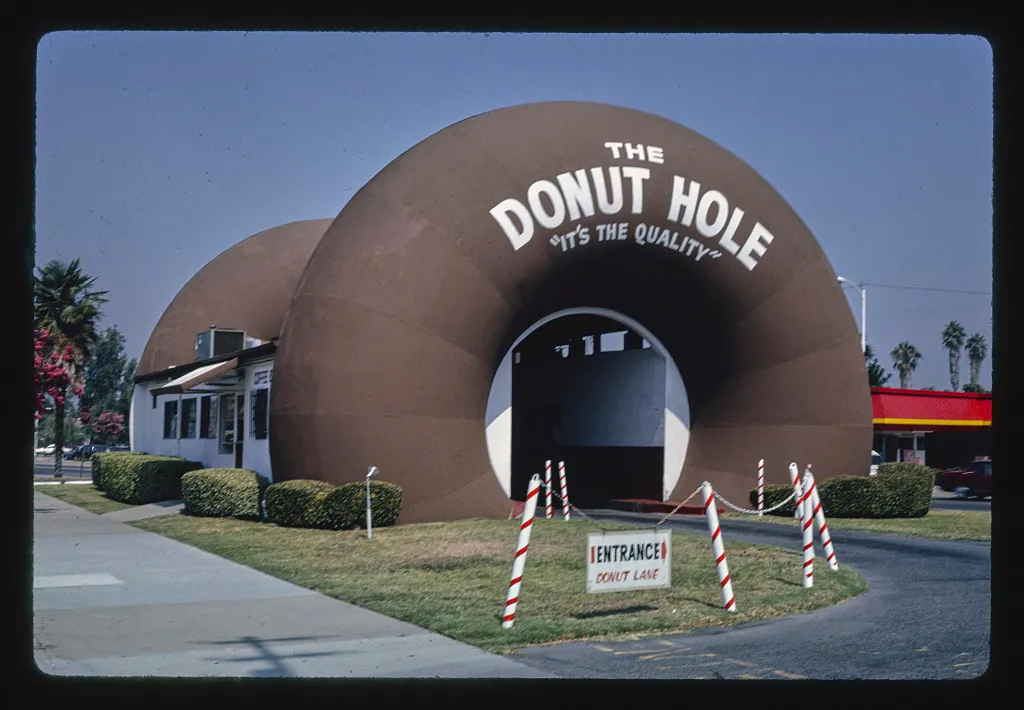
The Donut Hole, La Puente, California — cars still drive straight through the hole for a dozen glazed.
John Margolies spent 1969 to 2008 — forty years, a rented car at a time — photographing the commercial architecture that modernism was quietly erasing: teapot gas stations, doughnut-shaped drive-throughs, a pizza place shaped like a leaning tower. The Library of Congress now holds 11,710 of his color slides, digitized and free to download, with no known restrictions on publication.
Margolies wasn’t a hobbyist who happened to like weird buildings. He had a journalism and art-history degree from Penn, a stint as an Architectural Record editor, and a job as program director of the Architectural League of New York — credentials aimed squarely at the Philip Johnson wing of taste. He spent them instead defending the wing’s opposite: a 1970 exhibition on Morris Lapidus’s ostentatious Eden Roc hotel, a 1973 Progressive Architecture essay praising San Luis Obispo’s Swiss-chalet-themed Madonna Inn. Johnson, unbothered by the ribbing, helped fund the road trips anyway, alongside a 1978 Guggenheim Fellowship.
The method was as considered as the mission. Margolies rented cars rather than drive his own, timed trips for late spring or after Labor Day to dodge tourist traffic, and packed coolers to keep his film cold. He shot almost exclusively on a 50mm lens with ASA 25 film for maximum color saturation, worked only in “golden syrup” early-morning light, and would skip a building entirely if a car was parked in front of it. Motel nights came with a ritual: clothespins to pin the drapes shut, and a Fred Flintstone night light on a 20-foot extension cord so an unfamiliar bathroom wouldn’t be pitch dark.
What he came back with is the hero image above — the Donut Hole in La Puente, California, still operating on Amar Road — and thousands like it: the Teapot Dome gas station in Zillah, Washington, and a second teapot-shaped building in Chester, West Virginia; the Leaning Tower of Pizza in Quincy, Massachusetts; theme motels, mini-golf courses, drive-in signage, an orange juice stand built like an orange. Restaurants, gas stations, and movie theaters make up the bulk of it, concentrated in California, Florida, Texas, and the Northeast but reaching all 48 contiguous states — architecture built to read at 45 miles an hour, meant to be gone in a decade, most of it now actually gone.
The Library of Congress started acquiring the archive in 2007, took the bulk of it in 2015, digitized the 35mm transparencies the following year, and in July 2017 named it a “free to use and reuse” collection. The rights advisory on the individual images reads, plainly, “No known restrictions on publication” — the Library bought the intellectual property along with the slides, so there’s no third party to clear. Larger JPEGs and TIFFs are available straight from each item page.
Browsing rewards patience over precise search: the fastest route is the curated free-to-use gallery linked above, or the Prints and Photographs Online Catalog with the collection code “mrg” (loc.gov/pictures/search/?q=mrg&st=gallery). Library staff have layered subject and geographic headings onto Margolies’s own notes, but the metadata is his shorthand, not exhaustive captioning — expect to scroll. The original slides are in cold storage, so what you’re looking at is the digital surrogate, which is exactly what the Library recommends using.