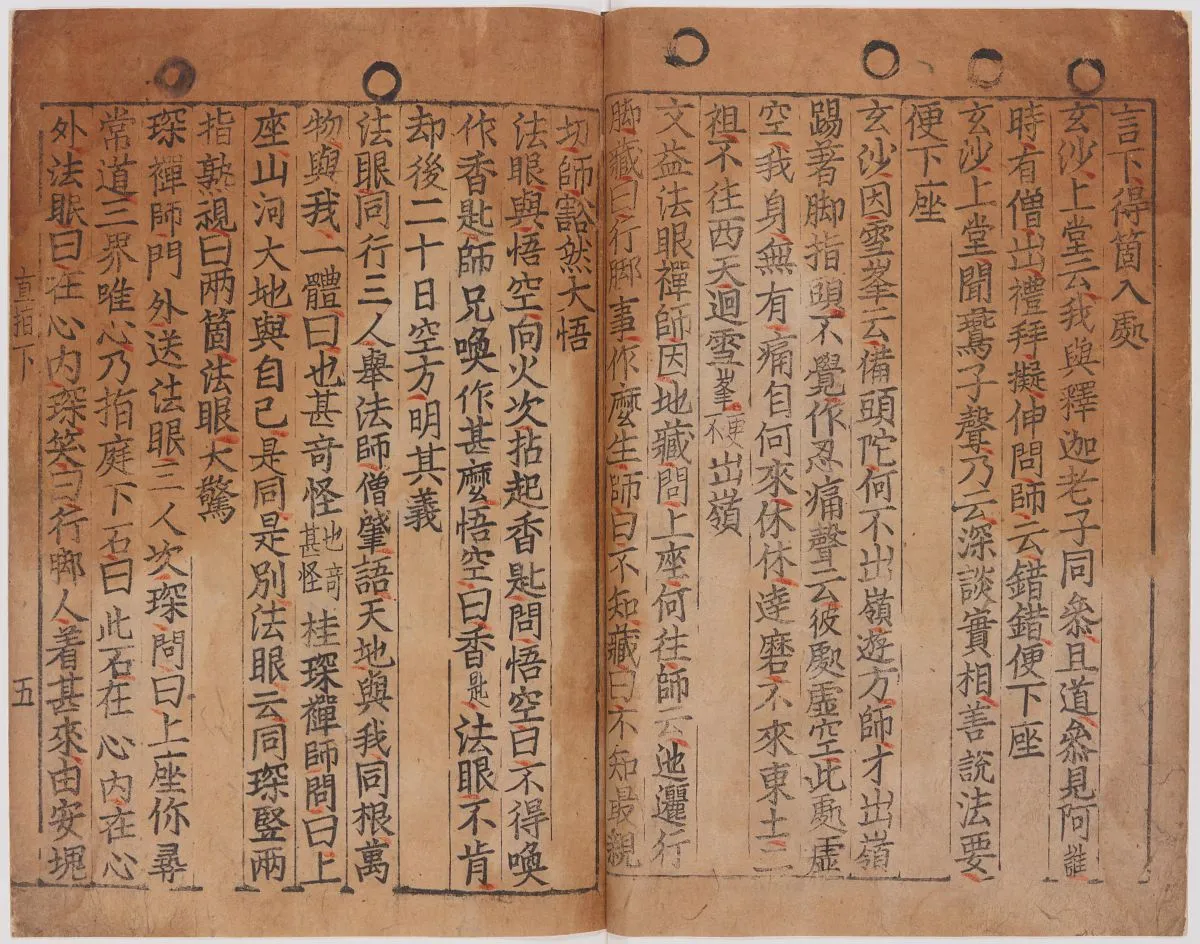
Leaves 4v–5r of Jikji, BnF Coréen 109. Scan by the Bibliothèque nationale de France, via Wikimedia Commons, public domain.

The oldest surviving book printed with movable metal type is a Zen anthology made at a Korean temple in 1377, 78 years before Gutenberg’s Bible. Only its second volume survives, and the Bibliothèque nationale de France has scanned every leaf, from its bookplates to its colophon.
The book says where it came from on its last printed page. The colophon dates it to the seventh month of 1377 and records that it was printed with cast type at Heungdeok Temple, outside Cheongju. Its full title, Baegun hwasang chorok buljo jikji simche yojeol, is what UNESCO renders as “Anthology of Great Buddhist Priests’ Zen Teachings”. The monk Baegun (1298–1374) compiled it from earlier Zen texts, and his disciples Seokchan and Daldam printed it after his death. The temple itself was forgotten until a housing development in Cheongju turned up its site in the mid-1980s, confirmed by a bronze gong inscribed with its name. The Cheongju Early Printing Museum has stood there since 1992.
On dates: Gutenberg’s Bible was probably finished late in 1455, so the gap is 78 years, not the find’s “roughly 77”. Jikji isn’t the first book printed from metal type, either. Korean records mention earlier ones, but no copies survive. Volume one of Jikji is lost too. A complete edition survives in Korea, printed from woodblocks in 1378.
The scan shows how it reached Paris. Pasted inside the cover is the bookplate of Victor Collin de Plancy, France’s first diplomat in Korea, who owned it by 1900, when he showed it at the Paris Exposition. Beside it is a label reading “Collection Hri Vever, Paris 1911–1943”: the jeweller and collector Henri Vever bought it at auction in 1911 for 180 francs. His bequest reached the BnF in 1950, and the book has been shelfmarked Coréen 109 since 1952. Its significance waited on Park Byeong-seon, a Korean historian on the library’s staff from 1967, who identified it in 1972, the year it was shown for International Book Year. In 1975 she also found royal Korean records at the library’s Versailles annex. French troops had taken them in 1866, and they went back to Korea in 2011, on a renewable loan.
That contrast drives the repatriation debate: those records were seized, but Jikji was bought. France holds that it was never stolen and has refused calls to return it. By 2021 Cheongju had asked to borrow it several times and been turned down each time. In 2021 France’s culture minister said she would consider a loan but worried it might be seized once in Korea. We found no record of it travelling there since. In 2023 it went on view in the BnF’s Gutenberg exhibition, its first public showing in half a century.
Gallica holds the whole volume, free to zoom and download as JPEG or PDF, with spreads about 7,400 pixels wide. The cover is cream paper embossed with a flowered lattice and sewn with red thread. 直指 (jikji) is brushed on it in large characters, with 下 marking the second volume. A French note in ink calls it the oldest known Korean book printed in cast type, “avec date = 1377”, with one word scratched out. Inside, each page has 11 columns of 18 to 20 characters, with red marks inked by hand beside them. The circles in the top margins are drawn in ink, not punched; the find mistook them for binding holes. The first leaf is missing, so the text starts on leaf 2. The last leaf names the disciples and a patron, the nun Myodeok, among handwritten lines in red.
The limits: the text is classical Chinese, so most of us will be looking rather than reading, and the original sits in the BnF’s Grande Réserve, not on open display. The scan is the way in, and it shows everything down to the last stitch.