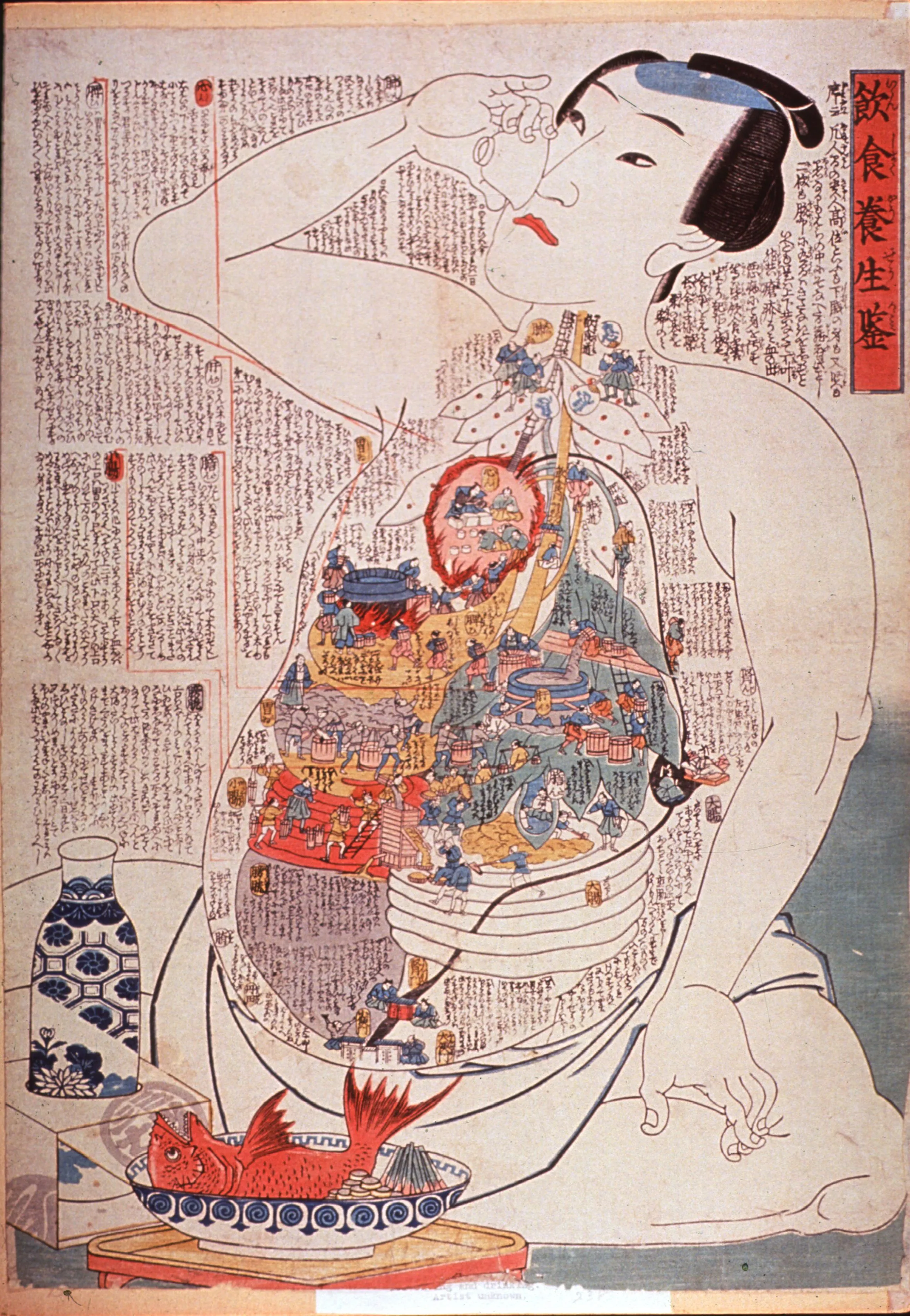
Inshoku Yōjō Kagami — a mirror of rules for eating and drinking — opens a reclining man’s torso to reveal his own digestion as a fully staffed workshop: laborers hauling loads through the stomach, a scholar presiding over a fire in the heart, and two unenviable guards posted at the “urine gate” and the “feces gate.”
Printed in color in 1855, the sheet rewards close looking more than most ukiyo-e: past the man’s face, raised sake cup, and a plate holding a whole fish, his opened belly is a cross-section crawling with figures the size of insects, each one acting out a job an organ is actually doing — stoking, hauling, ferrying loads toward the exits. Dense columns of woodblock-printed text fill every gap the anatomy leaves open.
Open Culture credits the print to Utagawa Kunisada, ukiyo-e’s most prolific 19th-century name — a claim that traces back to the design blog Spoon & Tamago and resurfaces at Hyperallergic. UCSF’s own catalog record for this exact sheet says otherwise: the creator is listed as Utagawa Yoshitsuna, active 1848–1868, a far more obscure member of the same school. A rare-book dealer who separately sold the matching companion print backs that up, listing the artist under his other name, Ittosai. Even a 2006 Japanese anatomy-journal study of the pair hedges the Kunisada credit as merely “presumed,” floating an anonymous “understudy at his shop” as the likelier hand — and a Harvard historian’s essay on the same print skips attribution altogether, filing it as anonymous. The famous name is the one that stuck online; the print’s own keeper doesn’t back it.
The subject is a warning dressed as a diagram. It belongs to Japan’s yōjō genre, health-regimen literature descended from Kaibara Ekiken’s 1713 bestseller Yōjōkun — “the most widely read medical text in Japanese history” — which preached that food and qi must keep circulating or the body sickens. This print restages that advice as bureaucracy: overindulge, and the workers hauling waste toward those two gates fall behind, and the whole village backs up. A companion sheet, Bōji Yōjō Kagami, ran the same premise on a reclining woman, tallying a different appetite’s toll.
UCSF holds both in its Japanese Woodblock Print Collection, more than 400 Edo-period prints acquired for the medical school’s own teaching. Calisphere’s item page, linked above, carries UCSF’s scan and catalog record; the image here is a separate, higher-resolution public-domain scan from the National Library of Medicine, easier to read at full size.