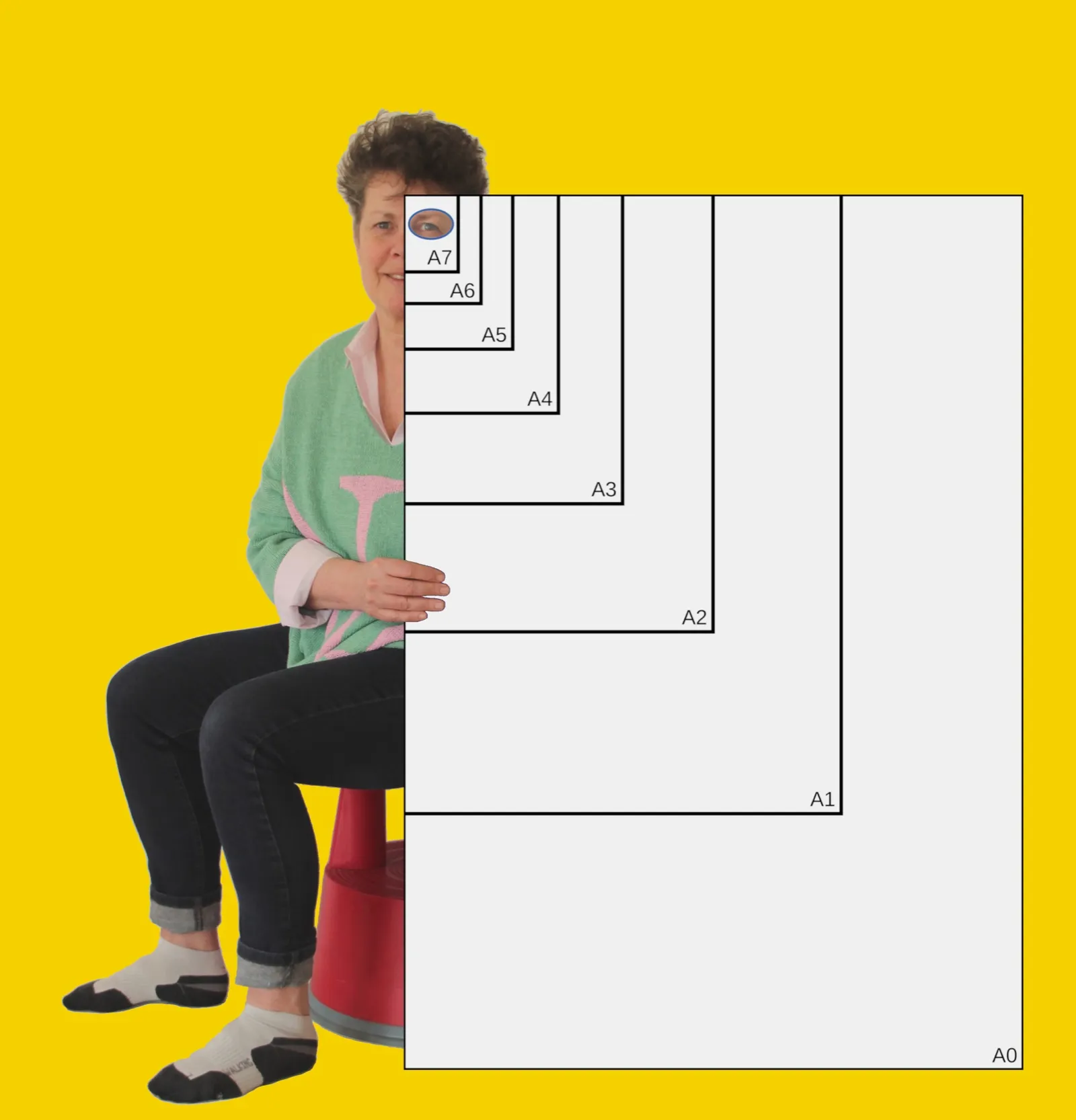
The A series from A0 down to A7, at the scale of a seated person. Photomontage by Frank C. Müller, via Wikimedia Commons — CC BY-SA 4.0.

A4 is not an arbitrary rectangle. Its sides stand in the ratio 1 : √2, so cutting a sheet in half gives the next size in exactly the same shape, and A0 is one square metre, so a sheet of 80 g/m² office paper weighs 5 g.
Markus Kuhn wrote this page in 1996, during a Fulbright year at Purdue, when A4 was hard to buy in American shops. He still keeps it up, in plain HTML: the last revision is from December 2025.
Kuhn follows the rule all the way through. B sizes sit halfway between A sizes by multiplication rather than addition, and C envelopes sit halfway between those, so an A4 letter slides into a C4 envelope, which slides into a B4. The millimetre dimensions are rounded down at every halving, so that two A5 sheets can never come out larger than one A4. The copier’s 71% button is √½, the setting that puts two journal pages onto one sheet with no margins wasted. Technical pens step by √2 as well, so after you reduce an A3 drawing drawn with a 0.35 mm pen to A4, you carry on with the 0.25. Passports are B7 and the German ID card is A7.
The history is the part to forward. Lichtenberg’s letter of 25 October 1786, which Kuhn reproduces in German and in his own translation, opens by reporting what London’s streets are paved with. Then it turns to paper. Lichtenberg had set a young English pupil the problem of finding a sheet that stays the same shape through folio, quarto and octavo. He went to trim ordinary writing paper to the answer with scissors and found, “with pleasure”, that it already had it. He wrote the letter on that paper, enclosed an untrimmed sheet in case the trimming had spoiled the proportion, and asked where the shape came from. He wasn’t first: the same problem had apparently been set in a mathematics examination around 1755. Revolutionary France defined sizes identical to A2, A3 and B4 in 1798 and then forgot them. Walter Porstmann arrived at the system again on his own, and it became DIN 476 in 1922 and ISO 216 in 1975.
Kuhn is an advocate, and parts of the page read like it. The section on US Letter, whose proportions alternate between 17/11 and 22/17 as you go up the sizes, is a sustained case for switching, and its list of North American A4 suppliers, with phone numbers, has aged. The reference half is still the best free account of the system, published under CC BY.