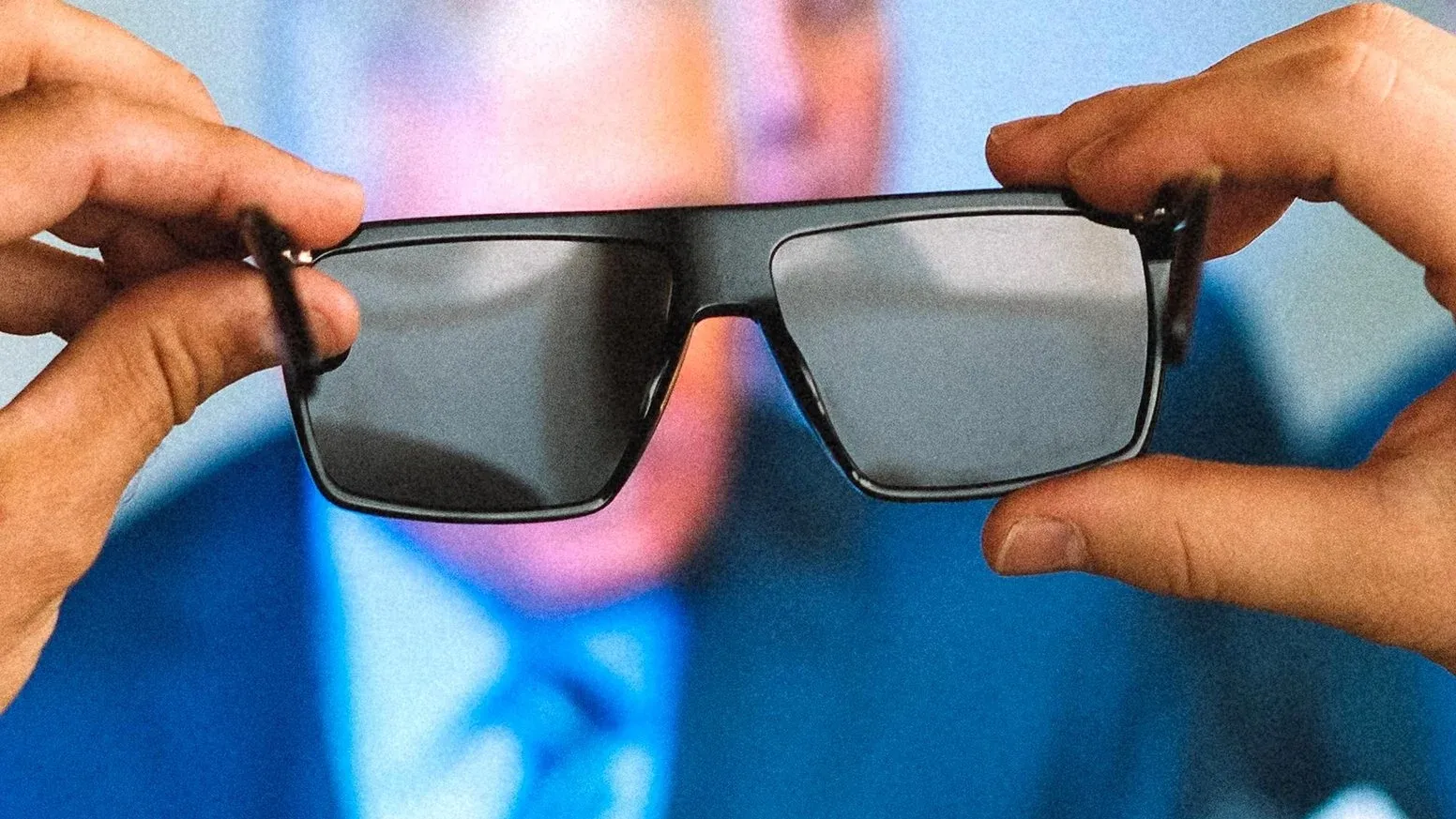
Ordinary polarized sunglasses are cut to pass the light an LCD television emits. Rotate that filter ninety degrees and the same screen goes flat black — which is the whole product, and the reason there is nothing to buy.
The direction is the counterintuitive part. “The light emitted from most LCD and LED displays is vertically polarized,” inventor Scott Blew told Vice. “To block this light we use a horizontal polarizing filter.” Ordinary sunglasses transmit vertically, to kill the horizontal glare off water and roads — which is exactly why wearing a pair in front of a television does nothing at all. IRL’s lenses are the same stock optics as any drugstore pair, TAC 1.1, Cat 3, UV 400, rotated on the way into the frame. No electronics, no coating, no app. An axis.
What that defeats is narrower than “ad blocker” suggests. Most LCD and LED-backlit televisions, some computer monitors, and then it stops. Phones and tablets are OLED and stay lit. Digital billboards stay lit. The lens has one fixed axis and panel manufacturers never standardized theirs, so a screen only vanishes when its own polarizer happens to sit square against yours. The departure lounge goes dark; the thing in your hand does not. IRL shipped v1 labelled a beta and said so on the campaign page, which is why it reads as an argument rather than a gadget that overpromised.
And it was always partly an argument. The frames are modelled on the ones in John Carpenter’s They Live (1988), inverted: Carpenter’s glasses reveal what the billboards are really saying, these switch them off. Ivan Cash’s IRL Labs launched on Kickstarter in October 2018 against a $25,000 goal and closed at $140,920 from 2,030 backers at $49 a pair, manufactured by So-Pal Optics in Wenzhou and delivered in April 2019. The V&A accessioned one as CD.30-2019 and catalogues it as “a provocation and critique, and as a proof-of-concept.” It is not on display.
Nothing here is for sale, and nothing is coming. IRL Labs “has been sunset, for the time being,” and the second version — the one that would have taken OLED with it — never shipped. The site now calls it a research collaboration with the University of Rochester: “a crazy physics problem, that may or may not be possible, but we’re trying!” Which leaves 2,030 pairs loose in the world, and a campaign still captioned, a little defensively, No Special Effects Used.