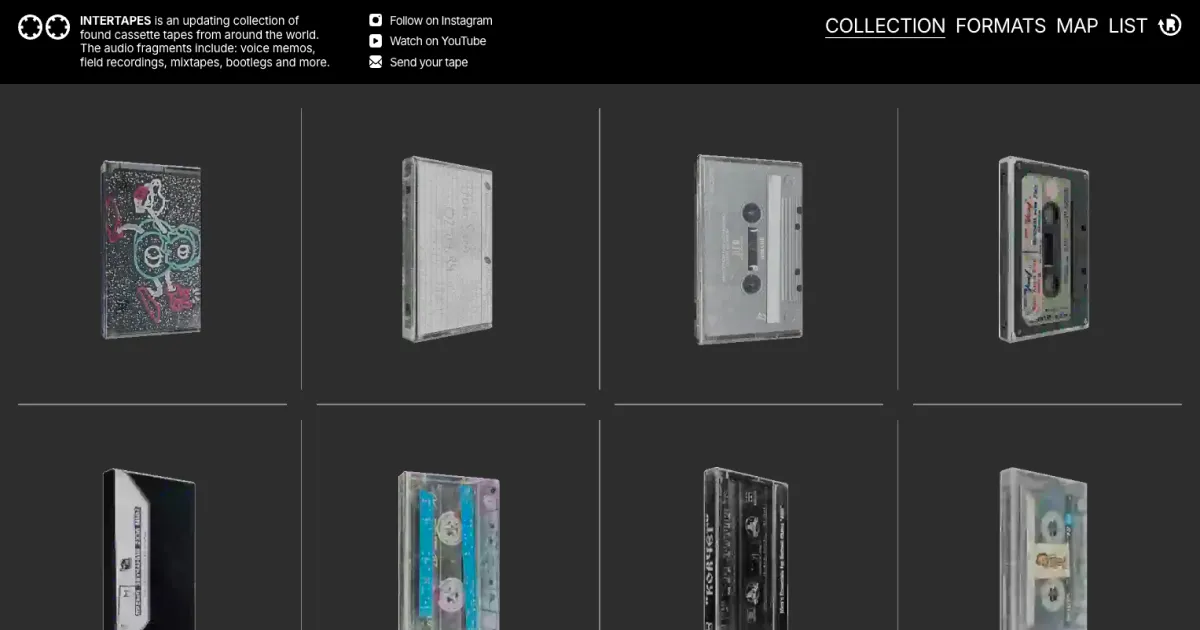
Twenty-one cassettes that somebody found and did not throw away, photographed, located, dated and played.
The collection is curated by retry.studio, and the thing that makes it an archive rather than a mood board is the catalogue. Every tape gets a number, a name, a country and a city, a language, a content class — Music, Speech, Radio, Noise — a year it was recorded and a year it was found. You can browse it as a wall of photographs, as a map, or as a sortable list, and the list is where it stops being pretty and starts being interesting.
The best entry is number 6. Name: Data. Country: Spain, Barcelona. Contents: Code. Language: Commodore BASIC. Recorded 1985, found 2023. It sits three rows above a WBLS broadcast taped off New York radio in 1994 and two rows below a Turkish reading lesson from sometime in the 1970s, filed under exactly the same headings. A cassette of a computer program and a cassette of a stranger’s voice get the same eight columns, which is the correct decision and a slightly startling one.
The dating notation is the other thing worth staying for. The recorded column reads 1989?, 197X, 199X, 1995+, 1988+ — a small grammar of uncertainty that carries precisely as much confidence as there is and no more. Tape 1, Aus dem Gerichtssaal, German speech recorded in Berlin, is dated 1989? and was found in 2017: nine years in the collection and still a question mark. Nobody has quietly rounded it to 1989 to make the table tidy.
There is a Formats page that nobody asked for and everybody should see — the Compact Cassette of 1963 and its four tape types, then Minicassette (1967), Microcassette (1969), M-Cassette (1975), Elcaset (1976), Akai MK (1984), Picocassette (1985), DAT (1987), NT (1992), ADAT (1992), DTRS (1992), DCC (1993). Most of those lost, and the losing is the point.
It is small and says so: twenty-one tapes, found between 2017 and 2025, five of them out of Barcelona alone, which tells you more about where the curator lives than about where cassettes end up. There is a form to send in one of your own. That is the whole business model, alongside an Instagram, a YouTube channel and a donate link.
Someone left a voice on a tape and then left the tape. This is the address it ended up at.