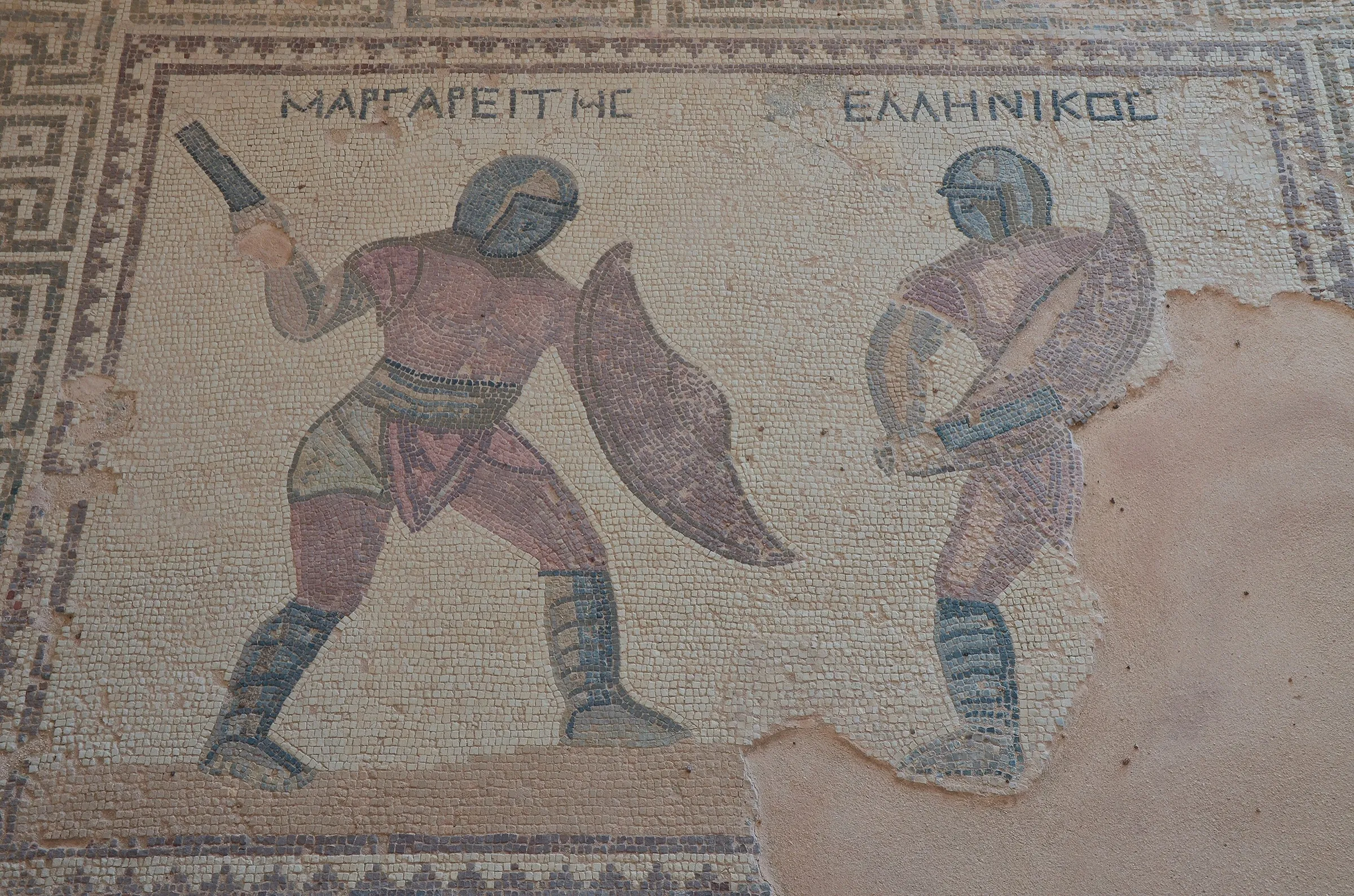
Margarites (left) and Hellenikos, House of the Gladiators, Kourion. Photo by Carole Raddato, via Wikimedia Commons, CC BY-SA 2.0.

On a clifftop in southwest Cyprus, a Roman floor shows gladiators mid-fight with their names spelled out above them, like a cast list. It is the only place on the island where the arena is set in stone chips.
The building takes its name from two mosaic panels in the northern and eastern porticoes of its courtyard, dated to the late 3rd century AD. They are the only gladiator mosaics in Cyprus. In one, two fighters face off under inscribed Greek names: Margarites and Hellenikos, helmeted, shields up, one arm raised to strike.
The second panel has more story. A heavily armed gladiator named Lytras, dagger held point-up, presses an opponent of whom only a helmeted head and a foot survive. Between them stands an unarmed figure with a rod: Darios, the referee, stepping in to check Lytras. The names are the detail that matters: four people, referee included, held still at the moment of a decision.
The surviving pieces are what you would expect of a floor that is 1,700 years old. Plaster covers part of the Margarites panel, and the opponent in the Lytras scene is mostly gone. Nor is it certain what the building was. Scholars have read it as an elite house or, more likely, a public palaestra, a training hall with an attached bath, entered from the east through the baths. Earthquakes in the late 4th century damaged it badly, though its eastern rooms stayed in use until the mid-7th century.
To see it, you visit Kourion, a hilltop site west of Limassol, near Episkopi. The House of the Gladiators sits south and east of the House of Achilles, so one walk covers both. The Cyprus Tourism Organisation lists the site as open daily 08:30 to 17:00 from 16 September to 15 April and 08:30 to 19:30 from 16 April to 15 September, with admission of €4.50. Hours and prices change, so check the Department of Antiquities before you go, and avoid midday in summer: there is little shade.