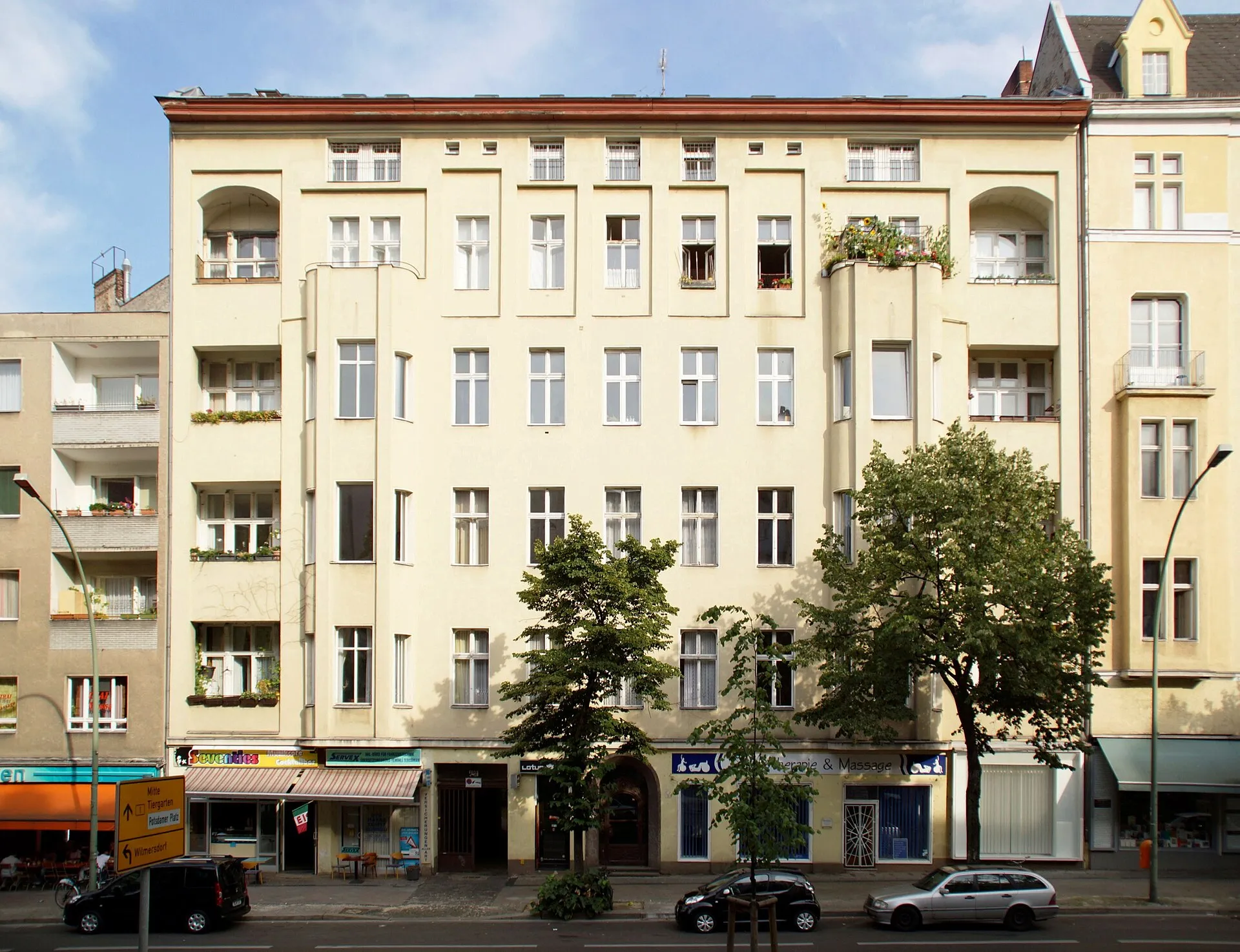
Hauptstraße 155, Berlin-Schöneberg. Photo by Detmar Owen, Wikimedia Commons — CC BY-SA 3.0.

David Bowie spent 1976 to 1978 in a seven-room flat on the first floor of an unremarkable Schöneberg tenement, above an auto-parts shop. The building is still unremarkable. Twice every January, strangers push fresh roses into the iron flowers on its door.
The address is Hauptstraße 155, and the first thing to say about it is that there is nothing to see. No museum, no gift shop, no restored interior — it is a working residential block, flanked by a tattoo parlour and a physiotherapy clinic, its entrance a cast cement archway of the sort Berlin put up by the hundred during the Gründerzeit. The oak door is handsome and defaced in roughly equal measure: cast-iron floral ornaments, several hastily sprayed tags. Its lock still has two keyholes set at ninety degrees to each other, made for the pass-through keys of the early twentieth century, a design meant to force tenement residents to lock up behind themselves.
What makes it worth standing in front of is the flowers. Real roses turn up wedged into the metal petals of that ironwork, left on 8 January or 10 January — his birthday, and the day he died — by people who mostly do not know each other. By late February they are withered and still there. In 2016 the city added a memorial plaque beside the entrance, which is the official gesture; the roses are the unofficial one, and they are the reason the building reads as a site rather than a stop.
Bowie came here in 1976 to get out of Los Angeles and off cocaine, which is the part of the story the plaque does not carry. His assistant Coco Schwab found the flat and shared it; she painted the walls white, turning the place into a private gallery for the bleak canvases he was producing at the time. Iggy Pop moved in with him and did not last long in the main apartment — the accounts agree he was turned out over food taken from the fridge — after which he took a flat of his own in the back courtyard of the same building. Two of the most influential musicians of the decade, then, in one Schöneberg address, one of them out by the bins.
Worth being precise about what actually happened here, because the shorthand oversells it. This period produced the run of records known as the Berlin Trilogy, but only “Heroes” was recorded in Berlin proper, at Hansa by the Wall. Low was made largely at Château d’Hérouville in France and mixed at Hansa; Lodger was recorded in Montreux and New York after Bowie had already left. Hauptstraße 155 is not a studio and never was. It is where he lived while the work was going on — where he cycled to the studio, drank at the neighbourhood bars, and was, by every account including his own, left alone by Berliners with better things to do than notice him.
That last fact is the one the building still demonstrates. Nobody has turned it into anything. You can stand at the door, look at the roses somebody left in January, and then get out of the way of a resident with shopping.