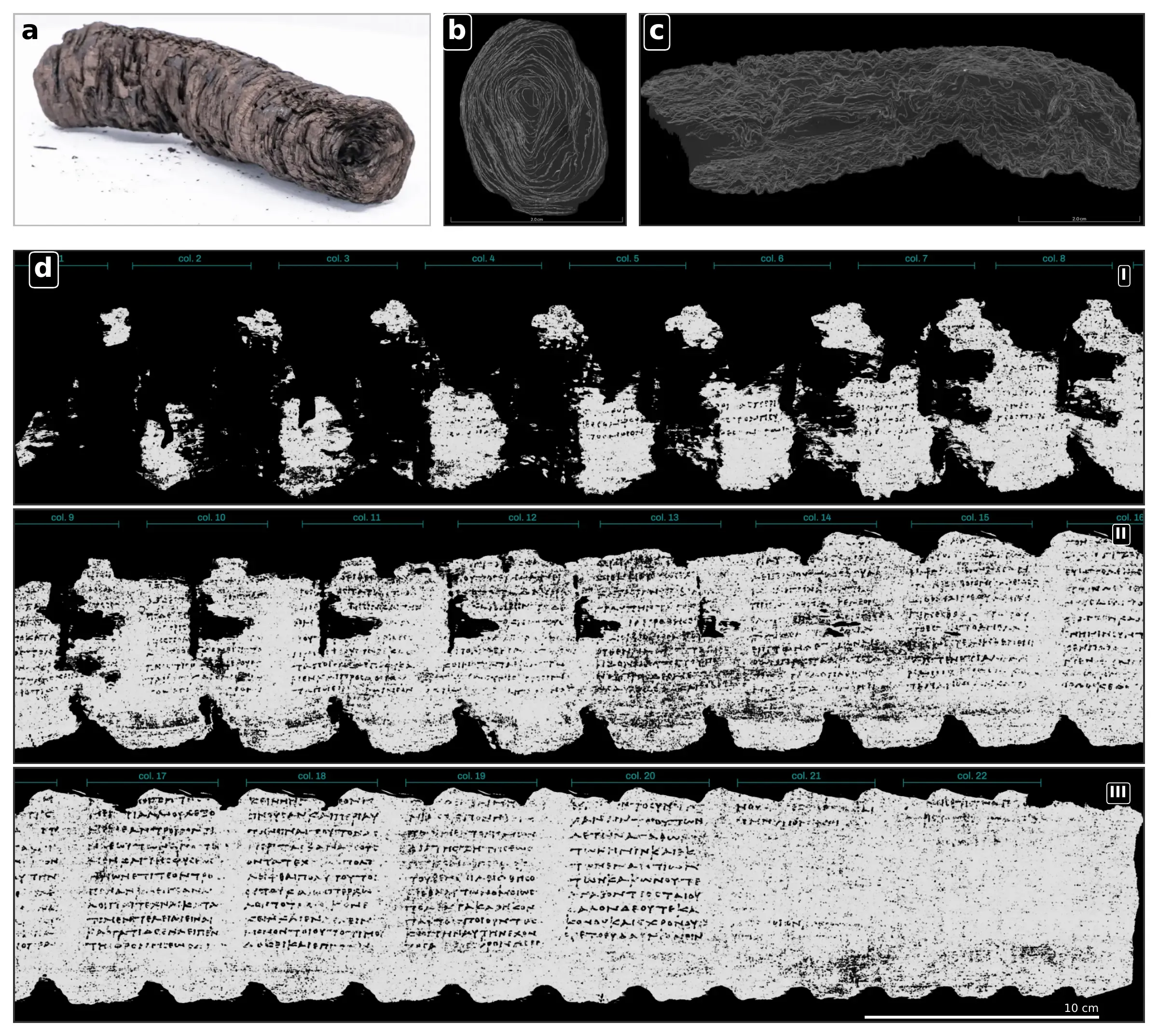
From object to text, in one image: the sealed lump, the X-ray cross-sections of the sheet wound inside it, and the twenty-two columns of Greek that came out the other end.
PHerc. 1667 — carbonized by Vesuvius in 79 AD and far too fragile to unroll — has been virtually unwrapped with X-ray scanning and machine learning, and its surviving text read continuously from beginning to end. It is the first Herculaneum scroll ever read that way, and you can pan across the unwrapped page yourself.
The Herculaneum papyri have always come with a cruel catch: they survived the eruption only by being carbonized, and carbonization is what makes them unopenable. To unroll one is to destroy it. That is not a hypothetical — it is PHerc. 1667’s own biography. Hand-opening attempts in the nineteenth century, and again in 1969 and the 1980s, tore away its outer layers and left a compact inner core roughly 8 cm tall out of an original 19–24 cm. By the 1980s it was written off as unreadable. Hundreds of rolls in the same library have sat sealed ever since, their contents intact and unreachable at the same time.
On 25 June 2026 the Vesuvius Challenge announced it had read that core straight through. Worth being precise about what “read end to end” means, because it is both less and more than it sounds: this is not the entire original scroll — more than half of that was destroyed by the people who tried to open it — but it is the entire preserved text, roughly 1.4 metres of papyrus and around twenty-two columns of Greek, read continuously rather than in the isolated words and patches that every previous milestone produced. That distinction is the whole story. In October 2023 the Challenge recovered a single word from a sealed scroll (ΠΟΡΦΥΡΑϹ — “purple”). In February 2024 its Grand Prize went to a few columns’ worth, around 5% of one roll. This is the first time anyone has read a rolled Herculaneum scroll as a document — front to back, in order, with enough continuity for scholars to actually work on.
The method is the same idea scaled up and hardened. The scroll was scanned with high-resolution phase-contrast X-ray microtomography on the BM18 beamline at the European Synchrotron Radiation Facility in Grenoble, in collaboration with the National Library of Naples “Vittorio Emanuele III”, which holds the papyri. From those volumes the team reconstructed the scroll’s geometry, traced the wound sheet and flattened it into a readable surface, then trained machine-learning models to pick out ink that is chemically and visually almost indistinguishable from the carbonized papyrus under it — the middle and bottom panels of the image above are exactly that pipeline. Papyrologists then examined and transcribed every reading. Two companion results landed alongside it: in PHerc. Paris 4, higher-resolution imaging now makes ink directly visible in the 3D X-ray data, and segmenting it reproduces the 2023 Grand Prize reading one-to-one — an independent confirmation, from better data, that the ML readings were real and not hallucinated. And in a third scroll, PHerc. 139, the title block was recovered: Philodemus, On Gods, Book 8.
What PHerc. 1667 actually says is the part worth slowing down for. It is a philosophical treatise on ethics, and the evidence points to a Stoic work — notable in itself, since the Villa dei Papiri library is dominated by Epicurean material (Philodemus, as the PHerc. 139 title above obligingly demonstrates). It turns on human nature, impulse, and moral progress, and its final preserved column names Aristocreon, nephew and disciple of Chrysippus, which together with its language and themes places it in a Stoic context and dates the work to the 2nd century BC — some papyrologists read the hand as late 3rd. The author is not named and remains unknown; the lead papyrologist’s team has floated Chrysippus himself as a suspect, but the title and attribution were lost long ago and the scroll does not give them up. A sentence nobody had read in two millennia: “…we will inquire into something, but we will not grasp it, if in some way we depart from ourselves and from our own nature…”
Honest limits, and there are several. The readings are fragmentary — the papyrus is damaged and there are gaps wherever the surface is gone, and because only the lower band of the roll survived, what you get is the lower parts of those twenty-two columns rather than whole ones. The work is a preprint, not yet peer-reviewed. The attribution is open. And PHerc. 1667 is one scroll out of hundreds still sealed. What keeps this from being a press release is that the whole thing is open: the tomographic data, reconstructed surfaces and transcriptions are released under a Creative Commons licence at scrollprize.org/data, archived at the ESRF, with the code on GitHub — anyone can check the work or apply it to the next roll. And the page itself is the artifact, not a write-up of one: it opens with the complete unwrapped writing surface as a pan-and-zoom viewer you drag sideways through all 1.4 metres and click to magnify, with the translated passages, a cross-section video sweeping through the sealed roll, and a high-resolution download of the page. Go read the columns.