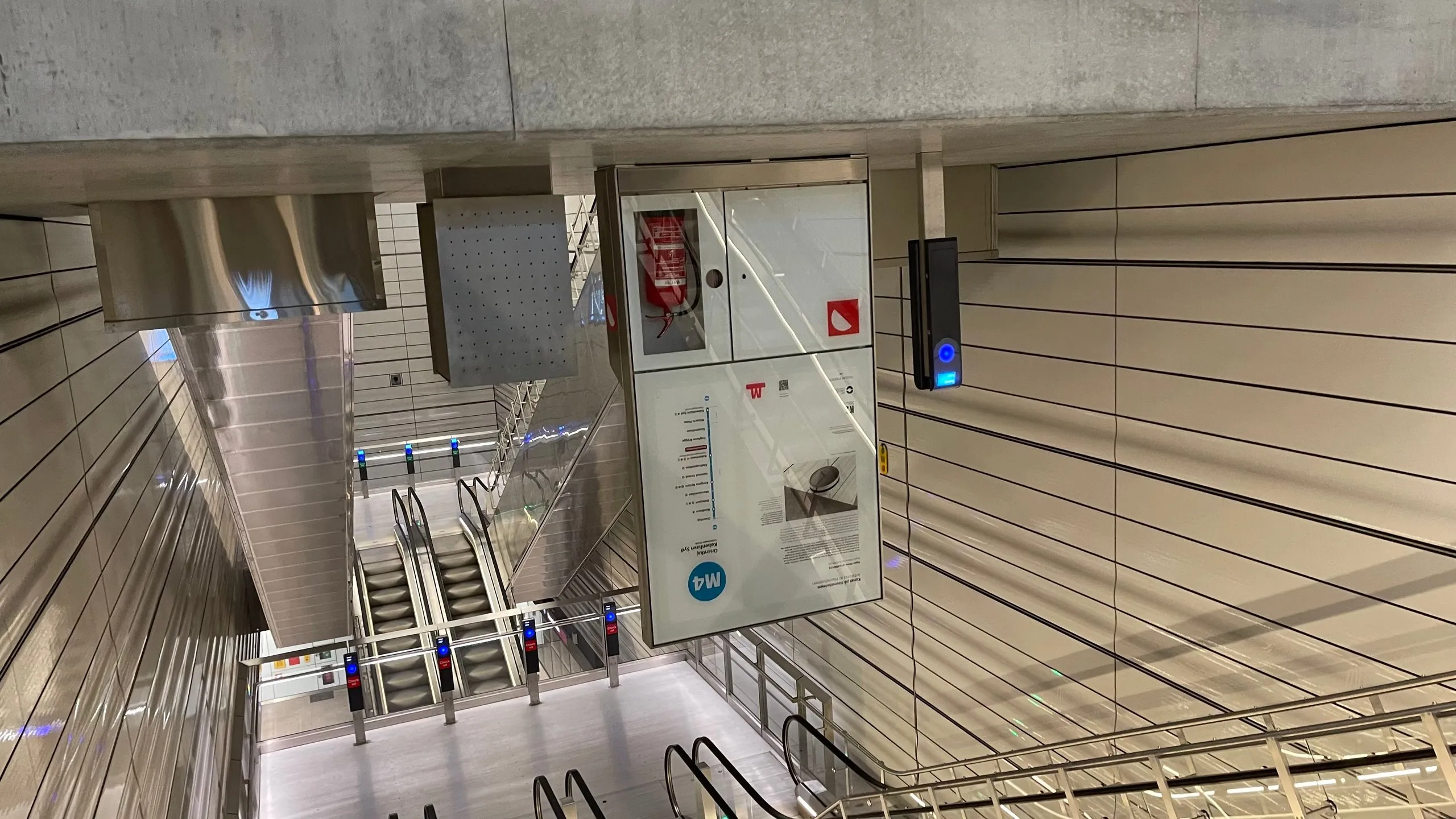
Upside-down fixtures over the escalators at Havneholmen. Photo by ThatGuyOnline, via Wikimedia Commons, CC BY 4.0.

Ride the escalator down at Havneholmen and the station’s furniture has come loose: card readers hang from the ceiling, screens jut from the walls, clocks spin backwards. It’s an artwork about travelling at the speed of light, and the real fixtures are still where you need them.
Havneholmen opened on 22 June 2024, one of five new stations on the M4 extension to Sydhavn and Valby, one stop from Copenhagen Central and beside the Fisketorvet mall. The Danish artist group Superflex made the art, an installation they call Super Metro.
The premise is a thought experiment. “We imagined the Metroselskabet increasing the speed of the trains so that you actually start travelling at the speed of light,” Superflex’s Rasmus Nielsen told the operator. “The space starts to curve, gravity changes, and the benches, blackboards and rubbish bins start to populate the walls and ceiling.”
So they did. Looking up from the escalators, you see the standard kit of a Copenhagen station (departure screens, benches, bins, the stands for tapping travel cards) bolted to walls and ceilings at angles no one could use. A fire-extinguisher cabinet and a line poster hang upside down. On the platform, several clocks have gone their own way; Superflex describes hands turning at different speeds, forward and back. Its own text pushes the idea further: the tunnels as black holes, passengers growing younger on the trip, the ceiling becoming the floor.
None of it gets in the way. Working versions of the fixtures sit in their usual places, so you can still read the time and see when the next train is due. The joke depends on that: the real clock is right there, so you notice the wrong one.
What makes it unusual is how the client behaved. “Metroselskabet always said we should just go for it,” Nielsen said (in the Danish, bare fyre den af). “On some points they were actually wilder than we were. It’s usually the other way around.” The M4 extension was the first time Copenhagen’s metro built art into its stations from the design stage. The Danish Arts Foundation picked one artist per station, with funding from the Obel Family Foundation and the Villum Foundation. The other four stations have their own works, so a ride to Copenhagen Syd makes a short gallery crawl.
One limit: it’s a working station, not a gallery, and the best views are from a moving escalator. Ride down, ride back up, then wait on the platform until a clock does something it shouldn’t.