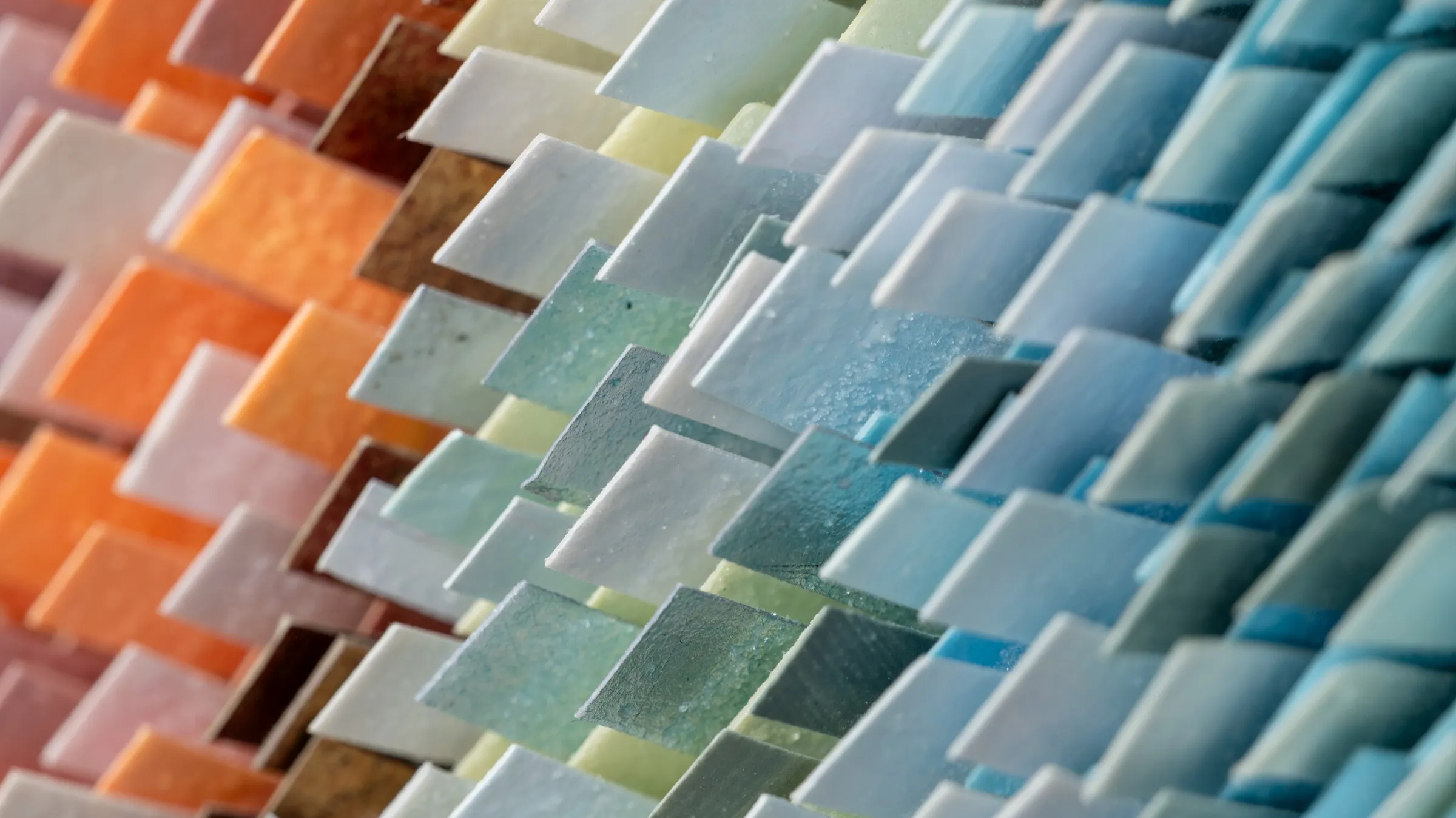
Down the surface of a finished work. Each tile stands proud of the panel; the pale line along every one is the cut edge of the paper. Photo: Gregor Becker Studio.
Becker guillotines hand-painted watercolour paper into two-centimetre tiles and stands each one on edge in wet adhesive — tens of thousands to a panel, with no drawing underneath. His first museum solo show opened in July.
The account on his own site is unusually concrete for an artist’s statement. Watercolour paper chosen by weight and texture, painted by hand — often on both sides, in multiple layers, some sheets taking gold or silver leaf. A hand-operated guillotine reduces the sheets to tesserae of roughly two centimetres; one work, he says, may need tens of thousands. Each fragment is set into a wet adhesive matrix on a wooden panel with tweezers, angled to catch light a particular way, in sittings that run to forty-eight hours. In the studio photographs the cut tiles are waiting in old plastic drink bottles, sorted by colour.
The part the roundups drop is what happens next. The panel cures for weeks, and then Becker shapes the surface by hand — bent, curved, refined — and seals it under a thin layer of resin. The finished pieces are not flat: photographed from the side they bow gently off the wall, so the relief of the standing tiles rides on a curve.
“Standing on edge” is The Awesomer’s phrase rather than Becker’s; his own word is “angled”, and the macro above bears both out. “Freehand, no sketches” is his, verbatim: there is no sketch, no preparatory drawing, no plan transferred to surface. He dates the method to 2014 and calls it a technique that exists nowhere else — his claim, not a checked one.
He was born in Mainz, trained in graphic design and landscape architecture, and built gardens in Germany, the United States and Australia before any of this. He works in Soriano nel Cimino, in Tuscia — the Viterbo country north of Rome, not Tuscany — in a studio surrounded by gardens he keeps himself. About thirty works from 2015 to 2026 hang at the Museo di Palazzo Doebbing in Sutri until 18 October 2026, curated by Antonio Arévalo, €10 in. It is his first solo museum exhibition.
Nothing is for sale in public: no shop, no price list, no gallery representation, no auction record; the only contact anywhere on the site is a Gmail address. The Italian press puts the work in private collections. And Becker supplies the caveat this page cannot get around: “These works exist only when you are present. Take all the photographs you like: nothing happens.”