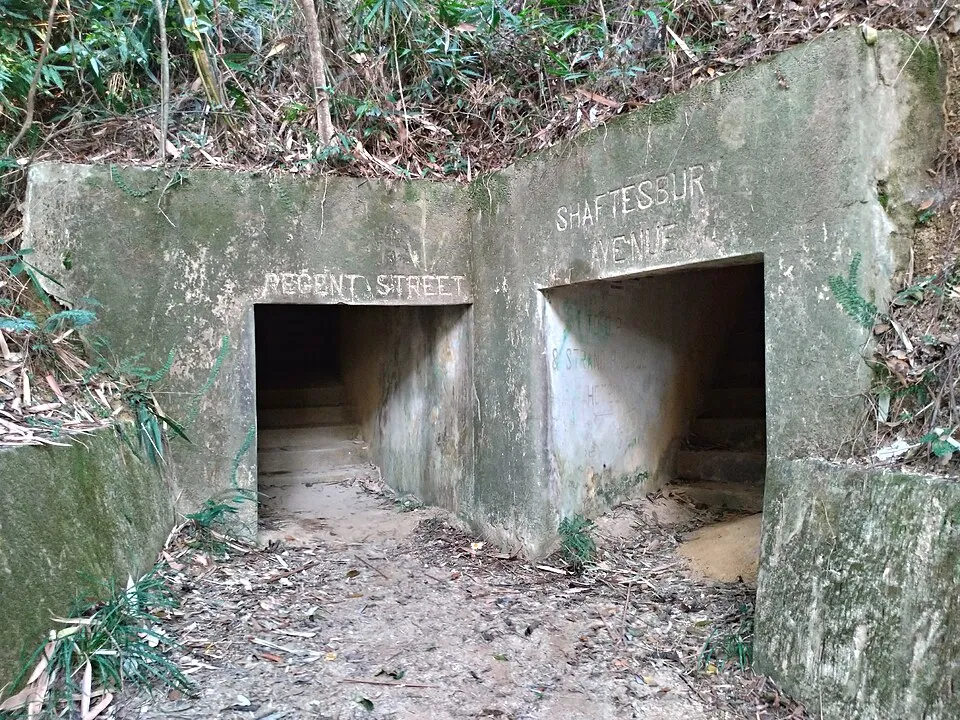
Somebody stood on a Hong Kong hillside in the 1930s with a paintbrush and labelled the tunnel mouths Regent Street and Shaftesbury Avenue. The lettering is still there. The line lasted two days.
The Gin Drinkers Line ran eighteen kilometres across the New Territories, from Gin Drinkers Bay in the west — today’s Kwai Chung — to Port Shelter at Sai Kung in the east. Construction started in 1936 and took two years: trenches, pillboxes, bunkers and connecting tunnels, sited against an infantry advance from the north. The British called it the Maginot Line of the East, which in 1938 was a boast.
Its keystone was the Shing Mun Redoubt above the reservoir: a cluster of pillboxes joined by tunnels, holding the command post and the artillery observation post for the whole position. And the tunnels were named after central London. Oxford Street, Regent Street, Charing Cross, Haymarket, Piccadilly, Shaftesbury Avenue — inscribed over the entrances and exits so troops moving underground in the dark had a mental map they already owned. The lettering survives. You can walk from Regent Street to Charing Cross today, in surroundings the names do not flatter.
The arithmetic is the part that stays with you. Shing Mun Redoubt was built for 120 men. On the night the Japanese came it held 43. The invasion of Hong Kong opened on 8 December 1941; the assault on the redoubt went in on the night of 9–10 December and it fell almost at once. The whole line — two years of concrete, designed to buy several weeks — was gone in roughly two days. The survivors fell back to Hong Kong Island and the colony surrendered on Christmas Day.
What was wrong with it was not the concrete. The positions were correctly sited and genuinely well built; they were simply spread far enough apart that a garrison of the size Hong Kong actually had could not see between them, let alone hold them. It was a line drawn for an army that never arrived.
Most of it is now hiking. The Shing Mun War Relics Trail runs through the redoubt off MacLehose Section 6, the tunnels are open and unlit, and the Antiquities Advisory Board has a formal appraisal of the site — which means the thing is protected as heritage rather than maintained as a monument. Bring a torch. The floors are wet, the ceilings are low, and the West End is very badly signposted.