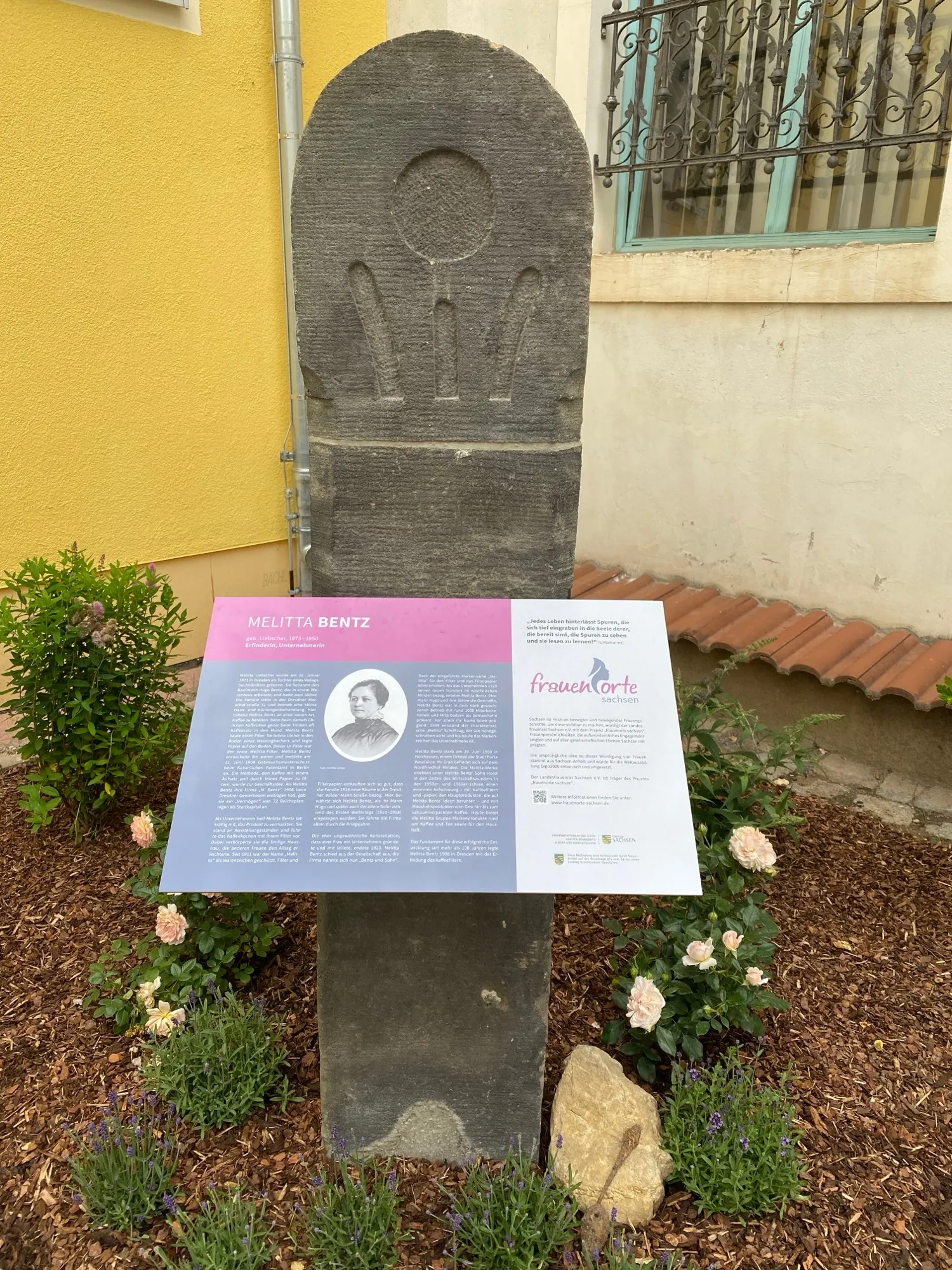
In 1908 Melitta Bentz punched holes in the bottom of a metal cup, lined it with a sheet from her son’s school exercise book, and poured coffee through it. The stone stands in the yard where the business that followed finally outgrew her.
She was thirty-five, in a flat on Marschallstraße, and the problem was grounds in the teeth and the bitterness that came with them. The fix took a hammer and someone else’s stationery: perforate a small metal vessel, cut a disc of blotting paper from her son Willy’s exercise book, seat the paper in the cup, pour. What she had was the pour-over, arrived at from first principles in a kitchen.
She protected it on 20 June 1908 — not with a patent but a Gebrauchsmuster, the German utility model, entered in the Imperial Patent Office’s register that July. The patent office’s own account of her calls her one of the first women to protect an invention of her own, which is a careful way of saying the category barely had women in it. In December she registered the firm M. Bentz at the same address, with the cash box holding under a mark.
Trachau is the next chapter and the reason the stone is where it is. In 1914 production moved out of the flat into a disused locksmith’s workshop on Wilder-Mann-Straße with fifteen employees — and then the war took the coffee. Imports stopped, her husband and eldest son were conscripted, and the company kept its lights on making cardboard boxes. It recovered, expanded into the building next door, and in 1929 left Dresden for Minden, where the group still is, still led by a Bentz.
The memorial went up on 29 June 2020, seventy years to the day after she died. It is the twentieth marker from frauenorte sachsen, the Saxon women’s council project that plants these at addresses where women actually did the work, and its best detail is that the stone was already there. It had stood elsewhere on the property, was pulled out years earlier to widen a fire lane, and turned up broken into three pieces during the site’s renovation. The housing cooperative that occupies the yard now put it back together and stood it up in a bed of roses, with a plaque: Melitta Bentz, geb. Liebscher, 1873 bis 1950. Erfinderin und Unternehmerin.
Two details are genuinely disputed and it seems worth saying so over a cup of what she made possible. The patent office says the vessel was brass; other accounts insist on a tin can punched with nails. And her starting capital is given as 72 pfennigs by the patent office and 73 by the Dresden city record. Nobody has settled either.