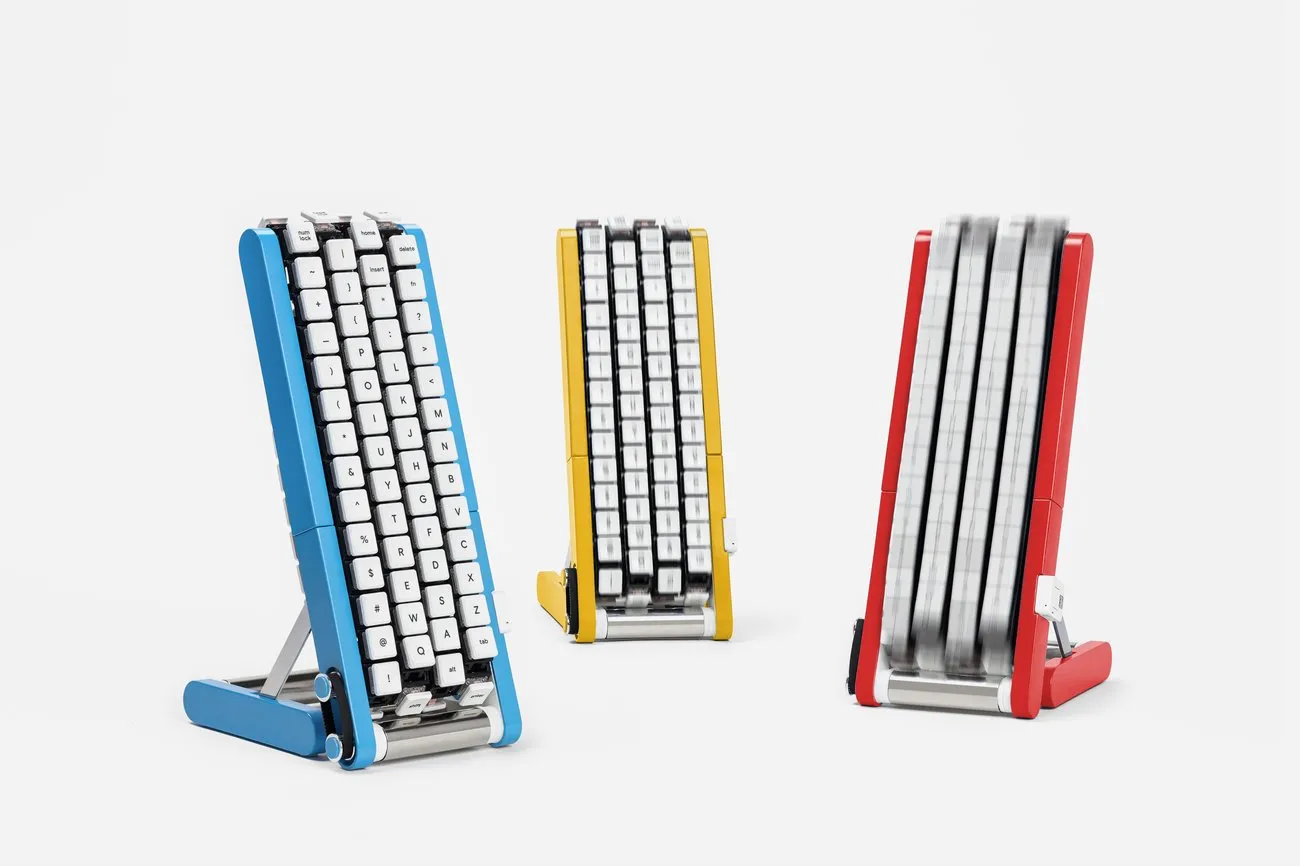
Gboard Conveyor Belt version, shown in blue, yellow and red. Photo: Google Japan, via the Gboard team’s announcement.
Most keyboards ask your hand to travel to the keys. Google Japan’s newest one reverses the arrangement: the keys ride conveyor belts and come to you.
It is the fifteenth entry in the Gboard team’s near-annual series of deliberately odd keyboards, and the announcement is written with a straight face. Its argument: a keyboard assumes two hands, so typing one-handed means moving your whole arm. Move the keyboard instead. You tap each letter as it passes under your finger, one hand covers everything, and the post notes you can do it while drinking tea or using a mouse.
The build guide gives the arithmetic. Four belt loops of 29 keys each, 116 keys in all, and both uppercase and lowercase letters can be typed directly.
The date is part of the joke. The team picked October 1 because the common standard keyboard has 101 keys. The series began on April Fools’ Day in 2010 with a Japanese input drum set, and moved to October 1 in 2021 with a teacup-shaped keyboard. Later entries in the repository include a bar, a CAPS version, a double-sided keyboard and last year’s dial.
Nothing is for sale. The announcement says plainly that no sale is planned; instead, google/mozc-devices publishes the 3D-printable parts, KiCad board files and firmware, and the README adds that it is not an official Google product. The bill of materials is not small: about 150 printed pieces, a small geared motor, a driver board, an ATOMS3 Lite controller, and 116 Kailh Choc low-profile switches with keycaps. Several parts are linked to Japanese retailers.
Two limits to know before you order switches. The guide’s Bluetooth edition, the version that behaves as a working keyboard, is marked “coming soon,” and the board documentation says the same. What the guide walks through today is the Moving Keys edition, the motorized belt. And the announcement itself is in Japanese; the repository README is in English.
As a typing tool, it is a joke. As an object, a four-lane conveyor of keys is a pleasure to look at, and the design files are free to study.