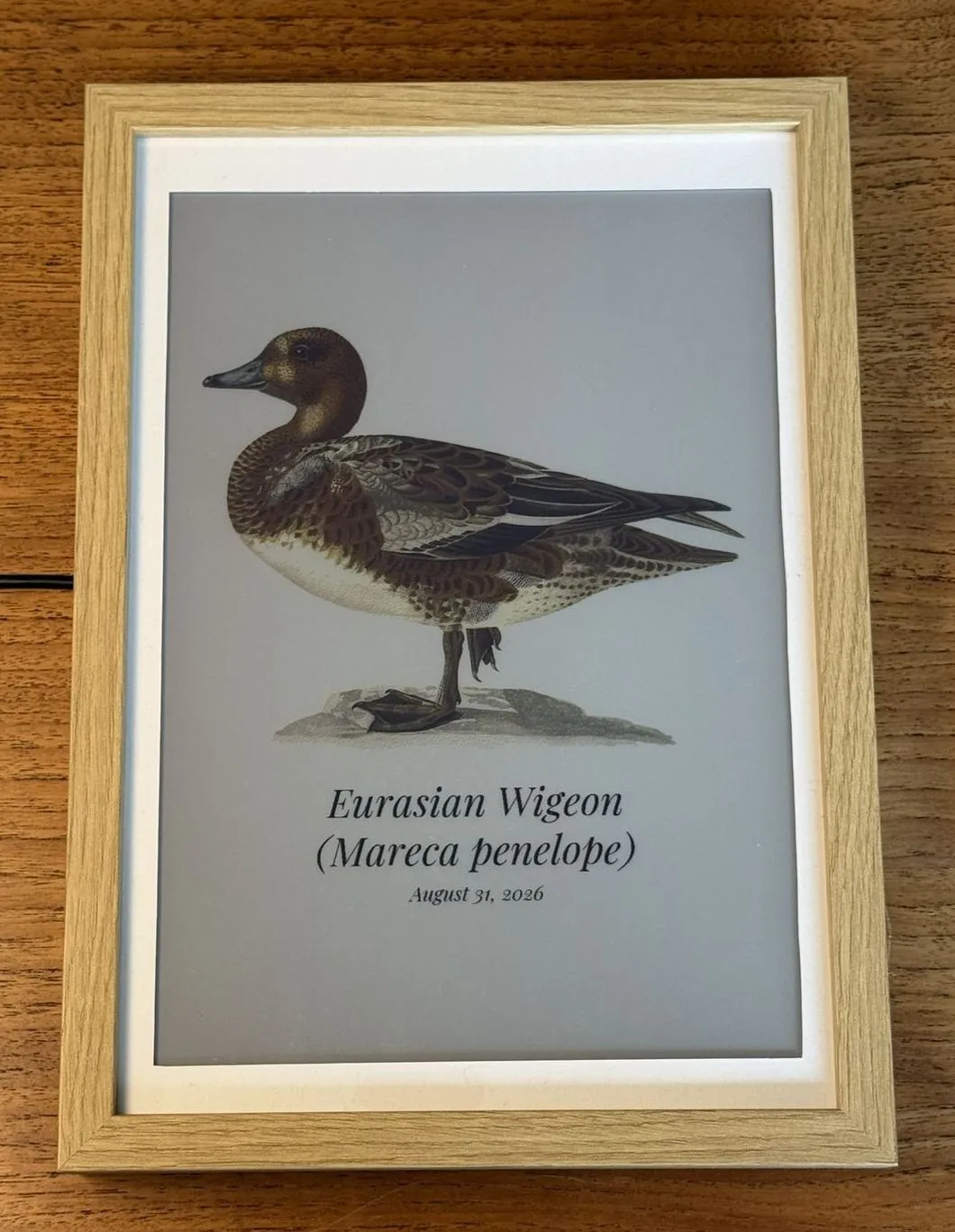
One detection, rendered. The illustration was cut from a real plate; the caption and date are the frame’s.
A microphone outside hears a bird, and the frame on the wall changes to show it. Not a photograph and not a generated picture — a bird cut out of a plate somebody engraved in the 1800s.
The hardware is four things: a Raspberry Pi 5, a 13.3-inch Inky Impression e-ink panel, a microphone, and an A4 frame. BirdNET-Go does the listening and the identification, entirely on the machine; Fugleramme polls its API, matches each detected species to an illustration, and redraws the panel. If you already run BirdNET-Go somewhere, point the frame at it instead — same box or anywhere on the network — and if you have no panel at all, the same view serves as a web kiosk on port 8080.
The art is where the work went, and it is the reason to care. Over 800 cut-outs covering more than 400 species, and the README is precise about their provenance: “every one taken from a real plate and hand-curated for this project (no art is AI-generated, though some has been retouched with AI).” Each detection is matched, background-removed, and packed onto a textured paper page with the larger birds placed toward the centre and everything sized by body mass, so a jackdaw and a goldcrest land on the page at the ratio they have in life. A morning with nothing on it shows a bare perch.
That precision reads differently once you look at the README’s own list of similar projects, two of which describe their illustrations, in their own words, as AI-generated. The frame exists because Arne Giacomo Munthe-Kaas, in Bergen, had a WWF Verdens naturfond poster by Axel Thorenfeldt on his wall and wanted the version of it that showed the birds actually in his garden. Cutting four hundred species out of real plates by hand is the expensive way to get there, and it is the whole difference.
The honest limits are stated up front. The plates are Scandinavian, British and central European, so the Nordics, the British Isles and Germany are well covered and “elsewhere not so much (yet)”. It is “still in early development: expect the odd bug and a few unpolished edges.” And the licensing is layered rather than simple — the code is MIT, but BirdNET-Go is CC BY-NC-SA and non-commercial only, and each art folder carries its own terms plus a manifest naming the plate every file was cut from. Ten weeks old and 1,681 stars.