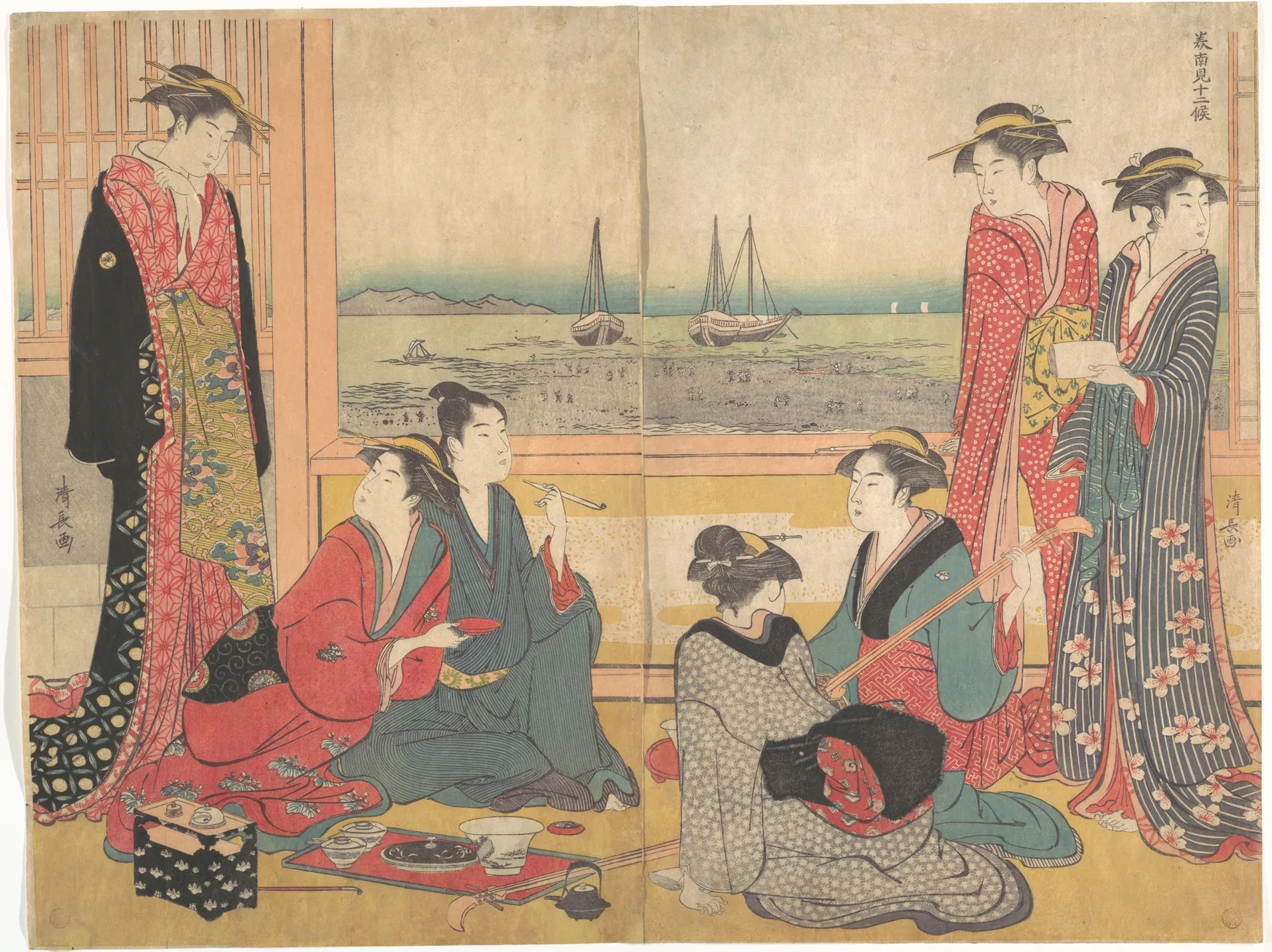
Torii Kiyonaga, “Teahouse in Shinagawa”, c. 1783 — given to the Metropolitan Museum by Wright in 1921. The Met’s own catalogue lists the medium as “ink with color reprinted and revamped on paper”. Metropolitan Museum of Art, JP1268a, b, public domain.
Frank Lloyd Wright sold Japanese woodblock prints on the side for decades, and Julia Meech’s research found that for years it earned him more than designing houses did. It ended in 1919, when prints he had been sold as originals turned out to have been secretly recoloured — and he had already passed some of them on.
He was not a collector who occasionally sold. He was a dealer who wrote it down. Meech found a letter from Wright to S. C. Bosch Reitz, the Metropolitan’s curator of Asian art: “In this matter I am a merchant and expect to be treated as one. I have little use for the gentleman dealer in works of art. He bores me.”
The trade was straightforward and it was lucrative. On the 1913 trip he bought 1,400 prints for two Boston collectors — the Spaulding brothers — for $100,000, and took a $25,000 commission. From 1918 the Met bought hundreds from him at a flat $62.50 a print, $75 for the rarer ones; the museum’s catalogue cards recorded the seller as “F.L. Wright”, which is how Meech, then a curator there, noticed any of this. In 1921 the Met trustee Howard Mansfield paid him $3,650 for a single Utamaro. Meech’s estimate for the whole career is around $300,000.
The find said Wright first sailed to Japan in 1901. He didn’t. Open Culture puts his first voyage “eight years” after the 1893 Columbian Exposition, and the arithmetic is where the error comes from — the trip was in 1905, a three-month tour with his wife Catherine, documented by the photograph album he brought back and by the Japan Society exhibition Meech built her book around. He returned in 1913, and again for the Imperial Hotel between 1917 and 1922. He never went back after that.
The 1919 affair is the part the article leaves out. A Tokyo dealer, Hayashi Kyûgo, sold Wright “revamped” prints — genuine but faded impressions given fresh colour from recut blocks, a technique refined by the collector Takamizawa Enji, whose artisans were good enough to fool most connoisseurs of the period. They were spotted among a hoard of 1,500 prints Wright brought home that year, some already sold; the connoisseur Judson Metzger identified the fraud. One sale of $60,000 to four American collectors had to be unwound, and Wright made it good out of his own holdings, replacing the recoloured sheets with clean ones. Who those four were, and what he said in his own defence, I could not establish from sources I could read; Meech covers it at pages 142–150. The one thing that survives in public is the diptych above, which he gave the Met two years later, and which the Met catalogues to this day as revamped.
The money explains the whole arrangement. Wright borrowed against prints and often didn’t repay; the collection was collateral before it was a legacy. On 6–7 January 1927 the Anderson Galleries in New York sold his prints over two days, the title page of the catalogue reading “to be sold by order of Bank of Wisconsin, Madison”. The bank took Taliesin and what was in its vaults, and let 5,000 prints go to the University of Wisconsin mathematician Edward Van Vleck for under a dollar each — the foundation of what is now the Chazen Museum’s collection.
He kept buying anyway. Roughly 6,000 prints were still his at his death in 1959, along with debts to New York dealers, and his foundation was still selling them off in 1966 against back taxes. The find compared that 6,000 to the 500 Van Gogh “left behind”; that number is the Van Gogh Museum’s holding of prints collected by Vincent and Theo, not a count of what Vincent owned, so the multiplier doesn’t hold and I’ve cut it.
On whether the prints made the architecture: Wright said so himself — “I began to see nature in a totally different way” — and Meech’s exhibition argued it visually, hanging his drawings against the flattened, asymmetric, strongly vertical prints he owned. That is a curatorial argument, well made, but it is an argument. The dealing is not. That is in the ledgers.