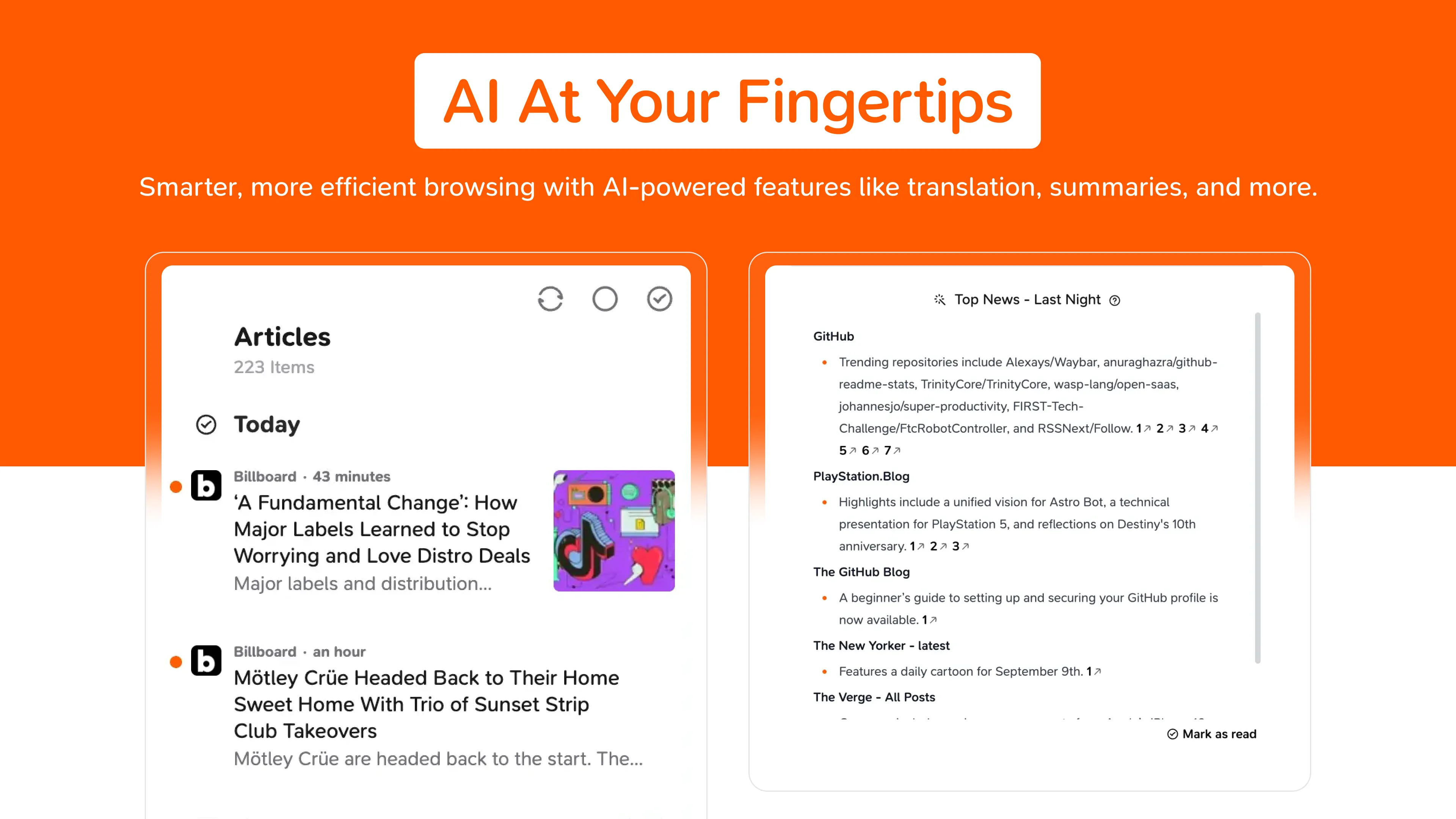
The two halves of the pitch side by side: a normal reading timeline, and the AI digest that condenses everything above it into a scan-in-thirty-seconds brief.
Folo is an open-source RSS reader that treats “feed” broadly — RSS, Bluesky, GitHub trending, Nature papers, YouTube channels — and pours all of it into one timeline, then lets an AI “Vibe Read” mode and a nightly digest do the actual reading-in-brief for you.
The find’s core description holds up: Folo really does ingest 24+ source types beyond plain RSS, and the AI layer is more than a gimmicky summarize button. Timeline Summary generates a running digest like the “Top News — Last Night” panel shown above — bullet points per source, each linking back to the original — so a morning catch-up across dozens of subscriptions becomes one scroll instead of dozens of unread badges. Vibe Read applies the same triage inline, and translation is built in as its own AI feature, not an afterthought.
What the find undersold is reach: Folo isn’t just “a web app and a desktop client.” It ships native iOS and Android apps alongside desktop builds for macOS, Windows, and Linux, plus the browser client — genuinely cross-platform, not desktop-first with a token mobile wrapper. The project also has real numbers behind the “briefly #1 trending” claim: 38.6k GitHub stars, a shared index the site claims spans 1.3 million feeds and 300+ million entries, and an active release cadence (desktop v1.10.0 as of late June 2026).
Two things worth knowing before installing. First, the license is AGPL-3.0, not the plain GPL-3.0 the find named — a meaningful difference, since AGPL’s network clause means anyone who modifies Folo and runs it as a hosted service owes the changes back, not just anyone who redistributes the binary. Second, “open source” here doesn’t mean “easy to self-host”: the README documents desktop and mobile installs in detail but gives no instructions for standing up your own instance, so most of what makes Folo distinctive — the shared 1.3M-feed index, the AI credits — runs through RSSNext’s own hosted service. The code is open; running the full experience yourself isn’t a solved path. It’s also worth knowing the project used to be called Follow (RSSNext still uses that name for the Nix package and the site’s GitHub repo, follow.is) — the same app under its current name.
Pricing is friendlier than the find implied by omission: there’s a genuine free tier (150 feed subscriptions, 1 list, 1 inbox, 3 AI summaries a day), with paid tiers — Basic at $4.17/month, Plus at $8.33/month (billed yearly), and a $83.33/month Pro tier with a bring-your-own-API-key option — raising the subscription caps and unlocking unlimited AI summaries and translation. For anyone drowning in feeds spread across five different apps, Folo’s bet is that one AI-triaged timeline beats five unread counts, and the free tier is generous enough to actually test that bet before paying for it.