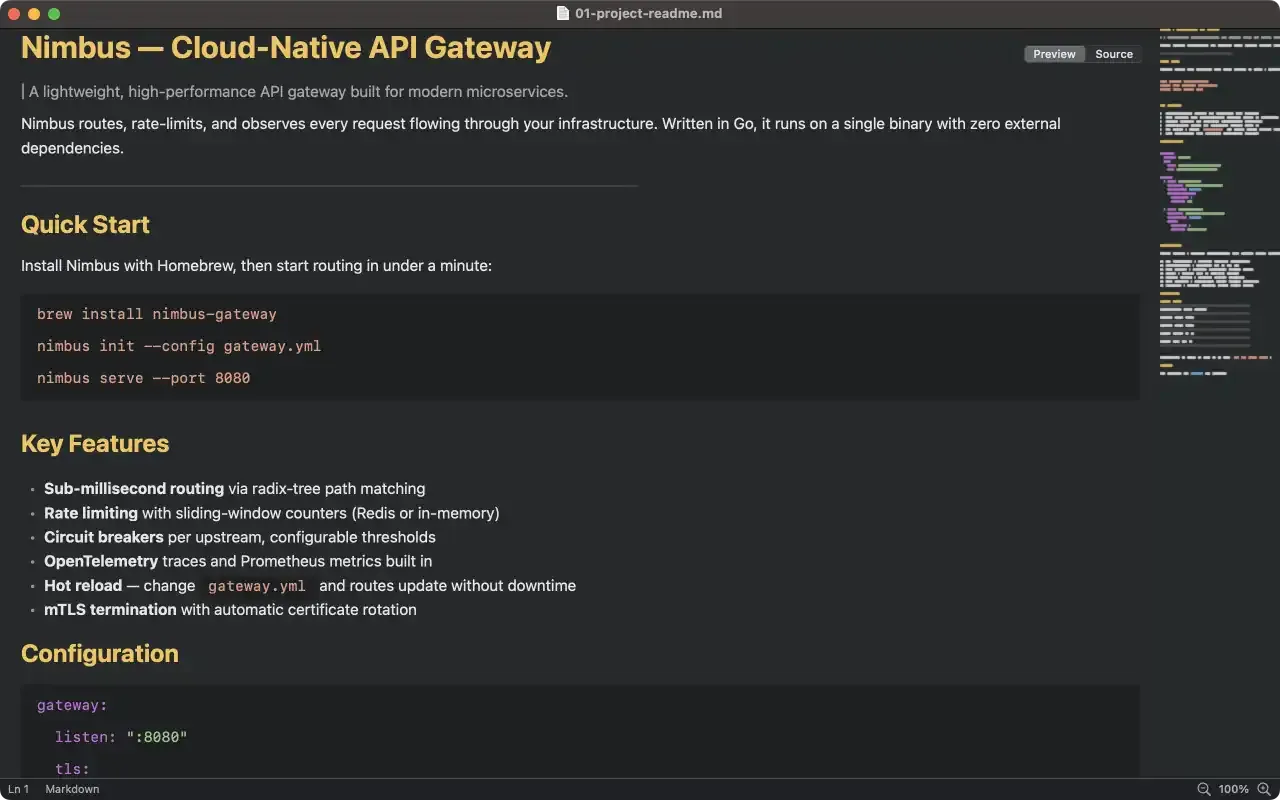
Split view, independent minimaps, code-block syntax highlighting inside the prose.
Lovre Crncevic’s native-AppKit markdown + code editor for the Mac. Free on the Mac App Store. Sub-100 ms file open, ~40 MB RAM, 180+ syntax-highlighted languages, side-by-side editor and preview with independent minimaps for each pane.
Most Mac editors split. The “markdown writers” (iA Writer, Bear, Obsidian, Ulysses) optimise for prose and treat fenced code as render-only afterthought. The “code editors” (VS Code, Zed, Sublime) optimise for code and render markdown as a preview pane. Editorio’s pitch is that a working developer writes both kinds of text in the same files — READMEs, docs, blog posts, runbooks, post-mortems — and wants both behaviours in the same window without switching apps.
The technical choice is rare in 2026: AppKit, not Electron. The numbers reflect it — file open under 100 ms, app launch around half a second, idle memory around 35–40 MB. Side-by-side source and preview with draggable dividers and independent minimaps for each pane (a small detail VS Code’s preview doesn’t manage). 180+ languages syntax-highlighted; four themes (Default Dark/Light, Nord, Solarized Dark) with system-appearance detection; native macOS tabs; project sidebar with themed icons; PDF export with proper pagination; find-and-replace with regex; distraction-free mode.
Free on the Mac App Store — no trial, no subscription, no in-app purchases. The App Store privacy label is honest: “Data Not Collected” across every category, and the app makes one optional daily update check that can be disabled. Developer Lovre Crncevic surfaced it on r/macapps in May 2026; current release at this writing is 5.4. macOS 14+.
The honest limits: it’s a markdown-and-code reader/writer, not a full IDE. There’s no LSP, no language servers, no debugger; the code-block highlighting is for legibility, not interactive editing. If you write production code, stay on VS Code or Zed. But for the documentation-heavy, post-writing, README-maintaining middle ground, Editorio is the cleanest native-Mac option that has shipped — and the price tag (free, with no follow-up sting) is hard to argue with.