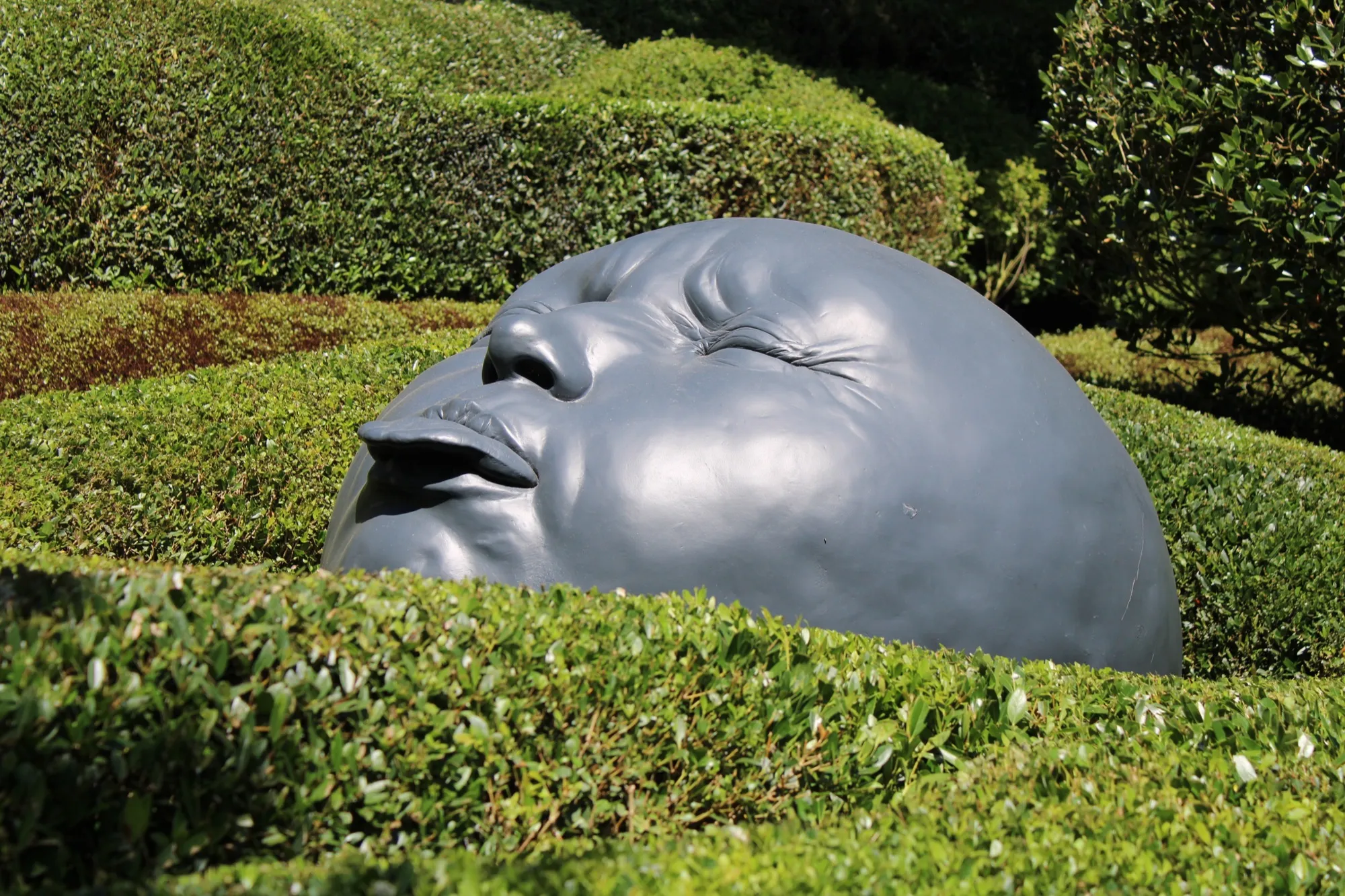
Samuel Salcedo’s Gouttes de pluie are enormous grey heads set low in the topiary of a Normandy cliff garden — eyes shut, mouths pulled into pouts and grins, one tongue out at whoever walks past. The hedges around them are clipped to read as seabed.
The garden calls this section the Jardin Émotions, one of seven named parts, and the sculptures have been in it since 2016. They are polyester resin loaded with aluminium powder, which is why they read as cast metal from a few paces and as something softer up close. Salcedo — born in Barcelona in 1975, trained there and in Manchester, and formed in part by a spell in Jaume Plensa’s studio — has built a career on faces pushed past dignity into comedy: not portraits so much as expressions caught at the moment they stop being socially acceptable.
What makes the installation rather than the objects is the planting. The heads sit low, wedged into the clipped domes so that you come over a rise and find a face already looking away from you. The garden’s own telling is that the section echoes the oyster park at the foot of the cliffs — the trimmed shapes standing in for the seabed the oysters live in, the faces surfacing out of it. It is a good idea that survives not knowing about it, which is the test.
The oyster park is real. There are rock-cut basins below Étretat, still visible at low tide, dug in 1783–84 by a man styling himself the Baron de Bellevert, who shipped oysters in from Cancale and sold them on to Paris and Versailles. The line you will read everywhere — including, for years, on the garden’s own website — is that this was Marie Antoinette’s oyster farm. That part is tradition rather than record: even the local histories that repeat it hedge with paraît-il, “so it’s said.” Worth knowing before you repeat it at the gate.
The garden itself is a recent invention on an old footing. The Parisian actress Madame Thébault built a villa here in 1905 and planted the first garden; the landscape architect Alexandre Grivko found the site derelict in 2015 and reopened it, rebuilt, in 2017. It is open daily through the summer, 10:00 to 18:30, at fourteen euros for an adult in peak season, on Avenue Damilaville.
One honest gap: nobody publishes how many heads there are or how big they are. Counts circulate — seven is the usual figure — but the garden has never said, and neither has the artist. You will have to go and count them.