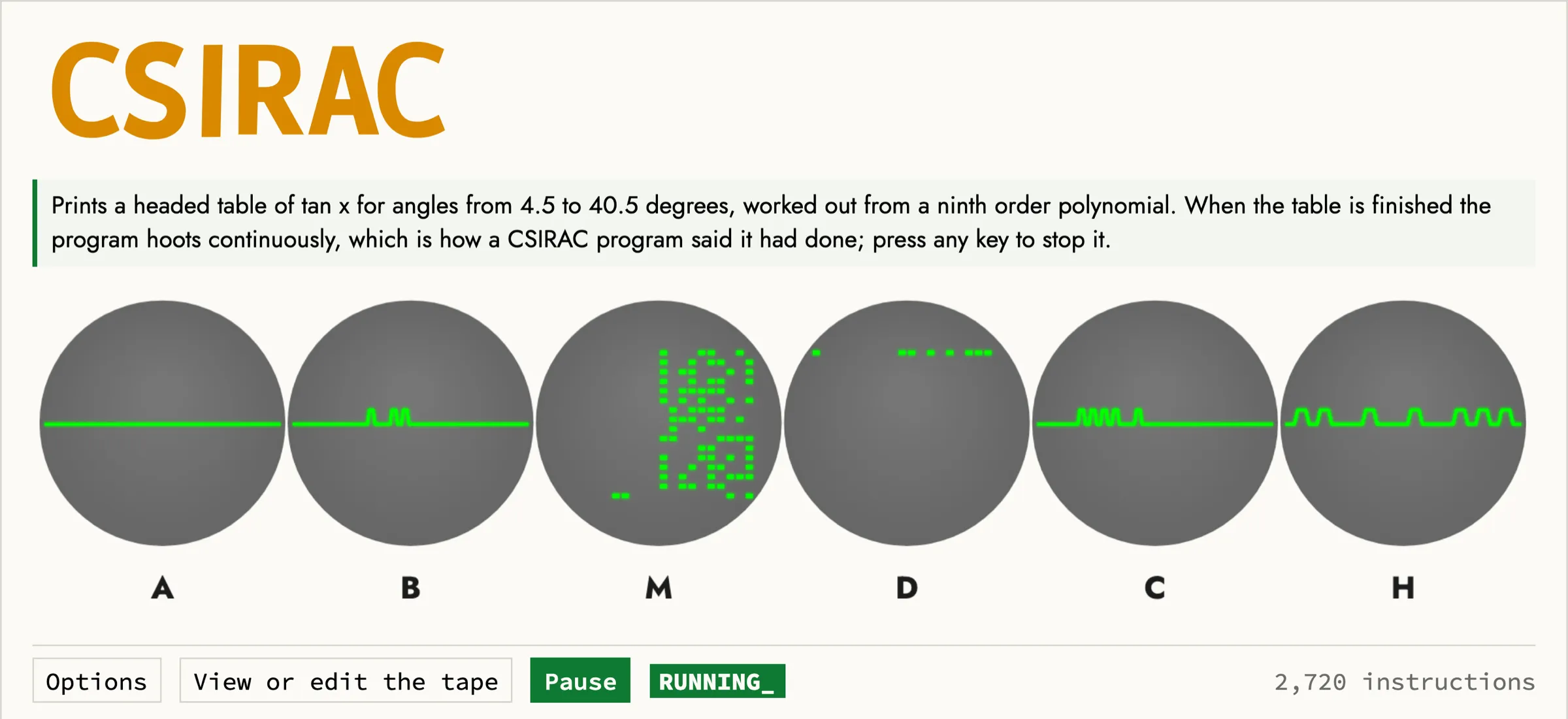
The tube bank while tape T725 computes a table of tangents. Screenshot of the emulator by Grahame Bowland, AGPL-3.0.
Australia’s first computer ran its last program in 1964 and has sat intact in a Melbourne museum ever since. This page hands you its console, its library tapes and the language its first programmer wrote for it.
Trevor Pearcey and Maston Beard built it at the CSIR Radiophysics Laboratory in Sydney out of radar-era valves. It ran its first test program in November 1949, moved to the University of Melbourne in 1955, was recommissioned there as CSIRAC in June 1956, and switched off for good in November 1964. Two thousand valves, twenty-bit words, memory that was literally sound circulating through mercury, about a thousand instructions a second. Whether it was the fourth or fifth stored-program computer built depends on who is counting — Museums Victoria says fourth, the University of Melbourne says fifth — but the museum that holds it is unambiguous on the other claim: it is “the only remaining and intact first generation computer in the world.”
The six tubes above are that console’s, reproduced. A, B, C and H each draw one register as a trace whose beam lifts for every digit that is a one; M and D each show sixteen words of store as rows of dots — a whole block of memory at a glance.
Underneath is a port rather than a tribute: Grahame Bowland rebuilt John W. Spencer’s Turbo Pascal emulator CSIRACEM for the browser, under the AGPL and with the permission of Spencer, who used the real machine from 1959 to 1964. The tapes keep their library numbers. T712 prints the whole teleprinter character set, Greek letters included; T725 works out a table of tangents from a ninth-order polynomial, then hoots continuously, which is how a CSIRAC program said it had finished. Interprogram is not a reimplementation either: the page threads the actual June 1960 compiler tape into the machine and works the console for you, shuttling the reader between program and source three times as the compiler asks. Geoff Hill wrote it in 1960; it is Australia’s first high-level language, not its first language outright.
The honest gap is the famous part. Hill also had CSIRAC play Colonel Bogey at Australia’s first computing conference in August 1951 — the earliest known computer music, never recorded. His player program T746 is bundled and does not play: the encoding of its tune tape has never been worked out, and Bowland’s notes set out two failed attempts and ask anyone with an example file to write in. The three tunes that do sound were punched by a script for this emulator. He is equally plain that Claude Code did much of the porting, with non-exhaustive review.