A conservation watch usually means a logo on the case back and a press release. This one starts from the parrotfish — an animal whose actual job is eating the algae that would otherwise smother a reef — and works the whole watch outward from it.
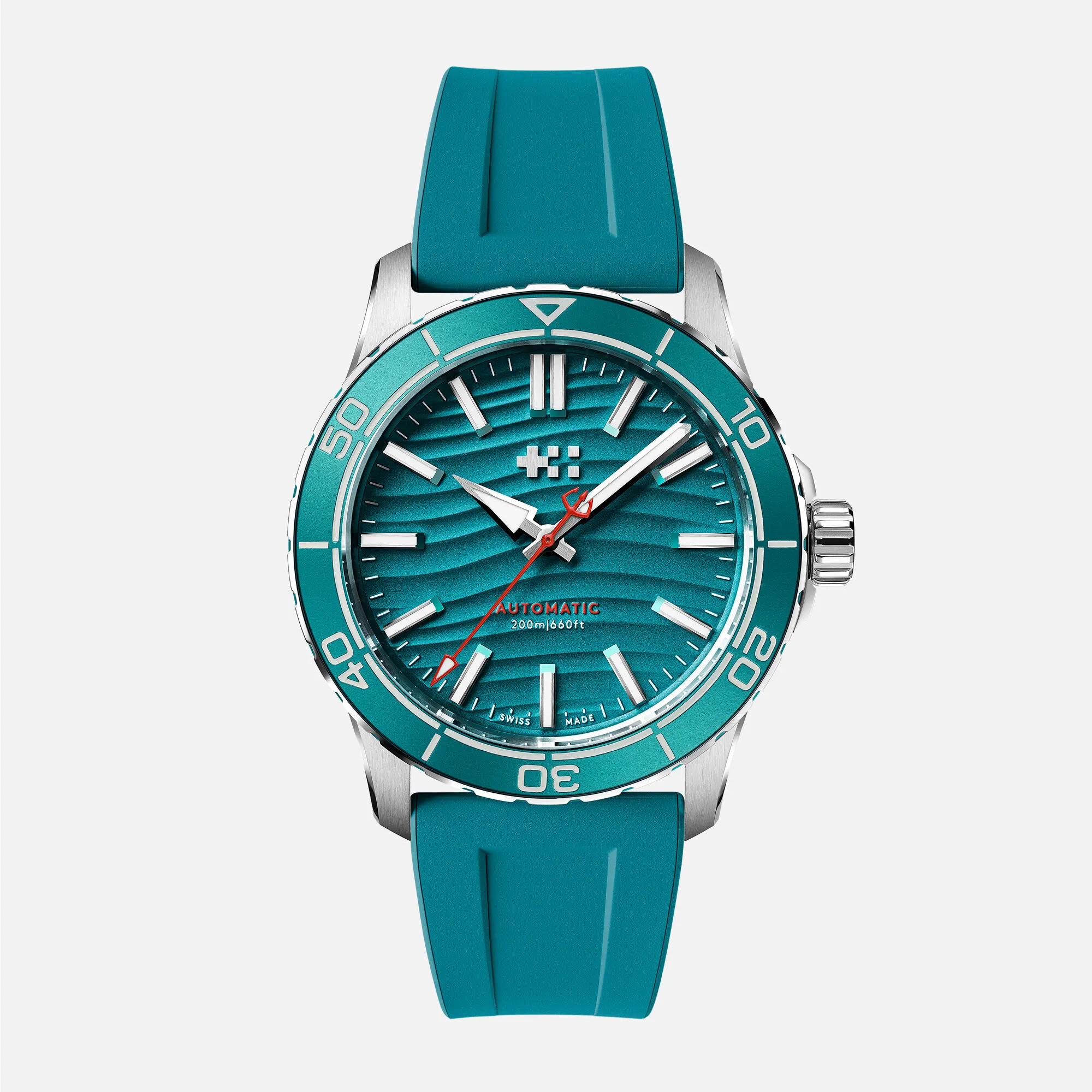
The teal is the fish. Christopher Ward calls the shade parrotfish blue, and it runs across the bezel, the dial and the rubber strap; against it, the seconds hand is coral red, tipped at both ends with the little forks the Trident line is named for. The dial texture has a name too — Aeolian, a bespoke pattern of shallow waves that reads as flat teal from across a room and only resolves into ripples when your wrist turns under a light. It is the rare case where the story and the object are the same decision rather than a decal applied afterwards.
The specifics behind it hold up. The name comes from Blue Marine Foundation’s 30x30 Ocean Action Plan, the campaign to put thirty percent of the world’s oceans under protection by 2030, and this is the third watch Christopher Ward has made with them. Inside the 41mm “Reef” case is a Sellita SW200-2 Power+ automatic with a 65-hour reserve, good for 200m, behind sapphire and a screw-down crown. Limited to 500 pieces at $1,250, with the strap swappable for a bracelet.
Two things the find undersold and one worth being plain about. The donation is not just the headline: it is an extra £30 per watch on top of the 2% Christopher Ward already gives Blue Marine. And the case back is closed rather than exhibition — a real trade for a Swiss automatic at this price, made deliberately so the 30x30 logo can be engraved on it.
Being plain: £30 on a $1,250 watch is roughly three percent, and nobody should buy this instead of donating. Buy it because it is a genuinely good-looking diver whose colour scheme means something, and take the reef money as the part that isn’t decorative. The parrotfish, incidentally, also grinds up dead coral and excretes it as white sand, which is a better fact than any watch has a right to carry.