A billboard in SoMa advertises ChatTJB as the leading chat interface powered by AI*. The asterisk, largely hidden behind a tree branch, explains that AI stands for Average Individual.
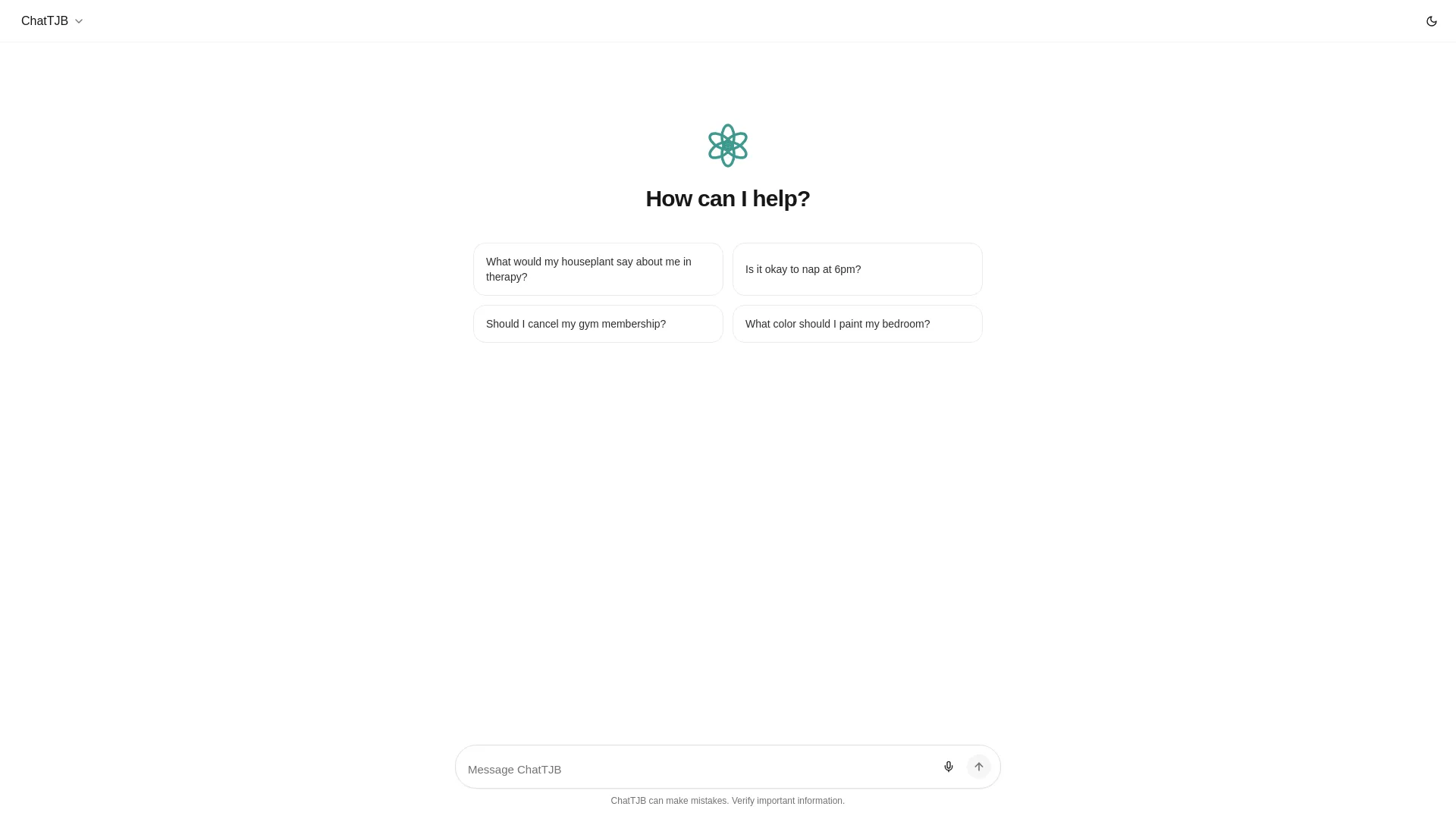
Tucker Bryant, a conceptual artist and former Google marketing manager, put roughly $6,000 into one month on a 14-by-48-foot board on Sixth Street just off Folsom in late July. The site it points to is a faithful copy of every assistant you have used: a centred “How can I help?”, four suggested prompts, a message box, and the fine print at the bottom — “ChatTJB can make mistakes. Verify important information.” That disclaimer is the only fully honest sentence on the page.
Send a prompt and Bryant reads it and types back, by hand, alone. No account, no waitlist. It began at a few dozen a day; after the billboard caught, the SF Standard counted roughly 15,000 prompts from 11,000 people in a week, peaking at 5,000 in a single hour. Some write-ups have that peak as a daily figure — his own site and the Standard both put it at an hour — and he sat at the keyboard up to ten hours a day trying to keep pace.
The about page is where the joke earns its billboard. ChatTJB is described as a “single-operator large language experience” running on a “human-grounded inference layer”: no ensemble, no router, no mixture of experts, “only a mixture of moods.” Latency is reframed as deliberation. Being wrong is a feature, sharpening the critical thinking that competing systems erode. Scale posture: a deliberate concurrency ceiling of n=1. A $5 Pro tier sells a blue checkmark and queue priority, and he asks you not to buy it, since it exists mostly to help pay off the sign.
He has since opened the queue to approved volunteers, each claiming one conversation at a time so nobody gets passed between people mid-chat. It is live today, and the waiting screen is candid about what that costs: thousands of people are writing in, a reply can take days, and you can leave an email or connect Telegram rather than sit there. The scaffolding underneath is more careful than the bit implies — anything reading as distress is pulled before a volunteer sees it and answered with crisis resources instead. Bryant frames the whole thing as a high-effort joke about cognitive surrender, and on the site more plainly: he hopes it reconnects us to AI, the Average Individuals, in a small way.