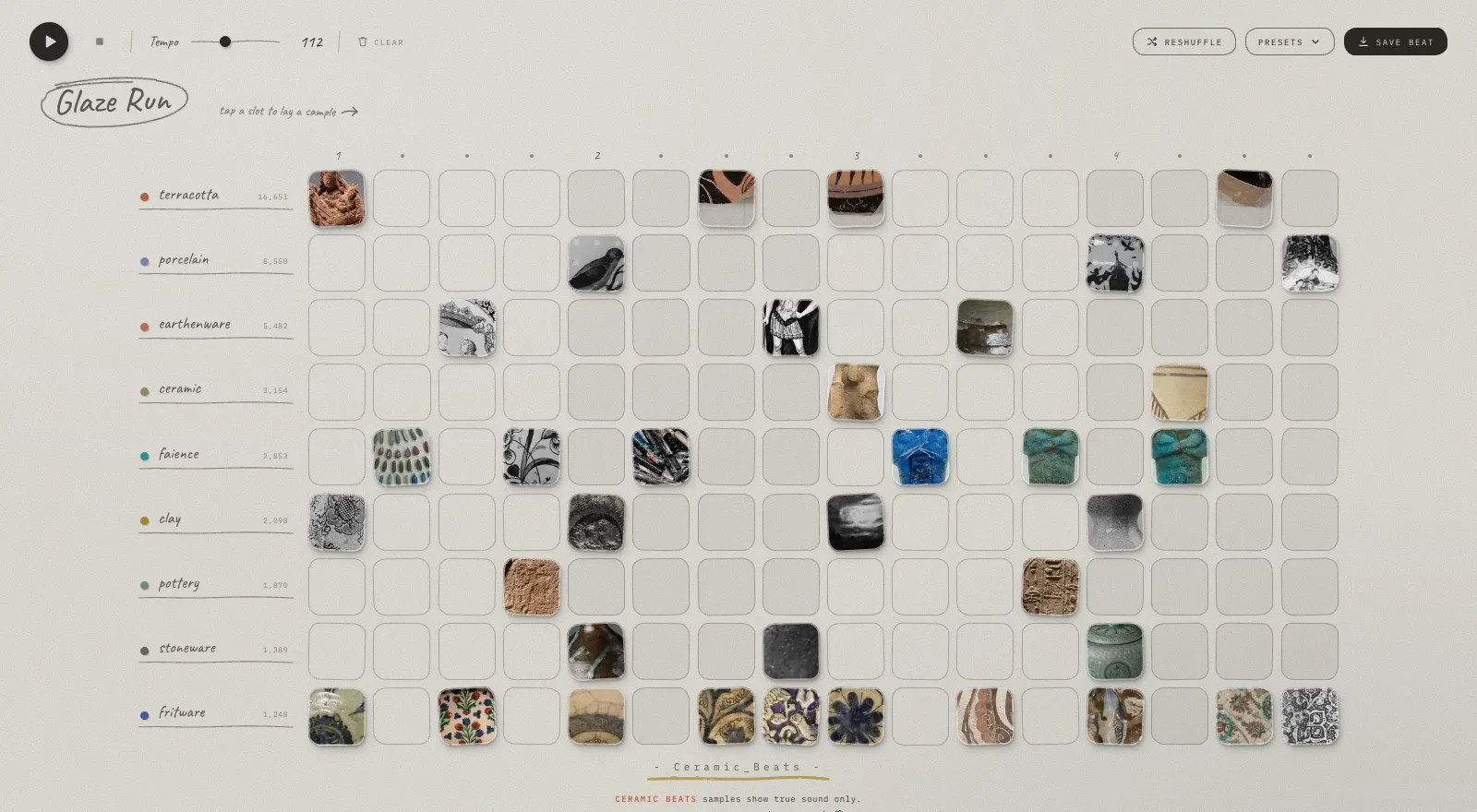
Tap a porcelain teacup and it rings; knock a flowerpot and it thuds. Ceramic Beats builds a drum machine out of that difference: nine rows, one per material the Met’s catalogue names, each laying real objects from the museum’s collection on the beat.
The rows run terracotta, porcelain, earthenware, ceramic, faience, clay, pottery, stoneware and fritware, the order in which the collection counts them, from 16,651 terracotta objects down to 1,248 fritware. Click a slot and a crop of a real glazed surface drops into it; hover and it names the object (“Terracotta stemmed dish, 6th century BCE, Lydian”); Option-click and the Met’s catalogue page opens. It opens on a working four-on-the-floor preset, not an empty grid, with four more presets and a tempo slider from 60 to 200 bpm.
What you hear is one sound per material, not per object: a row’s sixteen tiles all strike the same sample. None of the nine were recorded off the pots. The maker generated them with ElevenLabs’ sound-effects model, prompting each from a physical description of that body being hit, then trimming back to the attack. The logic is firing temperature: wet clay slaps dead, terracotta thuds, and porcelain, faience and fritware ring like the glass they nearly are. A “How each sample is generated” sheet publishes every prompt, including an honest failure: the stoneware pot prompts came back as two seconds of quiet wash, so that track is a hammer on a granite block.
The “44,354 objects” in the footer is the collection, not the board. It is the total in the maker’s companion Met Ceramics Lookbook, a hue-sorted field of every usable public-domain ceramic crop. The sequencer carries 288 objects, 32 per material, and Reshuffle rotates each row to a fresh run of 16. The picks sweep each material’s colour range, so a row reads left to right as a gradient rather than a scatter.
Save Beat is the neat part. The whole arrangement fits in 30 bytes and rides in the URL fragment, so the link is the beat: no account, no server, and a friend opens it with your name on the card. It began as a 2019 Parsons data-visualization project built on the Met’s Open Access API, rebuilt this year and named an FWA of the Day. On a phone, turn sideways; the board is sixteen slots wide.