Jack Furnival wanted a decent snooker table in a small terraced house. Everything on the market was plasticky and pitched at children, so he built the game that should have existed instead.
The route he took there is the good part. Carrom is the traditional Indian board game — a smooth square board, counters flicked with a finger into corner pockets — and it is played seriously in clubs and tournaments worldwide. Carrooka’s own telling is that when the British colonised India they took elements of carrom back into billiards, and billiards eventually produced snooker; so Carrooka is, as they put it, the step of that evolution that never happened. Treat that as the company’s story rather than settled history, but it is a good story, and the game it produced is real: carrom’s counters, snooker’s rules.
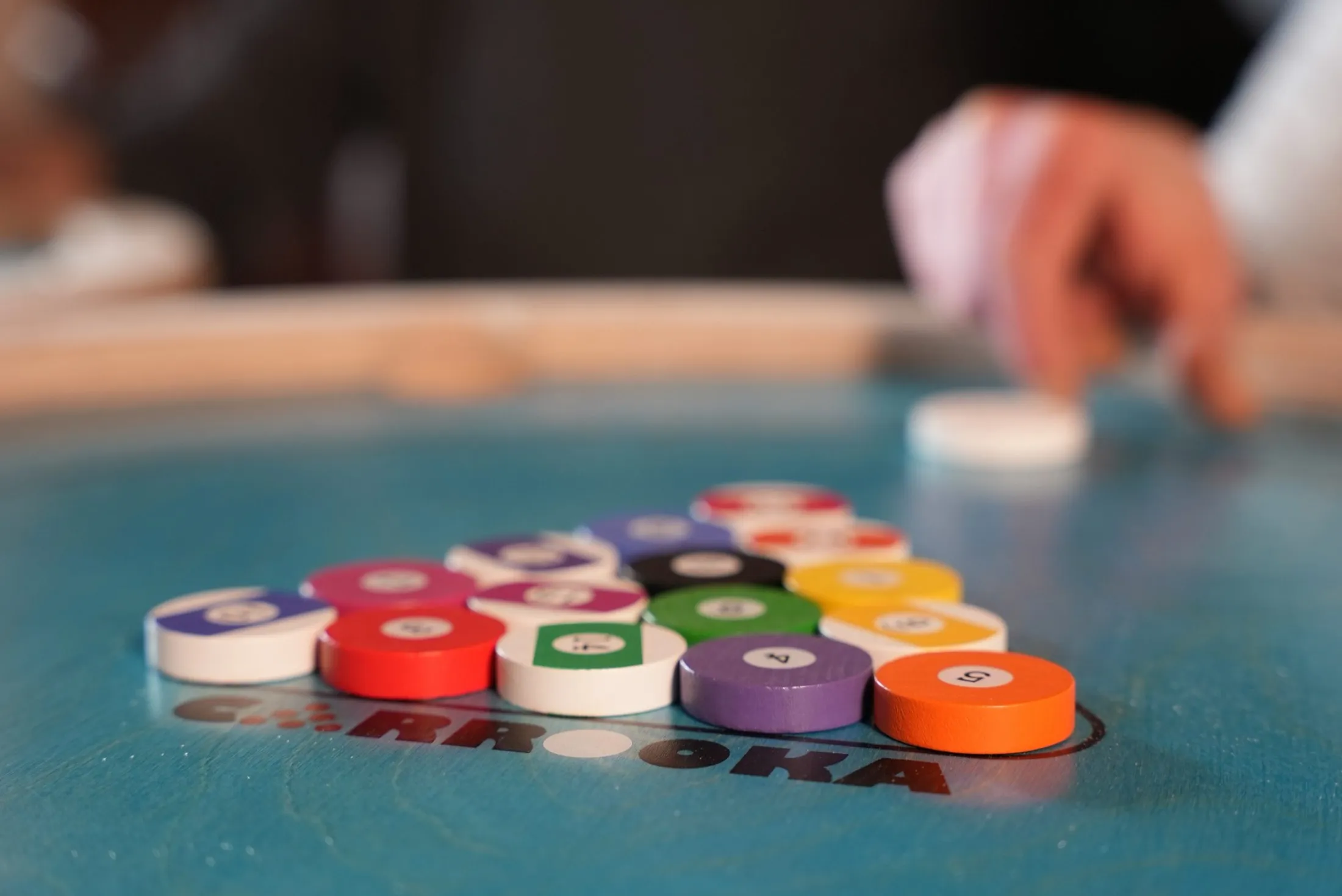
The invention is not the flicking. It is the spinning. In carrom you shoot from your own side of a fixed board, which is fine for carrom and useless for a game where you need the cue ball wherever the cue ball happens to be. Carrooka’s board rotates, so two or four players stay in their seats and turn the table to bring the striker in front of them. That one decision is what makes a snooker substitute fit a room that cannot hold a snooker table — and it is why the numbered pucks rack in a triangle and behave like a break.
Jack had forty years as a cabinet maker behind him, which shows in the object; his wife George turned it into a company. (The find said the two of them invented it — the maker’s own account credits Jack with the invention and George with everything that made it a business.) The prototypes began at home in 2020, rules refined with a friend called Bugsy, and the first board was rectangular before the rotation arrived.
One honest change since: in May 2026 they made their last standard board. After five years of building every single one themselves, Jack and George stepped back, and the classic birch boards now come from licensed makers in the UK, Canada and — since August — Woodestic in the EU. Jack still builds tournament boards, larger and in hardwood, made to order from £425. If you want one from the inventor’s own bench you now have to commission it; if you just want to play, that is no loss at all, and the boards ship in plastic-free packaging either way.