Jonathan Corley saw an electron-microscope photo of a stylus sitting in a vinyl groove and thought the groove walls looked like canyon walls. So he turned it around: take a real canyon, treat its cross-section as the groove, and drop the needle.
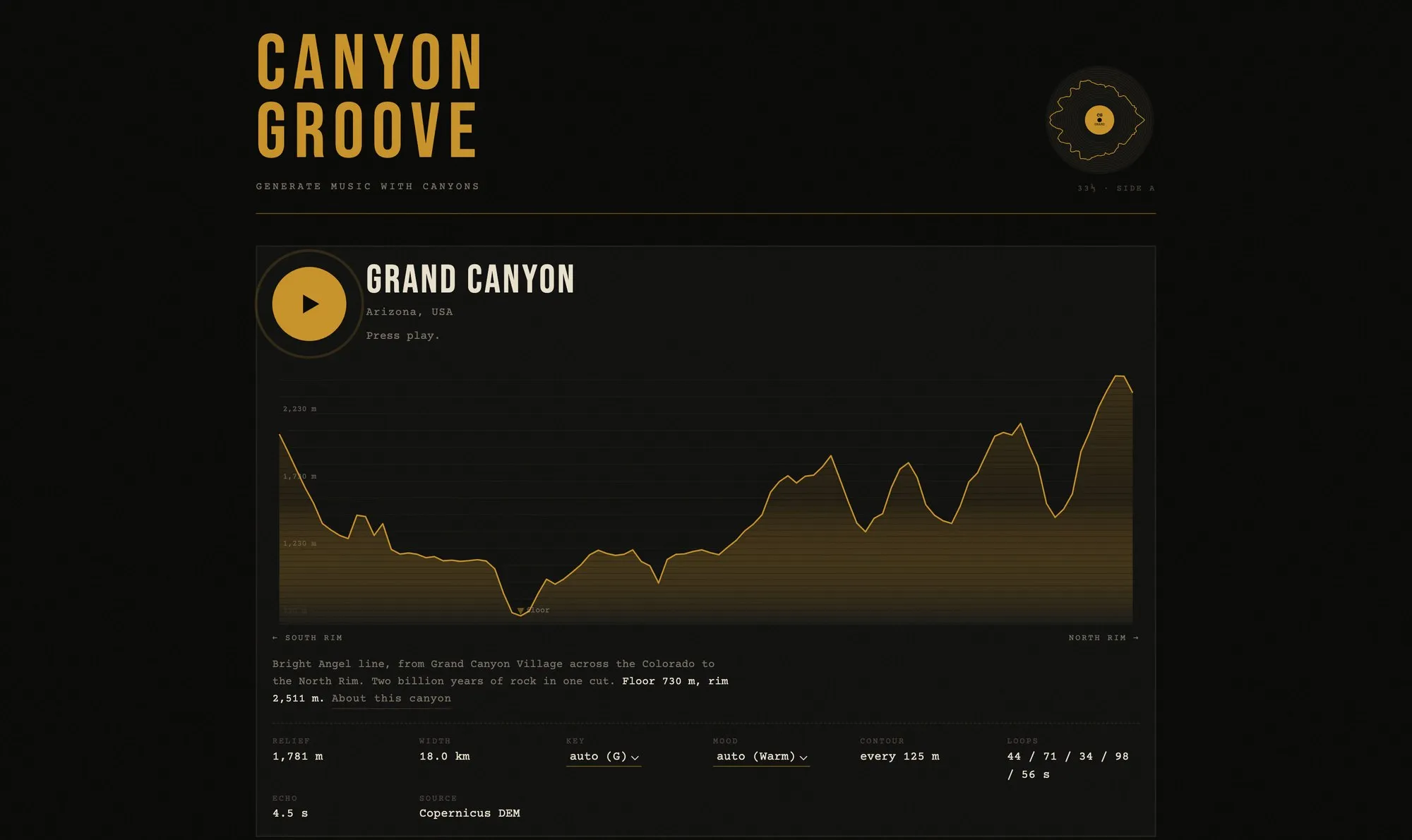
Each canyon is a straight line of 100 elevation samples, rim to rim, almost all of them from the Copernicus 90-metre terrain model. There are sixteen of them, not the handful the find named: Zion’s 4.4-kilometre crossing, Bryce, Waimea, Colca, the Verdon, the Tara, and at the far end the Indus Gorge at Nanga Parbat, 6,930 metres of relief on one line. The Grand Canyon crosses on the Bright Angel line. Its floor sits at 730 metres, and the key is floor height in hundreds of metres, counted round the twelve notes, so the Grand Canyon plays in G.
The find also undersold the mapping. Height into pitch is only part of it. Five voices ride the profile at once. Bedrock is a drone on the key. Strata reads slow chords off the elevation. Contours plays one note each time its needle crosses a contour line. Wind is filtered noise that swells on steep slopes. River only speaks in the lowest 18% of the canyon. Balanced walls play Bright or Open, lopsided ones Dusk or Dark. Width sets each pass at 28 to 72 seconds, and relief sets a reverb tail of three to eight. The voices loop at ratios like 1.618 and 2.236 that never line up. In Corley’s words: “Twenty minutes in it still has not repeated.”
The address bar holds the whole piece: canyon, voices, instruments, the seven sliders on each voice, and a random seed. Send the link and your friend hears exactly your cut, with a “Passed to you” banner and a pressing number that goes up with each share. #today gives everyone the same canyon for the day. Every sound is synthesised in the browser with no recordings, and the MP3 export renders two minutes at 192 kbps on your own machine.
Some honest notes. The site says it’s slow ambient music, and it is: textures that drift rather than tunes. The relief figures run under the published depths because a 90-metre grid on a straight line misses the deepest points. Corley’s advice is to “treat them as a floor”. The page also belongs to his consulting studio, and saving a cut means signing up for his newsletter, though sharing and MP3 export need no email. It is free, and the code is MIT-licensed on GitHub.