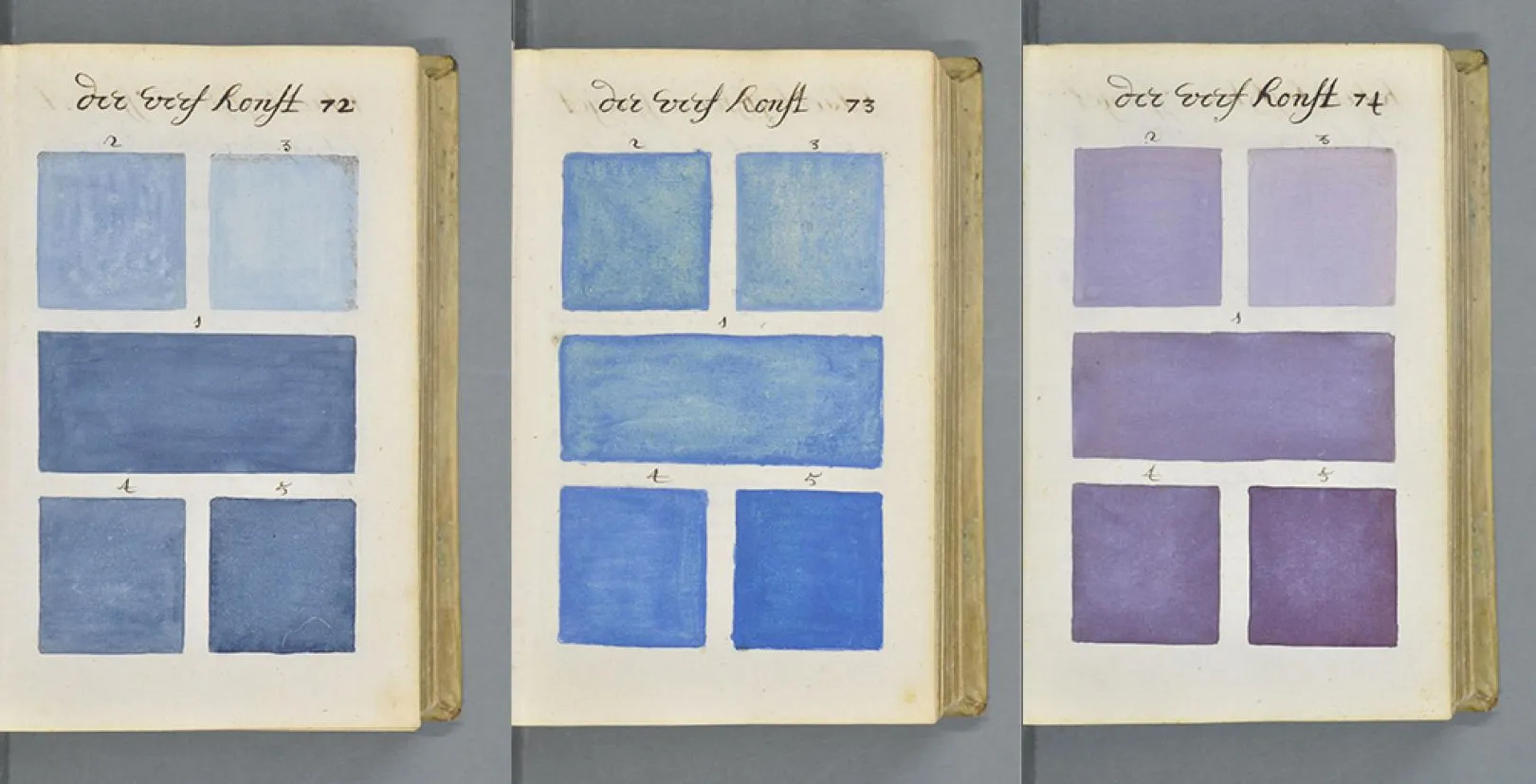
Pages 72 to 74 of the manuscript: the wide swatch is 1, the squares 2 to 5. Scan: Bibliothèque Méjanes, Aix-en-Provence (public domain), via Open Culture.
In 1692 a Dutchman who signed himself A. Boogert hand-painted a colour reference for watercolour: hundreds of pages of numbered swatches, in the only known copy. The whole book is online as zoomable scans.
Its own title is Klaer Lightende Spiegel der Verfkonst, roughly “clear-shining mirror of the paint art”. The Bibliothèque Méjanes in Aix-en-Provence, which holds it as Ms. 1389 (1228), catalogues it in French as Traité des couleurs servant à la peinture à l’eau. Of Boogert almost nothing is known beyond the name on the book; one suggestion is Adriaan Boogert, a patrician’s son from Delft.
Text pages describe a colour and how to mix it; swatch pages show the result. Each swatch page carries one wide rectangle numbered 1 and four squares numbered 2 to 5, under a running head, “der verf konst”, and a page number. The steps come from water: as Erik Kwakkel summarised it, a shade shifts by adding “one, two or three portions of water”, so one pigment fans out from deep to nearly clear. Across the three pages above, a slate blue gives way to a brighter blue, then to violet.
When it surfaced in the press in 2014, popularised by Kwakkel, a book historian, on his blog, it was hailed as a Pantone guide nearly three centuries early. On the page the comparison holds: numbered chips, systematic steps, a catalogue of every colour a painter might want. The difference is that each chip is a brush wash, with a pooled edge here and a streak there, and Boogert made every one of them by hand.
The scan runs to nearly 900 pages, counting covers and blanks. More than 700 of them are swatch pages. The writing is 17th-century Dutch script, so the text pages are for looking at more than reading, and the swatch pages need no translation. A public-domain PDF of the whole manuscript is also on Wikimedia Commons, if you want it offline.