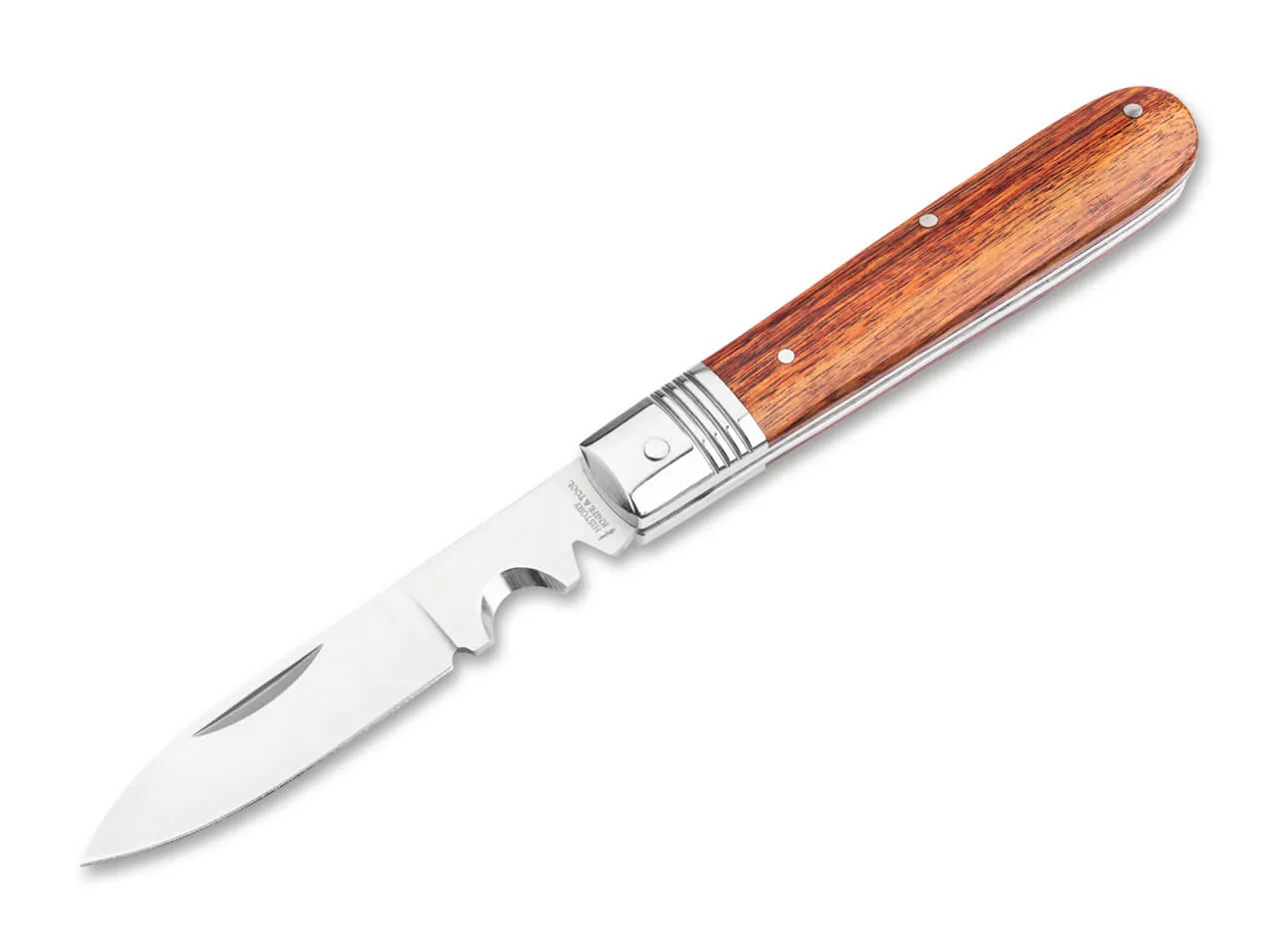
The V-notch near the pivot is the point of the whole knife — a purpose-built cable stripper, not a decorative grind.
Böker’s Cable Knife is a dimensionally faithful reissue of the folding cable-stripping tool the German Wehrmacht issued to pioneers, signal units, and mechanized crews in WWII, now cut into rust-resistant 440A steel. The V-notch that stripped field-telephone insulation is still the whole point — everything else is a century-old slipjoint pattern preserved for its own sake.
One correction to make up front: this is a WWII tool, not a WWI one. Böker’s own product page is explicit that the WWI-era Imperial Army never issued a standard pocket knife at all — it was the Wehrmacht, in WWII, that carried this folding cable knife, and not just in the signal corps: pioneers, mechanized-division mechanics, the Kriegsmarine, and the Luftwaffe all used it. The pattern outlived the war it was designed for — it’s still produced today to the same technical spec (TL 5110-0011, NATO supply number 5110-12-120-0816) for the Bundeswehr, and became a civilian favorite among electricians and hobbyist whittlers in the decades since.
The reason it existed at all is the V-notch cut into the spine near the pivot: a deeply concave, serrated edge sized to bite through cable insulation and stop before it nicks the wire underneath. That’s still a genuinely useful shape for stripping small-gauge wire today. Böker also markets the same notch as a bushcraft feature — its product page explicitly recommends it for “striking sparks with Pyrophoric-Cer fire steel,” so the find’s fire-steel-striker claim checks out against Böker’s own copy, rather than being an invented detail.
The reissue is a close copy in dimensions, not just concept: a 3.39-inch, 0.09-inch-thick 440A stainless blade (swapped in for the wartime carbon-steel original, for rust resistance), a 7.71-inch overall length, and 3.17 ounces. The handle is rosewood, not ebony — Böker’s own spec sheet lists “Rosewood,” and the reddish-brown wood in its product photos backs that up, even though some retail listings call it ebony. It opens manually via nail nick onto stainless liners with the pattern’s characteristic four grooves, and it’s made in Asia rather than Germany. At $49.95 direct from Böker, it lands at the top of the find’s estimated range.
The honest limitations: it’s a slipjoint, not a locking knife, so it’s not built for anything that fights back — no batoning, no prying, nothing that risks closing on your fingers. The V-notch is shaped for 1–3mm insulation, not general-purpose cutting, and the fire-steel trick is a “tip” in Böker’s own marketing, not the tool’s designed function, so don’t expect it to throw sparks as reliably as a dedicated ferro-rod striker. This is fundamentally a heritage piece — a well-made one, faithful down to the liner grooves — for people who want a slice of Wehrmacht field-kit history in their pocket, not a daily-carry workhorse.
Also on Amazon ↗ Affiliate
Affiliate link — we may earn a commission from qualifying Amazon purchases at no extra cost to you.