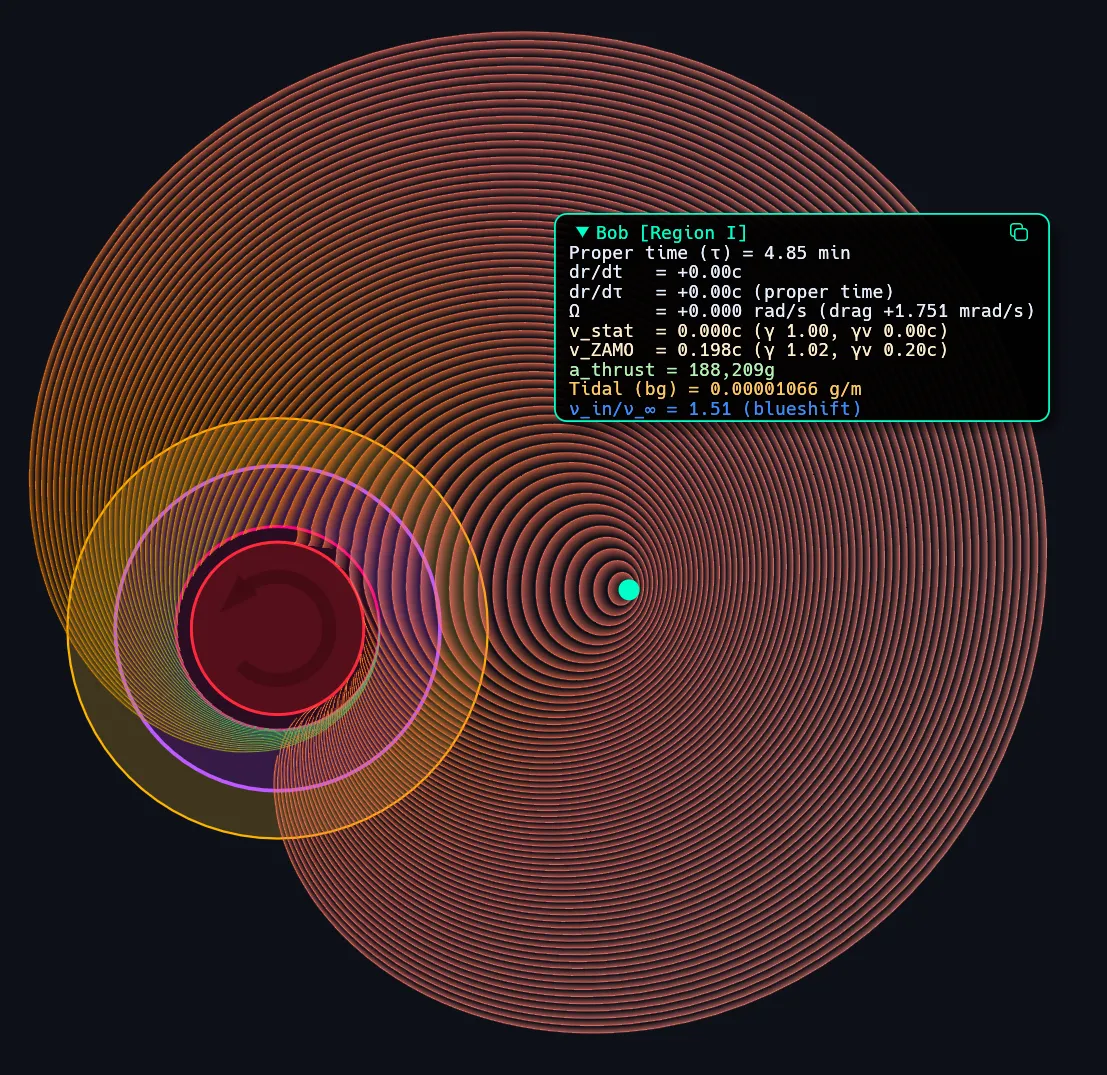
Bob holds still near the hole while his pulses spiral in. Image: Black Hole Lab README, via github.com.
A spinning black hole you can drop two observers into. Alice and Bob each carry a radio beacon, the simulation draws every wavefront as the hole bends it, and a log records each time one hears the other.
The physics is the Kerr metric, the exact general-relativity solution for a rotating mass, integrated numerically. The author’s claim is that, to the precision of that integration, what you see is what the equations predict. Presets set the hole’s mass and spin: Sagittarius A*, M87*, Cygnus X-1, TON 618, Gargantua, an extreme near-maximal spin, or a plain non-spinning Schwarzschild.
Each observer can be dropped from rest, held static, or put on a circular or innermost-stable orbit, prograde or retrograde. By default Alice orbits while Bob plunges. Space plays and pauses, the arrow keys step through time, and a “Wavefronts kept” slider sets how many pulses are tracked. A reception shows up as a tick mark on the receiver’s world line.
The views are the point. A top-down map shows the wavefronts being dragged around the hole. Time charts, 1D or 2D of space plus time, show each observer’s light cone tilting toward the hole. Switch to Bob’s own frame and the cone snaps back to a rigid 45 degrees. The README’s worked example holds Bob still outside the hole: his rocket needs 188,209 g to stay put, while tidal force is too small to feel.
The author built it to understand the inner horizon, where the README shows Alice’s signal arriving blueshifted more than a millionfold when Bob is 35 microseconds from crossing. A Look Around button renders an 8192-by-4096 panorama of an observer’s sky, ray-traced against NASA’s star map, which wraps into a sphere in a 360-capable viewer like VLC.
The limits are stated up front. The simulation halts at fixed caps, such as 10 billion for the ratio of coordinate time to an observer’s own, which the README calls unphysical; and it adds that nobody can say what would actually happen inside a hole.
Friction is real. It is a Rust app under GPL-3.0, started in September 2026, with builds for Windows and Linux (x86-64) and Apple-silicon Macs only. The Mac build is not signed, so macOS may refuse it until you run xattr -dr com.apple.quarantine . in the extracted folder. Look Around needs a 153 MB star-map download, offered on first use.