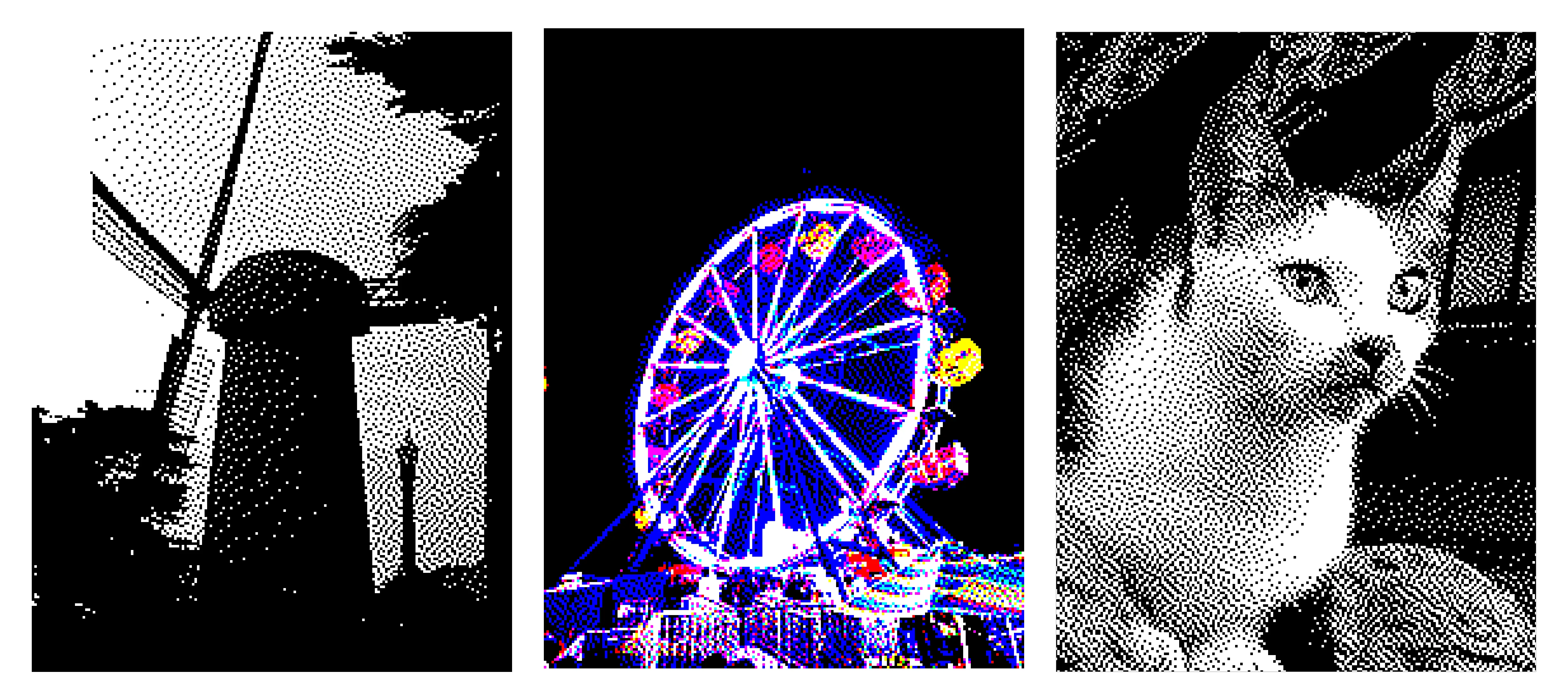
Not a filter that fakes an old Mac. A reimplementation of the actual algorithm, pointed at whatever is in front of you.
Bill Atkinson’s dithering routine is the reason a 1984 Macintosh could show you a photograph on a screen that had only black pixels and white ones. It spreads each pixel’s error into its neighbours, so the eye assembles grey out of a stipple that contains none. Héliographe’s own description of BitCam is the accurate one: “a pixel-perfect reimplementation of the original Macintosh’s signature Atkinson dithering, reimagined as a camera app.” Point it at a windmill and you get the windmill Susan Kare’s Mac would have got.
Version 2 is the ten-year release, and the app changed hands to get here. Iconfactory shipped BitCam in June 2016 for their own twentieth anniversary; Héliographe now owns and develops it, and this is the first substantial rebuild since. The camera gained zoom and a contrast control, direct on-screen controls instead of buried settings, and the modern iPhone camera plumbing — Lock Screen, Camera Control. It runs natively on iPad and Mac for the first time.
The addition that matters most is the Editor. Until now BitCam only worked on what you shot through it, which meant the ten thousand photographs already on your phone were out of scope. Now you load any of them and run them through the same processing, and the dithering is something you steer rather than accept: solid colours, linear and radial gradients, an eight-colour mode when two is not enough. Export is high-resolution PNG, so the output survives being printed or posted at size rather than dissolving.
One correction to how it was first written up here, and it is the kind worth stating. BitCam is a free download but it is not a free app: the full feature set is a single in-app purchase called Full BitCam, $9.99, no subscription. Requirements are iOS and iPadOS 15 or later and macOS 12 or later, and the whole thing is 7.1 MB — smaller than most of the photographs it will make.
The reason to have it is not nostalgia, which is a low bar and would wear off. It is that reducing an image to two colours forces the scene to be about shape and contrast, and quite often the dithered version is the better photograph.