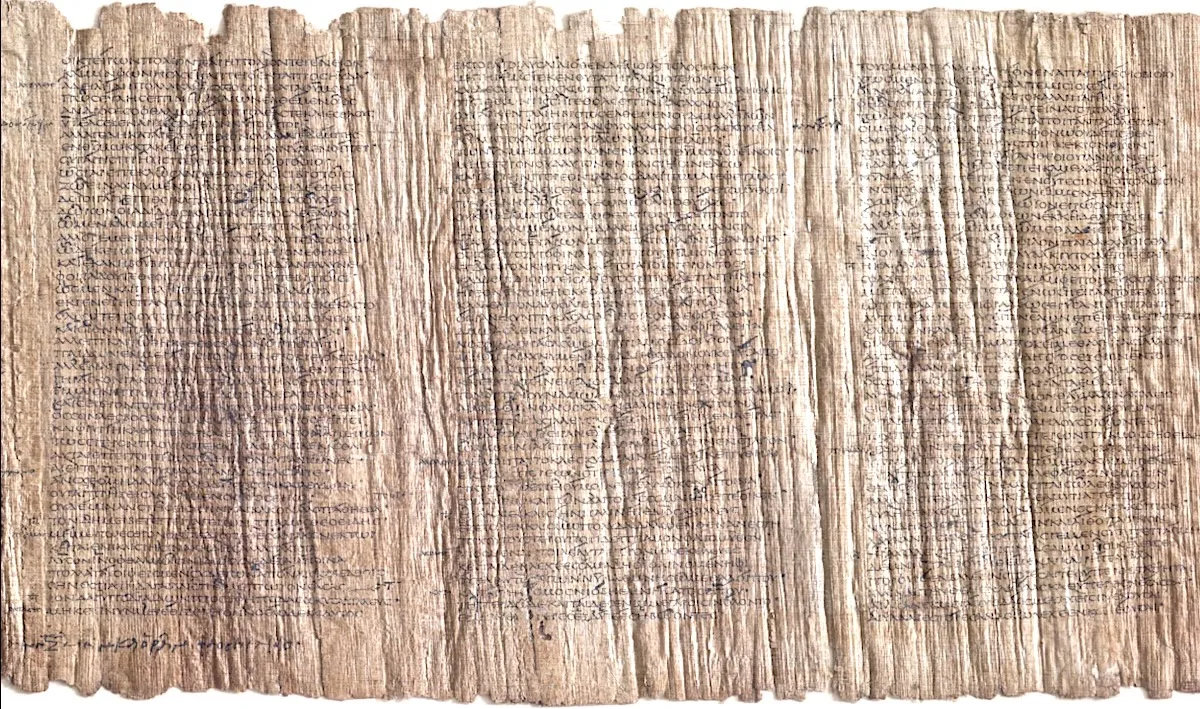
Somebody copied out the last book of the Iliad around 150 CE on a roll two and a third metres long. Somebody else then went through the whole thing correcting it. Both hands survive, and the British Library has photographed them at a resolution that shows the papyrus grain.
The object is British Library Papyrus 114, and it is one of the longest and best-preserved Homeric papyri anywhere. 240 by 2,325 millimetres — knee-high, and long enough to cross a room. Sixteen columns of Greek uncial capitals carrying Book 24, lines 127 to 804: Priam crossing the lines at night to ask Achilles for his son’s body, and the funeral that ends the poem. There is a colophon at the end, because the scribe signed off.
The best thing in it is not the scribe’s work. A diorthotes — a corrector — went through the entire roll afterwards in a second hand, fixing the copy against another exemplar. Those are the smaller marks scattered between the lines in the image above. This is what a text looked like before print made a book a fixed thing: a first pass, then somebody checking it, in ink, on the same physical object, with no way to hide the disagreement. The two hands are still arguing in the margins eighteen centuries later.
How it got to London is a story with a named beginning. William John Bankes — Egyptologist, traveller, and the man who brought the Philae obelisk back to Dorset — acquired it at Elephantine in 1821 through his agent Giovanni Finati. It sat in the Bankes family library for roughly fifty years, and in 1879 his heir William Ralph Bankes sold it to the British Museum.
One correction, and it is the reason to read this piece rather than the headline. Open Culture’s post announces the manuscript as now digitized. It is not new: the British Library put the high-resolution facsimiles online in April 2014, in both unrolled and pressed versions, and the Homer Multitext project had a panoramic scan up before that. This is the third repost we have caught from the same source in three days, after Stewart Brand’s How Buildings Learn and the Ansel Adams parks negatives — and the conclusion is the same each time. The news is a decade stale; the thing itself is live, free, and needs no login. Twelve years is nothing next to eighteen hundred.