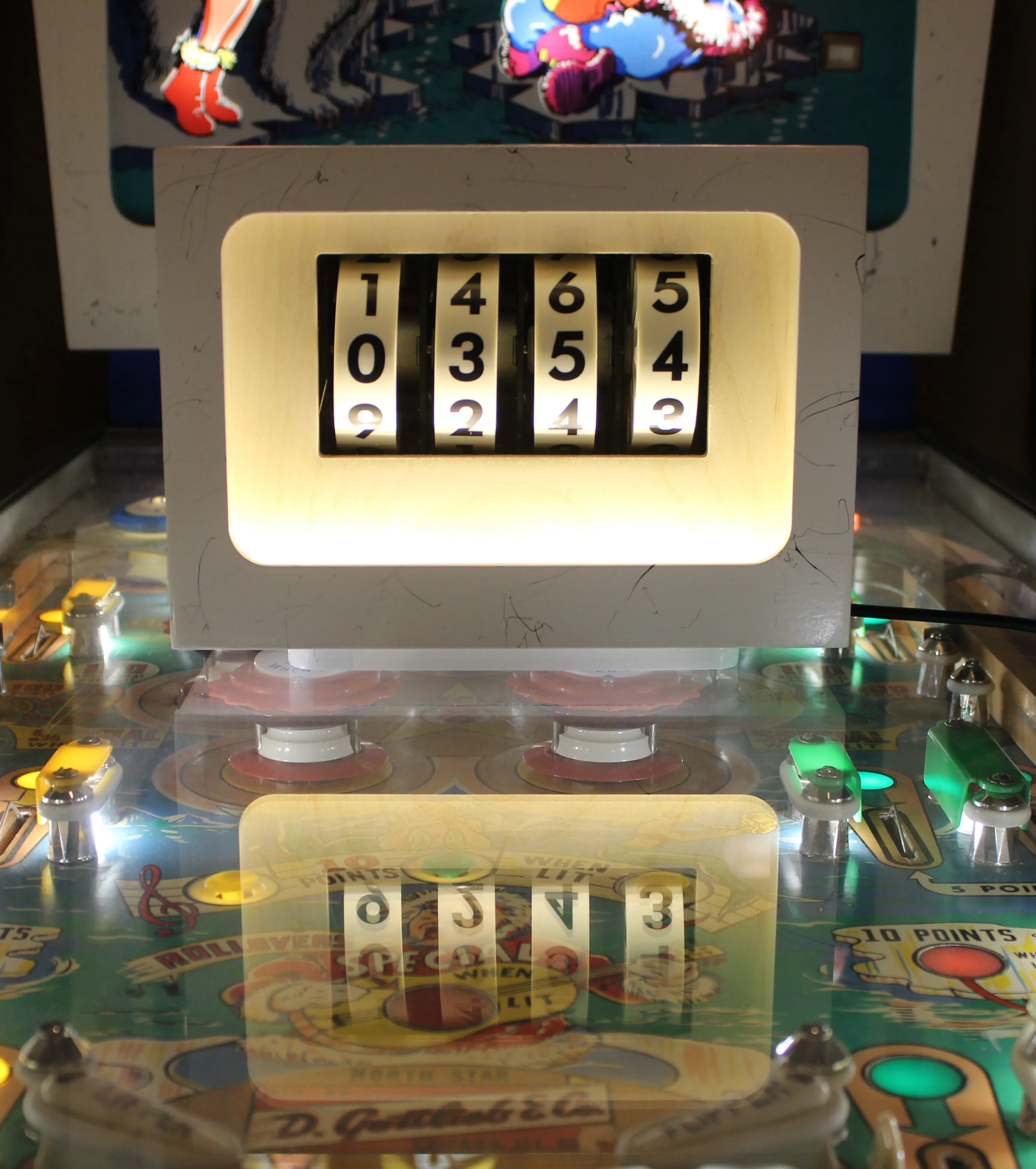
The digits are not a display. They are electromechanical pinball score reels, the same kind that used to clack over when the ball hit a bumper, and you set them with flipper buttons.
Philippe Gregoire is an engineer who started collecting pinball machines in his early thirties, went down the restoration rabbit hole, and came out the other side specialising in the electromechanical machines of the sixties and seventies — the ones with no software in them at all, where the score is a stack of printed wheels turned by solenoids. The clocks are what happens when someone who has spent ten years fixing score reels notices that a score reel is already a numeric display, and that a clock only needs four of them.
So each clock is a small pinball cabinet: half-inch hand-built plywood, stencil-painted, nine inches wide, with the reels lit from behind through an edge-lit translite — the printed plastic panel that lights a real backglass. Two round buttons sit on the sides where the flipper buttons go, and those are the controls. On the Bally™ Paragon the left pair of reels carries the date and the right pair the time, which is exactly how a two-player machine used to split its displays.
The art is licensed rather than borrowed, and credited by name. Ayscrim is an official Gottlieb® and Bally™ licensee, and the model pages say whose painting you are buying: Gordon Morison, whose work on the 1975 Atlantis wedgehead is half the reason that machine is collected, and Paul Faris, whose sword-and-sorcery panel gave Paragon its Beast’s Lair. A signature series adds living illustrators, and the translites swap out, so a cabinet can change its mind later.
Small mercies for actually living with one: a CR2032 keeps time while it is unplugged, a switch underneath kills the light without killing the clock, and it ships from Canada duties prepaid, so the checkout total is the total. The Classic is $319, the Paragon $339, the Atlantis $369, built to order in about four weeks.
The honest caveat is the obvious one. This is a $300-plus object whose entire argument is affection for a specific decade of arcade hardware, and if that decade means nothing to you it is a small wooden box that tells the time worse than your phone. The instruction on the artists’ page gives away who it is for, and it is written in the voice of a 1970s operator’s manual: the purpose of this device is twofold: first that the user gets a reliable reading of time, and second that they may bring the spirit of pinball into their home or office at all times.