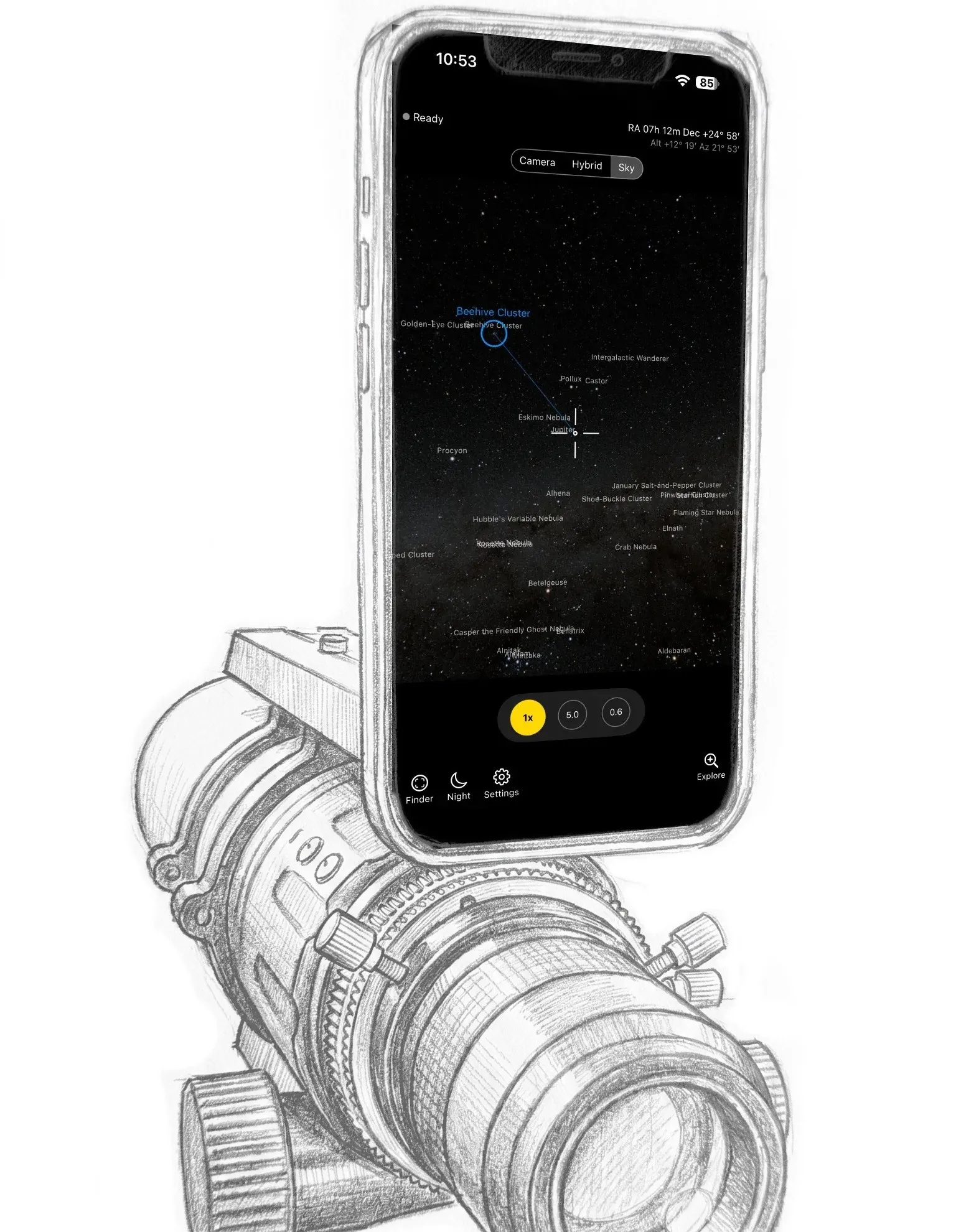
AstroHelm’s own illustration of a phone on a scope. Art: AstroHelm, astrohelm.app.
AstroHelm turns a phone bolted to a manual telescope into a push-to finder. It reads the stars in front of it, so there is no motor, no encoder and no compass to trust.
Plate solving is the trick. When the phone is steady, the app grabs a frame from the rear camera, masks out trees and rooftops, pulls out the stars, and matches that pattern against an on-device catalog. The site claims about ten arcseconds of accuracy and a solution in under a second. The solve repeats every time you move, so the arrow on screen keeps updating as you swing the tube toward your target. The solving never leaves the phone, and neither does your data, so it works in a field with no signal.
In the Show HN post, the maker says they wrote it to find objects from New York City, and the algorithm is tuned for phone cameras: poor light sensitivity, and a wide view that includes buildings and trees. An automatic one-second exposure mode kicks in when stars are scarce.
You pick any telescope or telephoto lens. The phone has to sit rigidly with its rear camera pointing the same way: the docs recommend a MagSafe mount on an iPhone 12 or later, or a clamp with a quarter-inch-20 stud on a dovetail or finder bracket, and warn against tape or friction. Then you align the reticle once on a distant landmark and observe.
Price. Free gets you plate solving, push-to guidance, the Moon, planets and a nightly shortlist. On iOS, Plus ($9.99, one time) adds the Messier and Caldwell catalogs and named stars. Pro ($29.99) adds NGC and IC, the iPhone-to-iPhone Remote mode, and external control: AstroHelm can pose as a telescope to SkySafari or Stellarium over ASCOM Alpaca, INDI or LX200. On Android, Pro is $24.99 and still labelled beta.
Limits. It guides you; it cannot slew anything. It needs at least eight visible stars, so it will not solve in daytime, through cloud or haze, or sometimes under a bright moon, and streetlights in frame can fool it. A phone held in your hand will not work, and nor will a phone held to an eyepiece. The app is new: the App Store shows version 0.5.0 and six ratings, averaging 4.5, which is too few to say much.