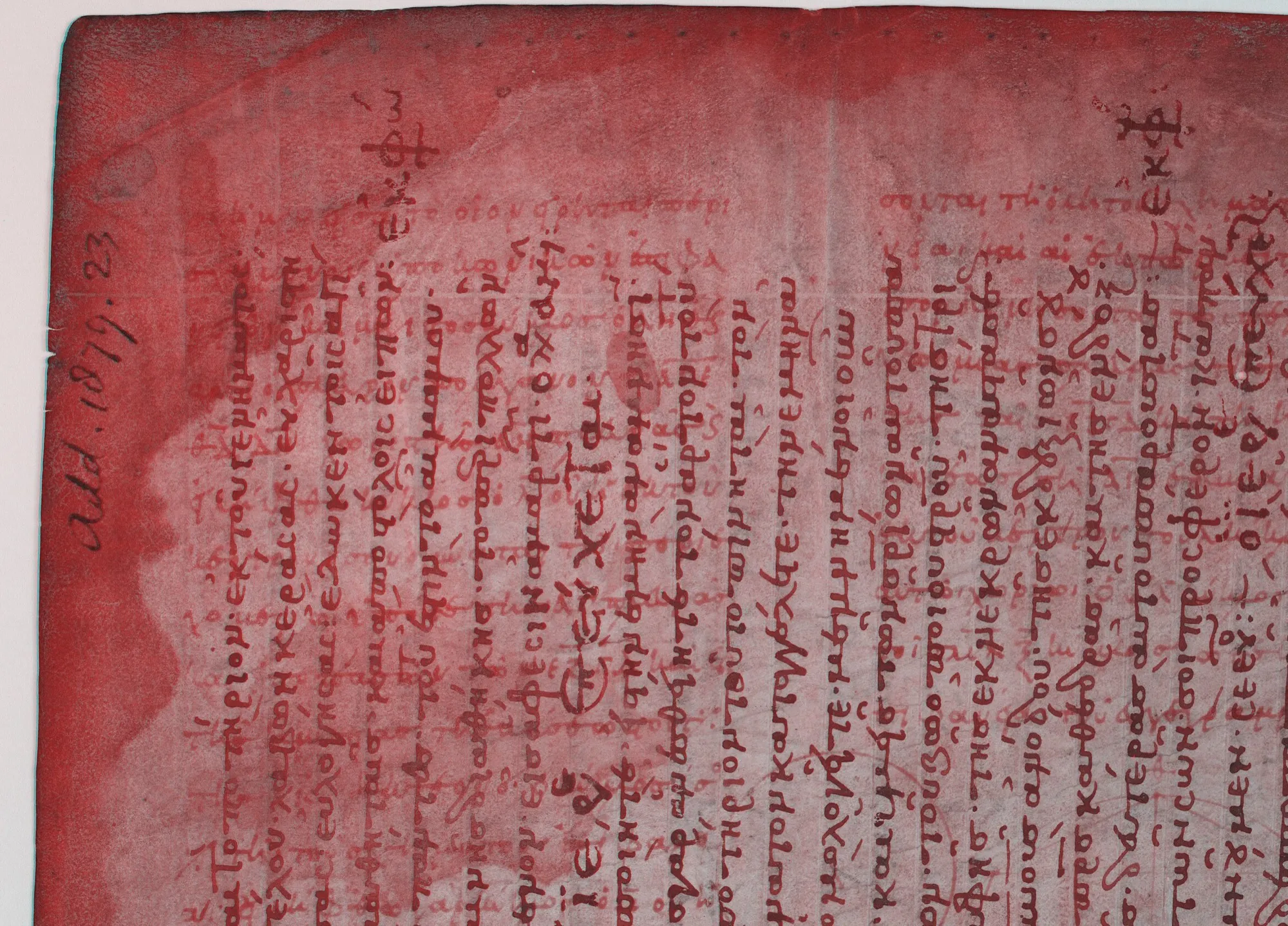
Someone needed parchment, so they scraped seven manuscripts and rebound them as a prayer book. One of the seven was the only copy of two Archimedes treatises anywhere.
Scraping is not erasing, and that distinction is the whole story. Parchment was expensive and reusable, and a thirteenth-century scribe recycling it was doing ordinary work, not vandalism. The leaves of seven older books were taken apart, the ink scraped back, the sheets split down the middle, turned ninety degrees and refolded to half-size — and a euchologion, a Greek Orthodox prayer book, was written across the grain of everything underneath. It was finished by April 1229, probably in Jerusalem. Some accounts name the scribe as Johannes Myronas, from a colophon read during the imaging work; the project’s own pages decline to name him, and that gap is worth keeping.
What went under the prayers is the part that matters. The palimpsest holds the only surviving Greek text of Archimedes’ On Floating Bodies, and the only known copies in any language of The Method of Mechanical Theorems and the Stomachion. The Method is the one that stops people: in it Archimedes explains how he actually arrived at his results, reasoning with infinities in a way that anticipates the calculus by nearly two thousand years. The Stomachion is a puzzle about how many ways fourteen fixed pieces can be recombined into a square — which makes it, in effect, the earliest surviving Western work on combinatorics.
And Archimedes was not the only casualty. The same book preserves ten folios of the fourth-century BC Attic orator Hyperides and fourteen of a third-century commentary on Aristotle’s Categories. Three separate literatures, saved by the same act that was supposed to destroy them.
The manuscript sold at auction in October 1998 and was deposited by its buyer at the Walters Art Museum in Baltimore, where conservation and imaging have run ever since. The technique is the reason any of this is legible: photograph the leaf under many wavelengths, including ultraviolet and X-ray fluorescence, and the two inks — different ages, different chemistries — separate. The hero above is a pseudocolour composite of exactly that, the older Greek surfacing beneath the newer script.
The honest limitation is that this is a wreck, not a book. The pages are mould-damaged, some carry forged Byzantine gold illuminations painted over them in the twentieth century, and the recovered text is partial. What it delivers is not a clean edition but the strangest kind of luck: the one copy survived precisely because someone thought it was worth less than the parchment it was written on.