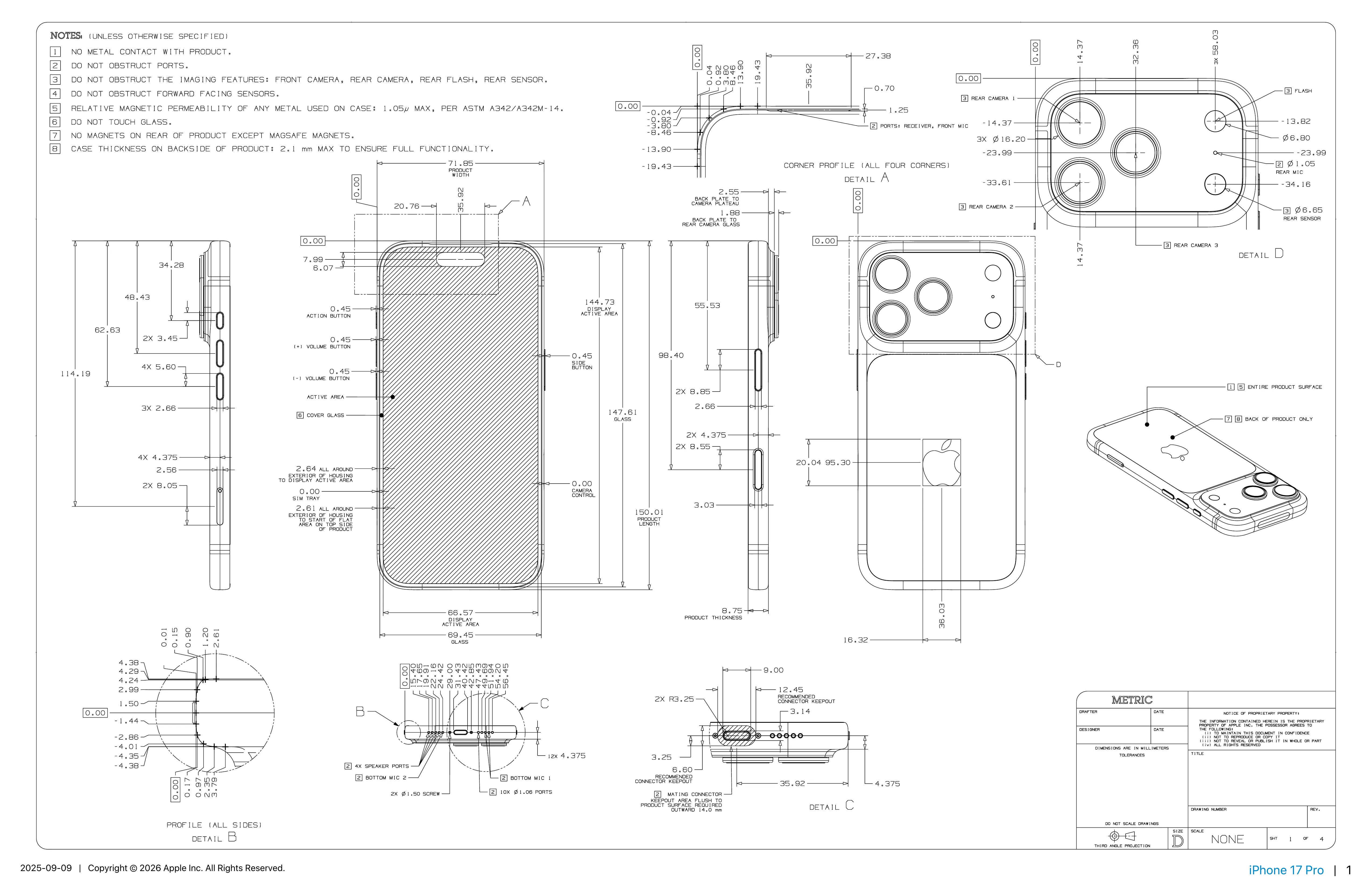
Sheet 1 of 4, rendered at 300 dpi straight from Apple’s own PDF. Every figure on it is metric and given to the hundredth; every field in the title block is blank.
Apple publishes an engineering drawing of nearly everything it sells, free and without a login. It is one of the more revealing documents the company puts out, and it is revealing mostly for what has been taken out of it.
The page is unglamorous: ninety vector PDFs behind tabs for iPhone, iPad, Mac, Watch and AirPods, with Apple TV, Vision Pro, its Zeiss inserts, AirTag and the MagSafe chargers alongside. Coverage runs from the iPhone 12 through this year’s line, and from the Apple Watch SE up to the Ultra 3. Apple’s own description of the exercise is flat: “Download precise dimensional drawings and technical specifications for Apple devices to ensure your accessory designs meet the exact requirements.” Everything is metric and given to the hundredth of a millimetre — 150.01 for product length on the 17 Pro sheet, 71.85 for width.
The notes block is where it gets specific in a way no marketing page ever is. Alongside the expected “DO NOT OBSTRUCT PORTS” sits a materials constraint written for people who will actually machine something: “RELATIVE MAGNETIC PERMEABILITY OF ANY METAL USED ON CASE: 1.05μ MAX, PER ASTM A342/A342M-14.” That is a real standard, cited properly, on a document you can download without an account.
Dr. Drang is the reason this is worth more than a bookmark. Forty years into reading engineering drawings, he catalogues what these lack: no drawing number, no draftsman or checker named, no revision history, no material specification beyond a generic mention of glass, and — the big one — no tolerances at all. Meanwhile features are labelled the way a product manager would label them, “display active area”, “volume button”, “rear sensor”, which a real manufacturing drawing would never bother to spell out.
His conclusion is the find. These are not Apple’s drawings; they are drawings Apple made for you. “Apple isn’t going to post its design drawings; they’re among its most tightly controlled proprietary documents.” And the missing tolerances are not sloppiness but a position on who carries the risk: “Apple’s dimensions are absolute and invariable.” Your case has to fit those numbers. There is no negotiation, because there is nobody on the other end of the drawing to negotiate with.
The sheets are maintained rather than dumped: the iPhone 17 Pro drawing carries 2025-09-09 in its own corner, and Apple re-served the file as recently as 24 April 2026. Stephen Hackett got there first, and put it best: “one of my favorite pages across Apple’s various websites.”